Lantern
lanterns, horn, light, paper, hanging and windows
LANTERN, a metal case filled in with some transparent material, and used for holding a light and protecting it from rain or wind. (An adaptation of the Fr. lanterns from Lat. lantern or laterna, supposed to be from Gr. Xa,urriip, a torch or lamp, X6.1.orEtv, to shine, cf. "lamp"; the i6th- and 17th-century form "lanthorn" is due to a mistaken derivation from "horn," as a material frequently used in the making of lanterns.) The appliance is of two kinds—the hanging lantern and the hand lantern—both of which are ancient. At Pompeii and Herculaneum have been discovered two cylindrical bronze lanterns, with orna mented pillars, to which chains are attached for carrying or hanging the lantern. Plates of horn surrounded the bronze lamp within, and the cover at the top can be removed for lighting and for the escape of smoke. The hanging lantern for lighting rooms was composed of ornamental metal work, of which iron and brass were perhaps most frequently used. Silver, and even gold, were, however, sometimes employed, and the artificers in metal of the 17th and 18th centuries produced much exceedingly artistic work of this kind. Oriental lanterns in open-work bronze were often very beautiful. The early lantern had sides of horn, talc, bladder or oiled paper, and the primitive shape remains in the common square stable lantern with straight glass sides, to carry a candle. The hand lantern was usually a much more modest appliance than the hanging lantern, although in great houses it was some times richly worked and decorated. As glass grew cheaper it gradually ousted all other materials, but the horn lantern which was already ancient in the 13th century was still being used in the early part of the 19th. By the end of the 18th century lanterns in rooms had been superseded by the candlestick. The collapsible paper lanterns of China and Japan, usually known as Chinese lanterns, are globular or cylindrical in shape, and the paper is pleated and when not in use folds flat. For illuminative and decorative purposes they are coloured with patterns of flowers, etc. The lanterns carried by the ordinary foot passenger
are made of oiled paper. In China the "Feast of Lanterns" takes place early in the New Year and lasts for four days. In Japan the festival of Bon is sometimes known as the "feast of lanterns." It is then that the spirits of the dead ancestors return to the household altar. The festival takes place in July. The "bull's-eye" lantern. has a convex lens which concentrates the light and allows it to be thrown in the shape of a diverging cone.
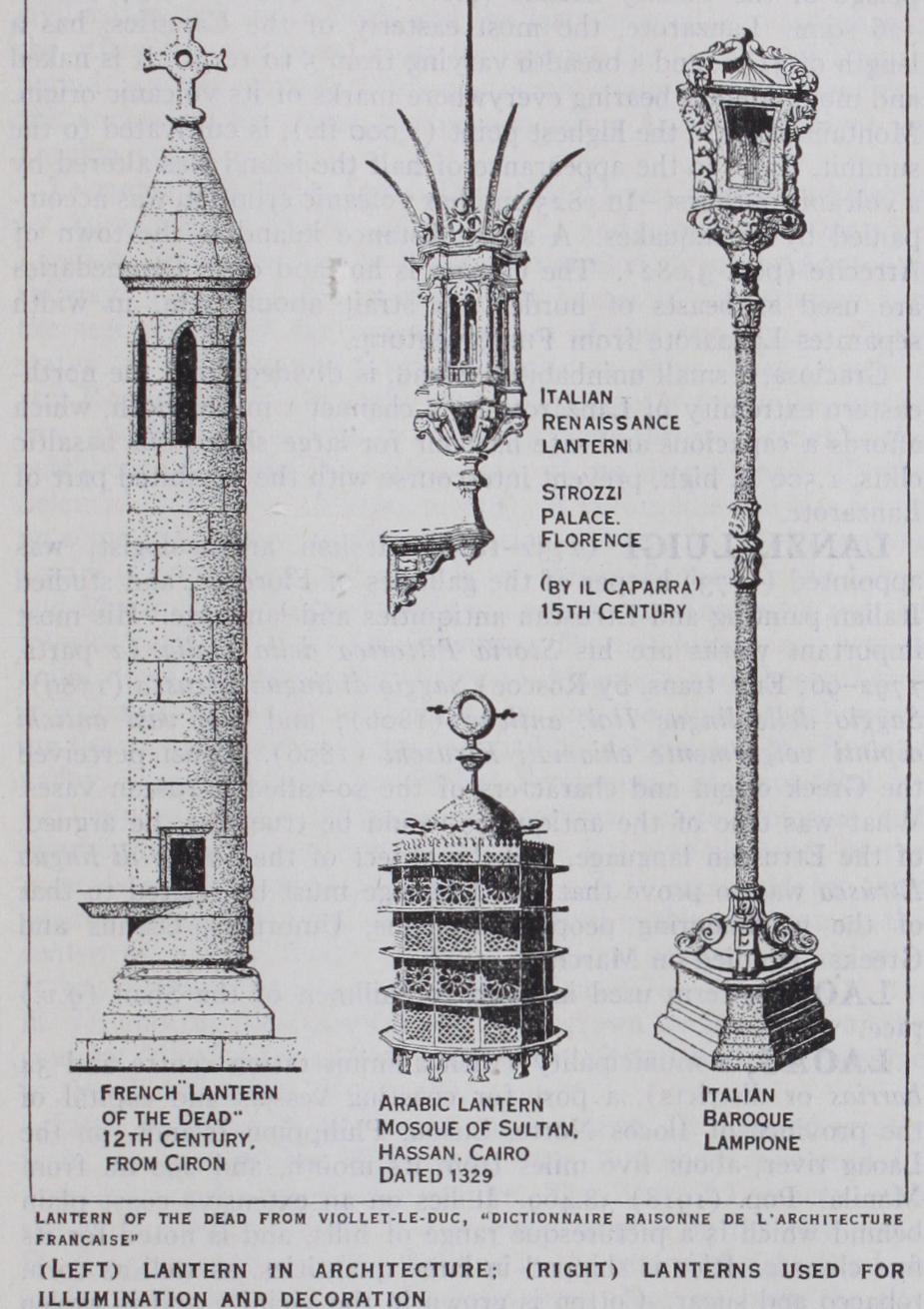
The "dark lantern" has a shutter or slide arrangement by which the light can be shut off at will. Ships' lanterns are used as masthead or other signal lights. On Trajan's column is a repre sentation of a heavy poop-lantern on a ship. The ships' lanterns of the i6th and i7th centuries were highly ornamental, especially when placed on the poop. At the Armeria Real in Madrid is a collection of these i6th-century ships' lanterns. The protected cages which contain the lights used in lighthouses are also known as "lanterns" (see LIGHTHOUSES).
In architecture a lantern is primarily a framework of timber, with windows all round, to admit ample light, placed on the top of a roof. In a broader sense, it is applied to those portions of buildings which are largely perforated with windows, and more especially to the upper part of the towers of cathedrals and churches, as in the octagon of Ely cathedral, or the tower of Boston church, Lincolnshire. The term is also applied to the entire church, as in the case of Bath Abbey church, which was called the "lantern of England," from the number of its windows, and St. John's Priory at Kilkenny, the "lantern of Ireland," on account of the window on the south side of the choir which was 54 ft. long In the style the lantern was looked upon as a decorative feature surmounting the dome, as in St. Peter's, Rome, the Invalides, Paris, and St. Paul's, London.