Lark
larks, fig, birds and skylark
LARK, applied with a prefix, e.g., titlark, wood-lark, to a number of birds, but when used alone by Englishmen means the skylark, Alauda arvensis. This bird, a favourite cage-bird by reason of its beautiful song, and also esteemed for the table, in habits the northern hemisphere of the Old World from the Fae roes to the Kurile Islands, mi grating southwards in winter to northern India, Persia and Egypt.
It has been introduced to Long Island (N.Y.), Hawaii and New Zealand, and is abundant wherever there is open or agricultural country. It nests in grass and growing corn, the eggs varying from three to five, dull grey in colour, heavily mottled with purplish-brown. In the winter the birds congregate in flocks. It is resident in Great Britain throughout the year, though most numerous in the autumn. Both sexes are protectively col oured. The male mounts in wide circles as it sings. The food is injurious insects and seeds of weeds.
The wood-lark, Lullula arborea, is more local than the skylark and is never found far from trees. Its song is less varied but very beautiful. It is almost con fined to Europe.
The crested lark, Galerita cris tata, has a larger crest, a stronger and more curved bill and a rufous lining to the wings. It is corn
mon in France. Some of its rela Lives inhabit deserts and exhibit a plumage of a light sandy hue. The harmony between plumage and soil is particularly striking in North African larks in the breeding season (see Ibis, supp. number, March, 1927).
The larks present a great variety of structure. The bill may be long and thin (fig. 1) or short and stout (fig. 2). The hind claw, usually long, may be reduced to moderate dimensions (fig.
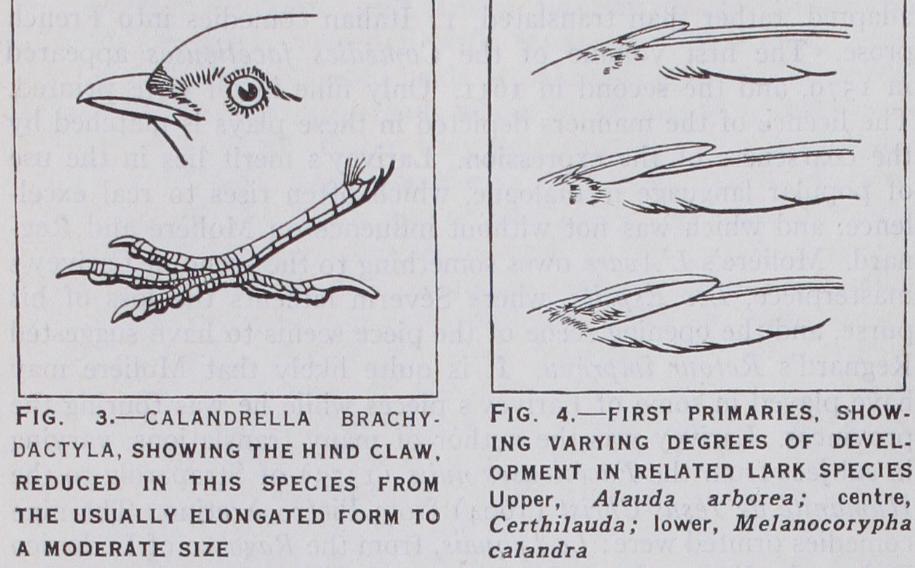
3). The firs primary, which is almost aborted in the skylark, is well developed in Melanocorypha (fig. 4). The most constant feature is the podotheca or covering of the tarsus, which is scutel late both in front and behind.
Only one genus, with a single species, Mirafrahorsfieldi, inhabits Australia, and one genus, Otocorys, extends to America.
Among the birds popularly called larks are the mud-lark, rock lark, titlark and tree-lark, which are pipits (q.v.), the grass hopper-lark, a warbler (q.v.), and the American meadow-lark, which belongs to the Icteridae (see IcTERus). The true larks moult but once a year, whereas the pipits moult twice.