Leguminosae
leaf, leaves, leaflets, robinia, acacia, simple and species
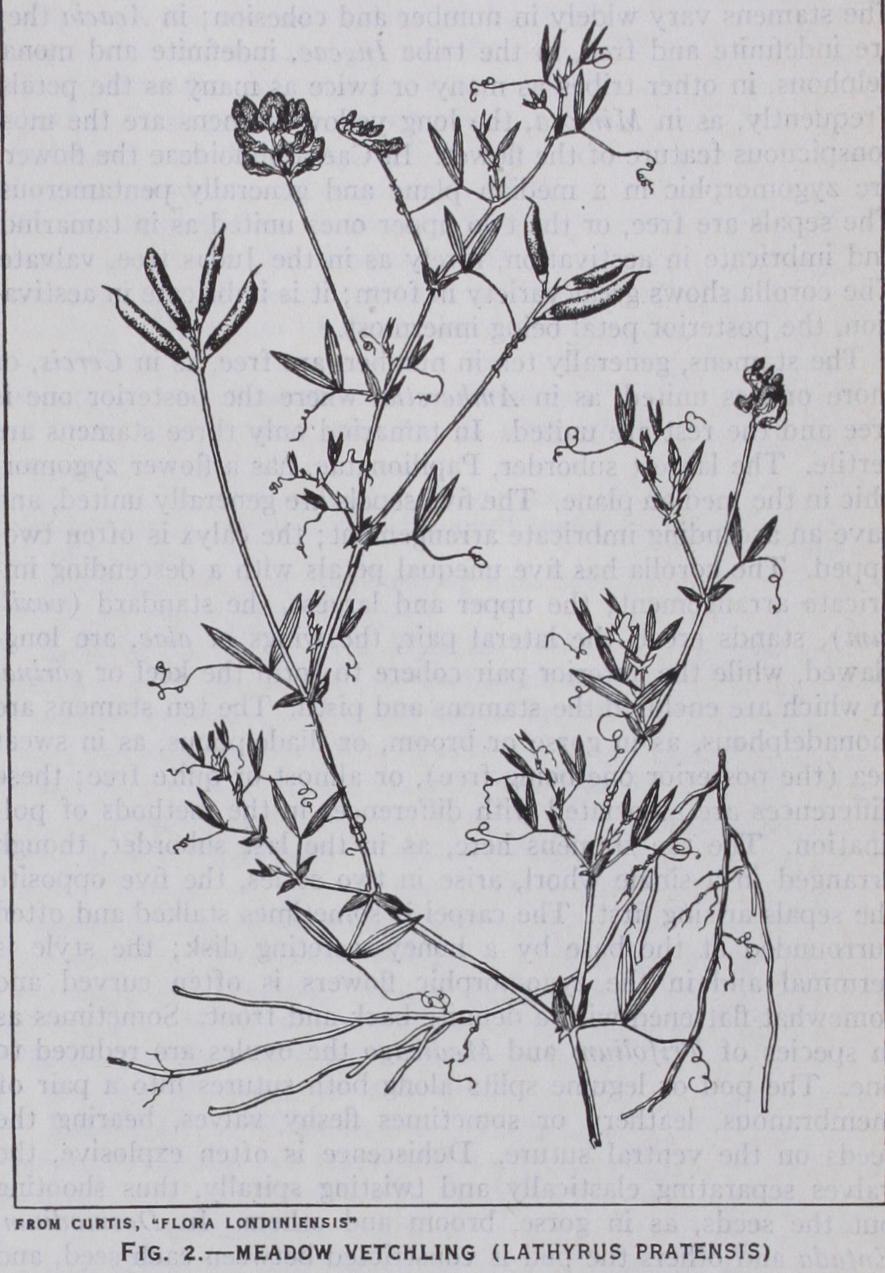
LEGUMINOSAE, the second largest family of seed-plants, containing about 600 genera with 12,000 species. It belongs to the series Rosales of the Dicotyledons, and contains three well marked subfamilies, Papilionatae, Mimosoideae and Caesalpini oideae. The plants are trees, shrubs or herbs of very various habit. The British representatives, all of which belong to the suborder Papilionatae, include a few shrubs, such as Ulex (gorse, furze), Cytisus (broom) and Genista, but the majority, and this applies to the suborder as a whole, are herbs, such as the clovers, Medicago, Melilotus, etc., sometimes climbing by aid of tendrils which are modified leaf-structures, as in Lathyrus and the vetches (Vicia). Scarlet runner (Phaseolus multiflorus) has a herbaceous twining stem. Woody climbers (limes) are represented by species of Bauhinia (Caesalpinioideae), which with their curiously flat tened, twisted stems are charac teristic features of tropical forests, and Entada scandens (Mimosoi deae) also common in the tropics. These two suborders, which are confined to the warmer parts of the earth, consist chiefly of trees and shrubs such as Acacia and Mimosa belonging to the Mimo soideae, and the Judas tree of southern Europe (Cercis) and tamarind belonging to the Caesal pinioideae. The so-called acacia of European gardens (Robinia Pseudacacta) and laburnum are examples of the tree habit in the Papilionatae. Water plants are rare, but are represented by Aeschynomene and Neptunia, tropical genera. The roots of many species bear nodular swell ings (tubercles), the cells of which contain bacterium-like bodies which have the power of fixing the nitrogen of the atmos phere. Hence the value of these plants as a crop on poor soil or as a member of a series of rotation of crops, since they enrich the soil by the nitrogen liberated by the decay of their roots.
Leaf Forms.
The leaves are alternate in arrangement and generally compound and stipulate. A common form is shown by the clovers, which have three leaflets springing from a common point (digitately trifoliate) ; pinnate leaves are also frequent as in laburnum and Robinia. In Mimosoideae the leaves are gen erally bipinnate. Rarely are the leaves simple as in Bauhinia.
Various departures from the usual leaf-type occur in association with adaptations to different functions or environments. In leaf climbers, such as pea or vetch, the end of the rachis and one or more pairs of leaflets are changed into tendrils. In gorse the leaf is reduced to a slender, spine-like structure, though the leaves of the seedling have one to three leaflets. In many Australian acacias the leaf surface in the adult plant is much reduced, the petiole be ing at the same time flattened and enlarged, and frequently the leaf is reduced to a petiole flattened in the vertical plane ; by this means a minimum surface is exposed to the intense sunlight. In the garden pea the stipules are large and foliaceous, replacing the leaflets, which are tendrils; in Robinia the stipules are spiny and persist after leaf-fall. In some acacias (q.v.) the thorns are hollow, and inhabited by ants as in A. sphaerocephala, a Central American plant, and various others. In some species of Astragalus, Onobrychis and others, the leaf-stalk persists after the fall of the leaf and becomes hard and spiny.
Leaf-movements occur in many of the genera. Such are the sleep-movement in the clovers, runner bean (Phaseolus), Robinia and Acacia, where the leaflets assume a vertical position at night fall. Spontaneous movements are exemplified in the telegraph plant (Desmodium gyrans), native of tropical Asia, where the small lateral leaflets move up and down every few minutes. The sensitive plant (Mimosa pudica) is an example of movement in response to contact, the leaves assuming a sleep-position if touched. The seat of the movement is the swollen base of the leaf-stalk, the so-called pulvinus.