Lemon
fruit, orange, trees, wild, rind, citron and lemons
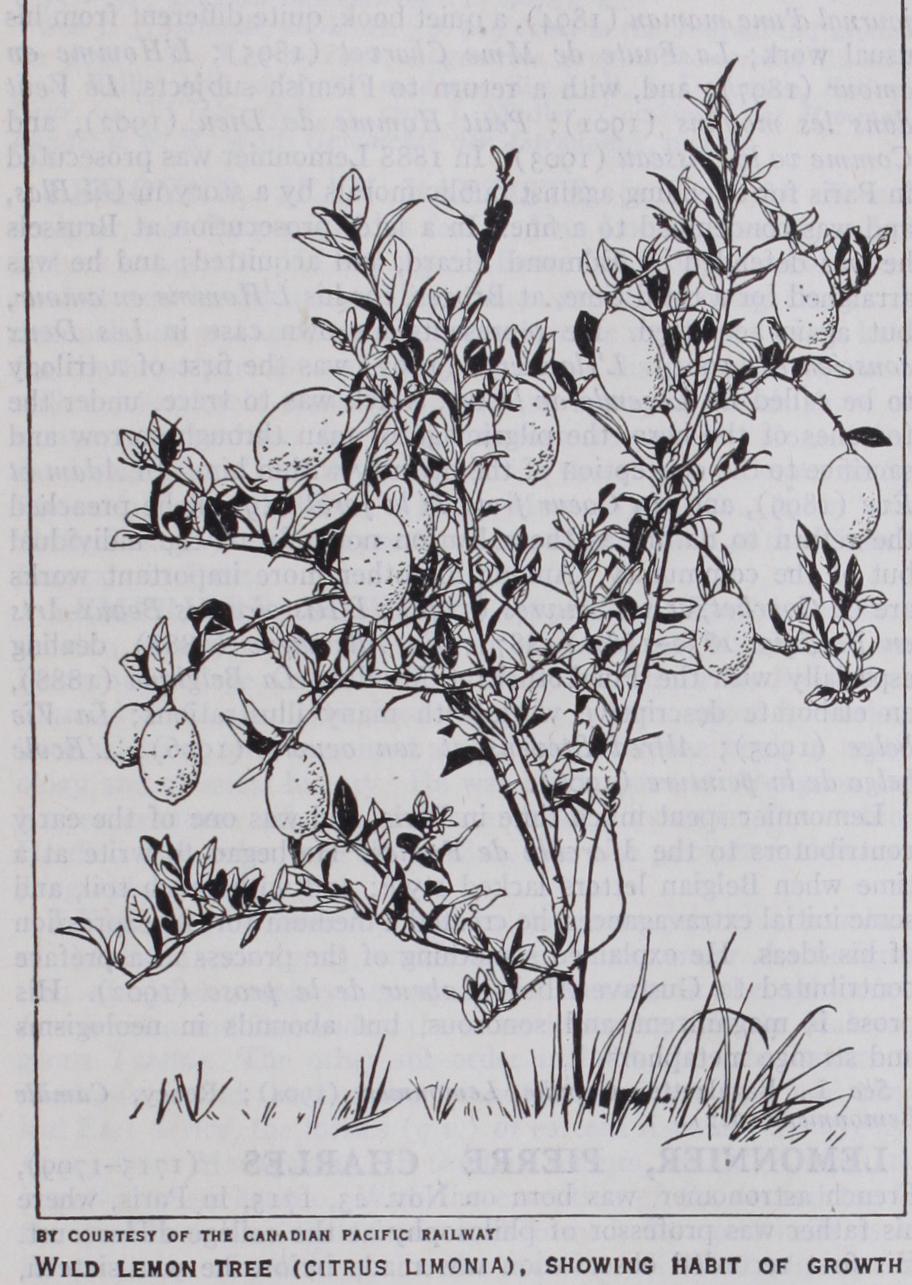
LEMON, the fruit of Citrus Limonia, which is often regarded as a variety of Citrus medico, the citron. The wild stock of the lemon tree is said to be a native of the valleys of Kumaon and Sikkim in the North-west provinces of India, ascending to a height of 4,00o ft., and occurring under several forms. Sir George Watt (Dictionary of Economic Products of India, ii. 352) regards the wild plants as wild forms of the lime or citron and considers it highly probable that the wild form of the lemon has not yet been discovered.
The lemon seems to have been unknown to the ancient Greeks and Romans, and to have been introduced by the Arabs into Spain between the 12th and 13th centuries. In 1494 the fruit was culti vated in the Azores, and largely shipped to England. As a culti vated plant the lemon is now met with throughout the Mediter ranean region, in Spain and Portugal, in California and Florida, and in almost all tropical and sub-tropical countries. Risso and Poiteau enumerate forty-seven varieties of this fruit, although they maintain as distinct the sweet lime, C. Limetta, with eight varieties, and the sweet lemon, C. Lumia, with twelve varieties, which differ only in the fruit possessing an insipid juice.
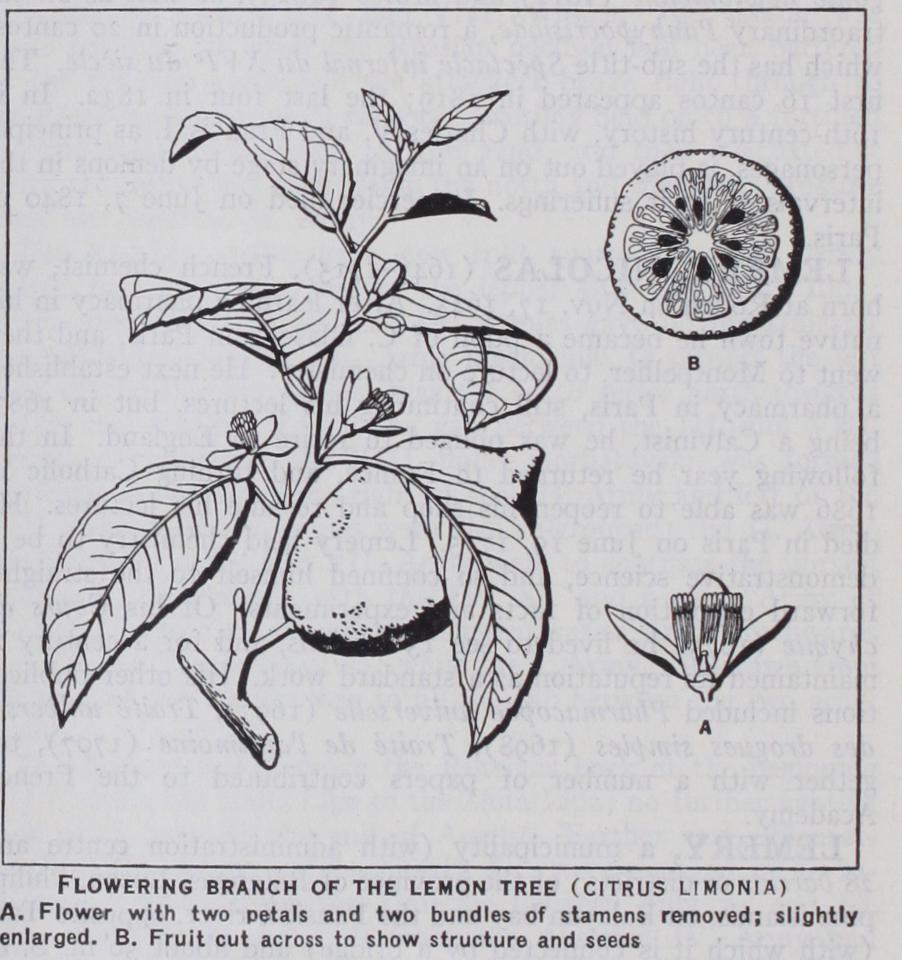
The lemon is more delicate than the orange, although both are injured by severe cold (temperatures below 25° or 20° F). Un like the orange, which presents a fine close head of deep green foliage, it forms a straggling bush, or small tree, io to ft. high, with paler, more scattered leaves, and short angular branches with sharp spines in the axils. The flowers possess a sweet odour quite distinct from that of the orange, the outside of the corolla having a purplish hue. The fruit, which is usually crowned with a nipple, consists of an outer rind or peel, the surface of which is more or less rough from the convex oil receptacles imbedded in it, and of a white inner rind, which is spongy and nearly tasteless, the whole of the interior of the fruit being filled with soft parenchy matous tissue, divided into about ten to twelve compartments, each generally containing two or three seeds. The white inner rind varies much in thickness in different kinds, but is never so thick as in the citron. As lemons are much more profitable to grow than oranges, on account of their keeping properties, and from their being less liable to injury during voyages, the cultiva tion of the lemon is preferred in Italy wherever it will succeed.
In damp valleys it is liable like the orange (q.v.) to be attacked by a fungus sooty mould, the stem, leaves, and fruit becoming covered with a blackish dust. This is coincident with or subse quent to the attacks of a small oval brown insect, Chermes hes periduin. Trees not properly exposed to sunlight and air suffer most severely from these pests. Syringing with resin-wash or milk of lime when the young insects are hatched, and before they have fixed themselves to the plant, is a preventive. Since 1875 this fungoid disease has made great ravages in Sicily among the lemon and citron trees, especially around Catania and Messina. Heritte attributes the prevalence of the disease to the fact that the growers have induced an unnatural degree of fertility in the trees, permitting them to bear enormous crops year after year. This loss of vitality is in some measure met by grafting healthy scions of the lemon on the bitter orange, but trees so grafted do not bear fruit until they are eight or ten years old.
The lemon tree is exceedingly fruitful, a large one in Spain or Sicily ripening as many as three thousand fruits in favourable seasons. In the south of Europe lemons are collected more or less during every month of the year, but in Sicily the chief har vest takes place from the end of Oct. to the end of Dec., those gathered during the last two months of the year being considered the best for keeping purposes. The fruit is gathered while still green. After collection the finest specimens are picked out and packed in cases, each containing many hundreds of fruits, and also in boxes, three of which are equal to two cases, each lemon being separately packed in paper. The remainder, consisting of ill-shaped or unsound fruits, are reserved for the manufacture of essential oil and juice. The exportation is continued as required until April and May. The large lemons with a rougher rind, which appear in the London market in July and August, are grown at Sorrento near Naples, and are allowed to remain on the trees until ripe.