Lepidoptera
moths, species, fig, reduced, abdominal, radial, median, butterflies and sternum
The Wing-veins.'--The
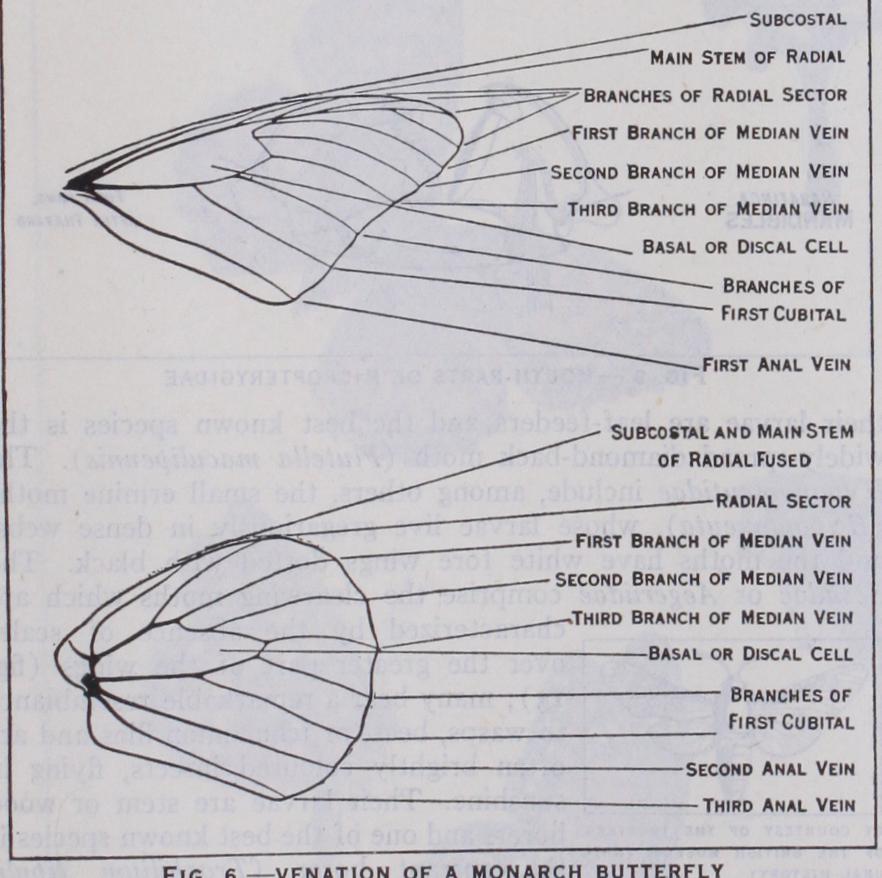
wing-veins are of great importance in classification. There are but few cross-veins, and in all except the most primitive forms there is a large basal cell which is partly formed by the elimination of the main stem of the median vein M : the radial sector (Rs) is typically f our-branched in the f ore wing and reduced to a single stem in the hind wing, while the median vein has generally three free branches (fig. 6). The ma jority of Lepidoptera carry a tympanal organ on either side close to the junction of the thorax and abdomen. In geometrid moths, for example, it takes the form of a bladder-like vesicle closely associated with the first abdominal spiracle of its side and certain of the neighbouring air-sacs. It is innervated from the last thoracic ganglion and from its general structure is be lieved to be an auditory organ. The reason for its existence is difficult to account for unless it be able to appreciate the notes produced by the vibrating wings of other members of the same species, since sound-producing organs are rare in Lepidoptera.
The Legs.
The legs are usually slender, covered with hairs or scales, and with five-jointed tarsi ; among butterflies the fore pair is often so reduced as to be useless for walking.
Abdominal Segments.
Ten abdominal segments are present.
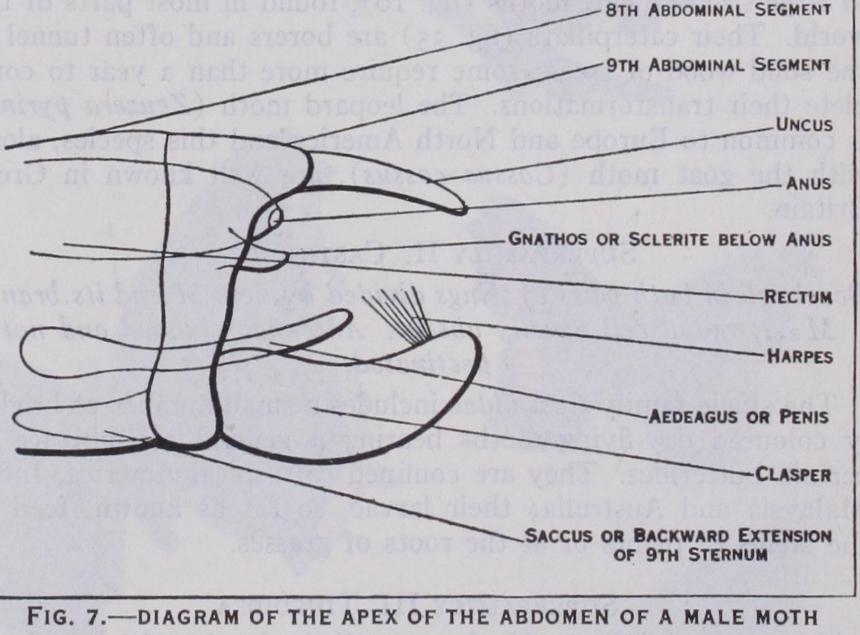
in Lepidoptera, but the first sternum is always reduced or atro phied and the terminal segments are modified to form external organs of reproduction. In the male (fig. 7) the latter consist of a pair of prominent claspers borne by the 9th segment, which are often beset inside with groups of stiff hairs forming the harpes. The 9th tergum bears a prominent median process or uncus above the anus, while the intromittent organ or aedeagus arises between the bases of the claspers. In the female the terminal segments in some cases are produced into a telescopic ovipositor, a true valvular ovipositor being undeveloped. In the most primitive moths there is a single female genital aperture on the 9th ab 'Throughout this article, the wing-veins (figs. 6, 8, is, i8, 18a, 22) are denominated as follows—Costal, C; Subcostal, Sc ; Radial, R; Radial sector, Rs ; Cubital, Cu Subcostal and main stem of radial fused Sc+R; Median, M.
dominal sternum, but in most Lepidoptera two openings are present. One, situated on the 8th sternum, is that of the copulatory pouch and the other, situated on the 9th sternum, is the opening of the vagina. During mating the male cells are discharged into the copulatory pouch, whence they travel along a seminal canal which connects that organ with the oviduct, where fertilization of the eggs takes place.
The classification of butterflies and moths into major groups presents difficulties, mainly owing to the absence of markedly different characters among great numbers of species. The old grouping of the order into two suborders, viz., Heterocera or moths, and Rhopalocera or butterflies, is open to the objection that the butterflies are raised to a tank equivalent to the whole of the moths, whereas their true status is that of a superfamily.
Among the several systems of classification that have been pro posed the recent one of Turner and Tillyard' has been partially incorporated in the present article.
Venation of fore and hind wings closely similar; vein Rs with several branches in both pairs of wings (fig. 8).
Two main families and several smaller groups belong here and they are of great interest on account of their primitive structure, not found in any other Lepidoptera.
The Micropterygidae are all very small moths with well-de veloped mouth-parts (fig. 9), functional mandibles being present in some forms, and the galeae of the maxillae are either un modified or elongated to form an imperfect haustellum ; tibial spines or spurs are present and the wing coupling apparatus con sists of a small jugum. The caterpillars in some cases (Micro pteryx) bear eight pairs of abdominal feet, a number never at tained in any other Lepidoptera; in others the feet are reduced or wanting. They either feed on mosses or liverworts (Micro pteryx, Sabatinca) or live as leaf-miners on birch, hazel and other trees (Eriocrania). The pupae have their appendages free, the abdominal segments movable, and large mandibles are present with which they bite their way to the exterior to allow of the emergence of the perfect insects. Micropteryx and Eriocrania occur not uncommonly in Great Britain; Epimartyria and Ne monica are North American ; while Sabatinca belongs to New Zealand.
The Hepialidae, or swift moths, have very short antennae, only vestiges of mouth-parts, and no tibial spurs ; the wing coupling apparatus consists of a well developed jugum. They are a widely distributed family, best represented in Australia, where the species attain a gigantic size and exhibit remarkable coloration. The caterpillars feed at the roots of grasses and other herbage or of trees, and some species are very destructive. The ghost moth (Hepialus humuli) is the most familiar British species.
'In R. J. Tillyard, Insects of Australia and New Zealand (Sydney, 1926).
Basal cell in both pairs of wings divided by vein M and its two main branches; radial cell present (fig. ii). Mouth-parts ves tigial, antennae pectinated, rarely simple but not clubbed. The Cossidae are the only family included here and are medium the males of Adela the antennae are often extremely long and threadlike (fig. 14). The Nepticulidae have a greatly reduced venation and, in some species, a small jugum is present which suggests their affinity with the Homoneura. Their larvae are leaf miners and the moths are the smallest of all Lepidoptera, in some cases with a wing-expanse of only 3mm. The Plutellidae have the head smooth instead of rough-haired as in most Tineidae;