Illuminants
lighthouse, burners, burner, gas, oil, introduced, light and century
ILLUMINANTS The earliest form of illuminant used for lighthouses was a fire of coal or wood set in a brazier or grate erected on top of the lighthouse tower. Until the end of the i8th and even into the i9th century this primitive illuminant continued to be almost the only one in use. The coal fire at the Isle of May light con tinued until 1810 and that at St. Bees lighthouse in Cumberland to 1823. Fires are stated to have been used on the two towers of Nidingen, in the Kattegat, until 1846. Smeaton was the first to use any form of illuminant other than coal fires he placed within the lantern of his Eddystone lighthouse a chandelier holding 24 tallow candles each of which weighed -I lb. and emitted a light of 2.8 candle power. The aggregate illuminating power was 67.2 candles and the consumption at the rate of 3.4 lb. per hour.
Oil.
Oil lamps with flat wicks were used in the Liverpool lighthouses as early as 1763. Argand, between 1780 and 1783, perfected his cylindrical-wick lamp which provides a central current of air through the burner, thus allowing the more perfect combustion of the gas issuing from the wick. The principle of the multiple-wick burner was devised by Count Rumford. Fresnel produced burners having two, three and four concentric wicks. Sperm oil was used in English lighthouses until 1846, but about that year the much cheaper colza oil was employed generally. Olive, lard, and cocoanut oils have also been used for lighthouse purposes in various parts of the world.
The introduction of mineral oil, costing a mere fraction of the expensive animal and vegetable oils, revolutionised the illumina tion of lighthouses. It was not until 1868 that a burner was devised which successfully consumed hydro-carbon oils. This was a multiple wick burner, invented by Captain Doty, which was quickly taken into use by lighthouse authorities. The "Doty" burner, and other patterns involving the same principle, remained practically the only oil burners in lighthouse use until the last few years of the i9th century.
Coal
Gas.—Coal gas was introduced in 1837 at the inner pier light of Troon (Ayrshire) and in 1847 it was in use at the Heugh lighthouse (West Hartlepool). In 1878 cannel-coal gas was adopted for the Galley Head lighthouse, with io8-jet Wigham burners. Sir James Douglass introduced gas burners consisting of concentric rings, two to ten in number, perforated on the upper edges.
The invention of the Welsbach mantle placed at the disposal of the lighthouse authorities the means• of producing a light of high intensity combined with focal compactness. For lighthouse pur
poses gaseous illuminants other than coal-gas are as a rule more convenient and economical, and give better results with incan descent mantles. Mantles have, however, been used with ordinary coal-gas in instances where a local supply of suitable types is available.
Incandescent Mineral-oil
Burners.—Incandescent lighting with high-flash mineral oil was first introduced by the French lighthouse service in 1898 at L'Ile Penfret lighthouse. The incan descent burners now in use in lighthouse services all the world over are all made on the same principle, but differ in details. The principle consists in injecting the liquid petroleum under pressure into a vapourizer where it is heated by subsidiary jets and con verted into vapour. This vapour issues from a nozzle and, draw ing in air, passes into a chamber in the head of the burner where it mixes to form a combustible gas for the incandescence of the mantle; at the same time a small proportion of the gas is diverted to the subsidiary jets. A small reservoir of compressed air— charged by means of a hand-pump—is used for providing the necessary pressure for injection. On first ignition the vapourizer is heated by a spirit flame to the required temperature.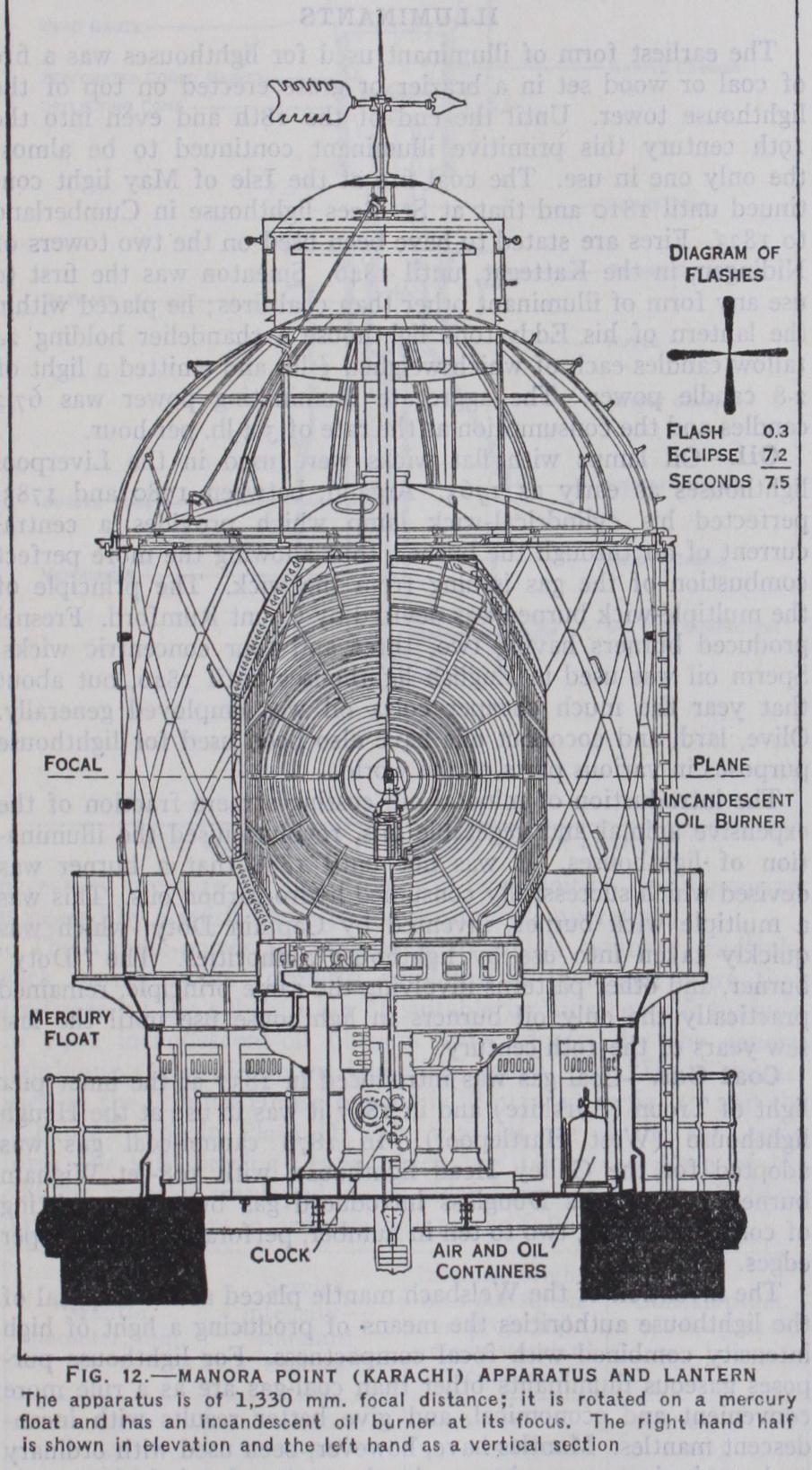
The candle-power of apparatus in which ordinary multiple wick burners were formerly employed is increased more than six times by the substitution of suitable incandescent-oil burners. In 1902 incandescent-oil burners were adopted by the general lighthouse authorities in the United Kingdom. The "Hood" burner used in the Trinity House service is illustrated in fig. 13 and the "Chance" type in Plate II. The mantles are of the soft auto form (or self-forming) type which has taken the place of the collodin mantles employed in the older forms of burner. Particu lars of the burners in ordinary use are as follows:— Oil Gas.—Pintsch's oil-gas system introduced in the '7os of the last century is the prototype of the several methods of gas light ing now employed for the majority of buoy and other unattended lights and, before the end of the 19th century was in general use in many countries. Incandescent oil-gas burners were introduced both for buoy and beacon lighting as well as for a few attended lights early in the loth century. The use of ordinary oil-gas necessitates its periodical supply by means of large transport con tainers in which it is stored at a pressure of from 9 to i o atmos pheres, a disadvantage which has led to its gradual supersession by acetylene or other forms of oil-gas (see below).