Of Cladonia Pyxidata
hyphae, spores, lichens, margin, ascogonium, thallus, fruit, bodies, cells and trichogyne
OF CLADONIA PYXIDATA the gonidia (Chroococcus) from a zone at the base of the upward hyphae. In Corella and Dictyo nema the Scytonema trichomes retain their form and are sur rounded by the lichen hyphae.
Basidiolichens are related to the fungal family Thelephoraceae: the fructification is by basidiospores borne on the under-surface of the thallus.
Lichens with few exceptions (Basidiolichens and primitive in determinate forms) are Ascolichens, their method of reproduction corresponding to that of Ascomycetes, i.e., by the production of ascospores in open or closed ascophores—apothecia or perithecia. In the slow-growing symbiotic plants these fruit bodies have been provided with special protective tissues that secure prolonged spore formation, differing in this respect from the fugitive ascophores of fungi.
Apothecia.
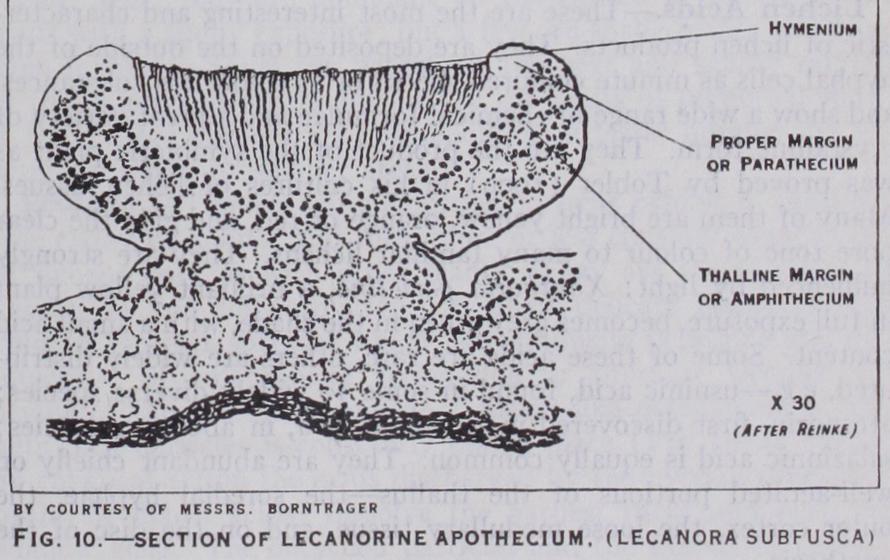
In lichens these are of several forms to which special names have been given :—ardellae, the irregular spot-like fruit of Arthoniaceae; lirellae, elongate, slit-like, dark-coloured bodies in Graphidaceae; in the larger majority of lichens open discoid apothecia. Those surrounded by a protective thalloid margin are called lecanorine (fig. o), such as occur in the genus Lecanora. Those consisting solely of hyphal tissue surrounded by a hyphal or "proper margin" only as in Lecidea are described as lecideine (fig. I I). If that margin is obscure with the disk of ten brightly coloured they are biatorine, as in the sub-genus, Biatora.
These are true distinctions, and are of value in the determination of genera and species. The differ ence is due to their origin in the thallus : in the lecanorine series gonidia are carried up with the developing fruit, and algal cells extend along the base and, enter ing into the "thalline margin," surround the apothecium. The lecideine tissues, solely hyphal, pass up through the gonidial zone, pierce the cortex and expand above it, the outer sterile hyphae forming the protective "proper margin." Minor differences in growth occur, with different types of apothecia—sessile or stalked, etc., and in size from a minute body to one of over three centi metres in width according to the genus or species of lichen. The disk or thecium is composed of a compact series of filamen tous upright simple or branched paraphyses and of asci—club-like structures within which eight spores (fewer or more numerous) are produced by free cell formation. These, constituting the hymenium, are subtended by a layer of tissue, the hypothecium; the tips of the paraphyses projecting above the asci form the epithecium, generally coloured; the surrounding sterile filaments represent the parathecium; the thalline margin when present forms the amphithecium.
Perithecia.—These differ from the apothecia in being com paratively small, globose or pear-shaped, closed bodies immersed or semi-immersed in the thallus, and opening above by a pore, the ostiole. When the outer dark wall is continuous it is described as entire, and when absent at the base as dimidiate. In some gen era the paraphyses dissolve as the asci mature.
Apothecia and perithecia are long lived like the thallus and may produce spores continuously or at definite seasons for several years, in Solorina saccata, for in stance, over a period of two to four years, as observed by Hil itzer (1926).
Spermogonia or Pycnidia.
—These are small closed bodies outwardly resembling perithecia ; the hyphae that line the interior walls bud off minute pycnidio spores. As spermogonia they were considered of great impor tance as the male organs that produce the spermatia. There is no reliable evidence of their sexual nature and they are now gen erally classified as pycnidia resembling similar bodies that form a secondary stage in the fruit cycle of the Ascomycetes. It has been proved that the spermatia germinate and produce hyphae, a char acteristic of spores.
Cytology.
This aspect of reproduction has excited great interest since Fuisting (1866) observed in a crustaceous Lecidea the fruit primordium or ascogonium as a coiled hypha. Stahl (1877) announced the further discovery in a Collema of a trichogyne, a filament that travelled upwards from the asco gonium and emerged above the surface. He noted also an empty spermatium (pycnidiospore) adhering to the tip of the trichogyne after presumed fertilization. Other workers made similar ob servations both in gelatinous and in non-gelatinous lichens, and in open and closed fruits. Copulation with the spermatium has also been demonstrated but the behaviour of the spermatial nu cleus has escaped observation. The ascogonium may be a coiled hypha or simply a complex of cells distinguished by their richer contents, and changes in these cells have been observed that seem to imply spermatial fertilization. It may be that in some lichens fusion takes place between neighbouring cells in the ascogonium : F. Bachmann (1912) found that copulation took place deep down in the thallus of Collema sp. between an internal trichogyne and a free spermatial cell. Apogamy, however, undoubtedly prevails in many lichens : either no trichogynes are formed or they fail to reach the surface and fertilization by spermatia is doubtful. Zahlbruckner (1924) has expressed the opinion that reproduction by sexual organs—present in the more primitive lichens—tends to die out in more developed forms. The whole subject bristles not only with the difficulties of observation in these slow growing plants, but also with the perplexities of interpretation : the func tion of the lichen trichogyne, a multispetate hypha of vigorous growth, is not understood; but it may be of some service to the deep seated ascogonium. From the ascogonium arise the hyphae that are destined to form the asci. As in fungi the nuclei of two adjacent cells at the tips of these hyphae fuse. and become the definitive nucleus of the ascus. There are normally eight spores, but the number varies in different genera and species from one, as in Varicellaria, to the large numbers in Acarospora. They are colourless or brown, and simple, variously septate or muriform, and they differ in size from a few microns in Acarospora, etc., to the large one-septate spore in Varicellaria (35oX 115 /2). Large simple spores, as in Pertusaria, are multinucleate. Spore ejec tion is brought about by pressure of the paraphyses when moistened.