Types of Lights
light, red, white, apparatus, employed, intensity and coloured
TYPES OF LIGHTS Occulting Lights.—During the last quarter of the 19th cen tury the disadvantages of fixed lights became more and more ipparent and they have fallen into disuse except in the case of the Less important harbour and river lights. The necessity of pro viding a distinctive characteristic has led to the conversion of many of the fixed-light apparatus of earlier years into occulting lights, or to their supersession by more modern and powerful flashing-apparatus. The occultation of a light is produced either by a cylindrical screen lowered and raised around the burner; or by a revolving screen ; or, when some form of gas burner is used, by intermittently extinguishing the light itself. Varying charac 'See W. M. Hampton, Trans. Optical Soc., vol. XXIX (1928).
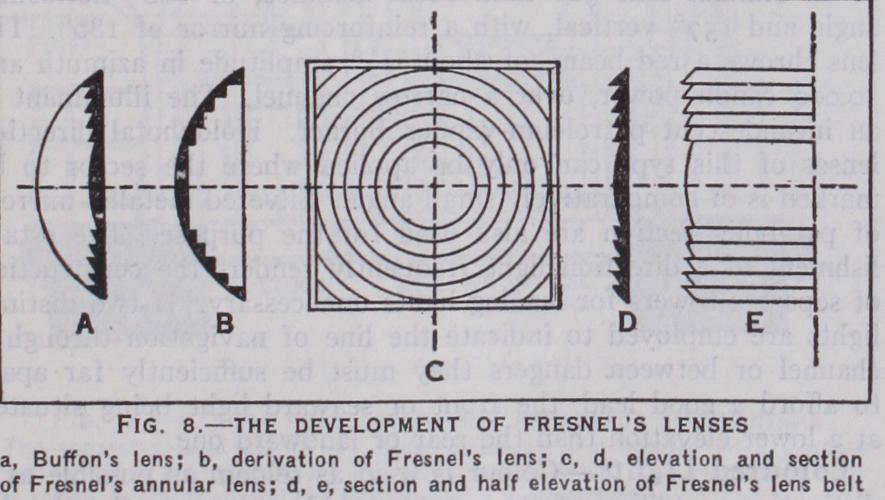
teristics, comprising one or more occultations, may be procured by means of such contrivances. "Otter" screens are sometimes employed in cases where it is desired to produce different periods of occultations in two or more positions in azimuth, in order to differentiate sectors marking shoals, etc. The screens are of sheet metal blacked and arranged vertically, somewhat in the manner of the laths of a venetian blind, and operated by mechanical means.
Leading Lights.
In the case of lights designed to act as a lead through a narrow channel or as direction lights, it is un desirable to employ a revolving apparatus. Fixed-light optics are used in such cases, generally fitted with an eclipsing mechanism. A typical apparatus of this description is that at Woodman Point, Fremantle, West Australia (fig. 1o). The occulting white light covers the fairway, and is flanked by sectors of occulting red and green-light marking dangers and intensified by vertical condensing prisms. A good example of a holophotal direction light is that at Suzac lighthouse (France). The apparatus consists of an annular lens 500 mm. focal distance, of 18o° horizontal angle and 157° vertical, with a reinforcing mirror of 18o°. The lens throws a red beam, of about 41° amplitude in azimuth and 50,000 candle-power, over a narrow channel. The illuminant is an incandescent petroleum-vapour burner. Holophotal directionlenses of this type can only be applied where the sector to be marked is of comparatively small angle. Silvered metallic mirrors of parabolic section are also used for the purpose. The estab lishment of a direction light frequently renders the construction of separate towers for leading lights unnecessary. If two distinct lights are employed to indicate the line of navigation through a channel or between dangers they must be sufficiently far apart to afford a good lead, the front or seaward light being situated at a lower elevation than the rear or landward one.
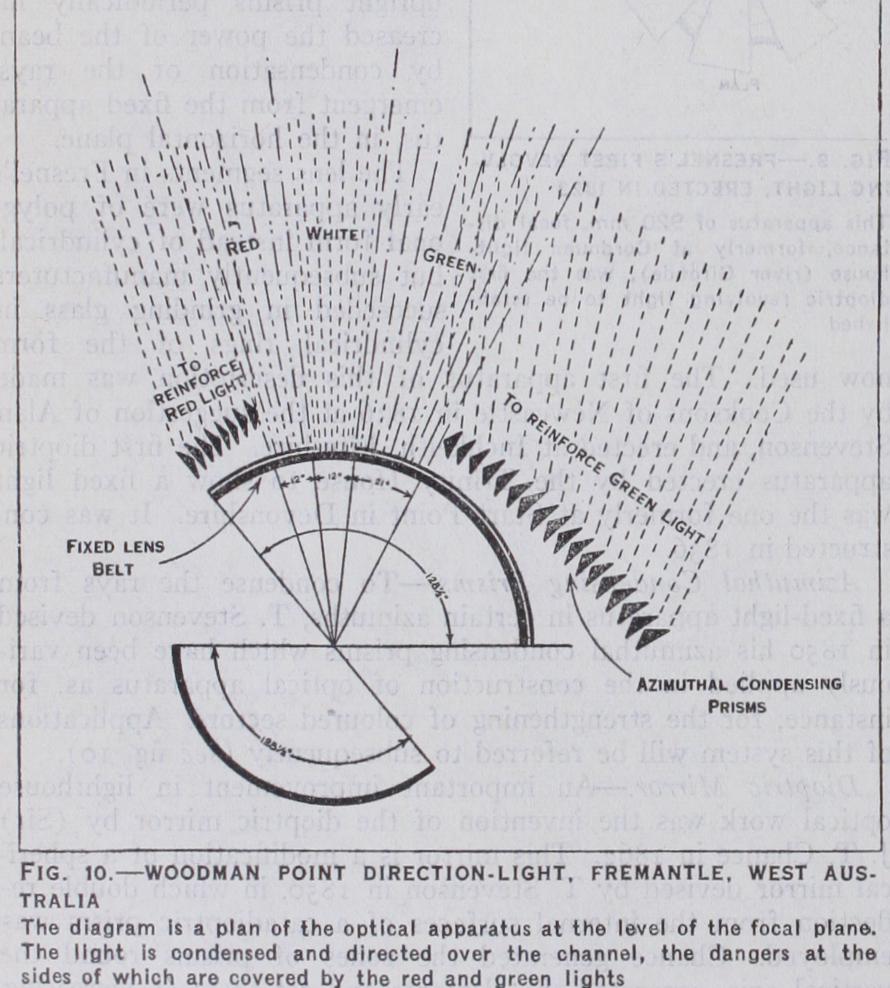
Coloured Lights.—Colour is used as seldom as possible as a distinction, entailing as it does a considerable reduction in the power of the light. It is however necessary in some instances for differentiating sectors over dangers and for harbour lighting purposes. Alternating colours for flashing lights are not to be commended on account of the unequal absorption of the coloured and bright rays by the atmosphere. Where such a combination has been employed, as in the Wolf rock apparatus, the red and white beams have been approximately equalized in initial intensity by constructing the lens and prism panels for the red light of larger angle than those for the white beams. Owing to absorption by the red colouring of the glass screen the power of the red beam is only 40% of the intensity of the corresponding white light. The corresponding intensity of green light is 25%. When red or green sectors are employed, in conjunction with a white light from a fixed apparatus, they should if it is practicable be reinforced by mirrors, azimuthal condensing prisms, or other means, to raise the coloured beam to approximately the same intensity as the white light. With the introduction of group-flashing charac teristics the necessity for using colour as a means of distinction for landfall lights disappeared. In situations such as a river f air way where a large number of buoy or beacon lights have to be provided with distinguishing characteristics, coloured lights are, however, frequently employed.