The Draftsmans Outfit 2
scale, blade, edge, scales, inch, inches and shown
14. Thumb-tacks are short tacks with large flat or almost flat heads, especially used for fastening the paper to the drawing board. They may be pressed into the soft wood of the board with the thumb. "Unless the paper is of com paratively large size, four tacks—one through each corner—will be sufficient to keep the paper in place. Small-sized copper tacks may be used if preferred, as the heads of these offer less ob struction to the motion of the triangles and other implements.
15. The T-square, shown with the drawing board in Fig. 13, consists of a blade and a head.
The blade may be permanently fastened to the head, or the head may be provided with a clamp so as to be adjustable.
For a right-handed draftsman using the T square against the left-hand side of the board, the upper edge of the blade is the working edge, as shown in Fig. 13. A good T-square should have a perfectly straight working edge, a straight working edge also for the head, and no motion between head and blade. The most accurate T-squares are made of steel, but very satisfactory ones are made of wood—some with plain edges, and others with edges of ebony or celluloid.
T-squares are made in various sizes, and numbered according to the length of the blade in inches. When not in use, the T-squares should be hung up, using the hole in the end of the blade and should be kept out of the sunlight, and away from radiators or steam pipes.
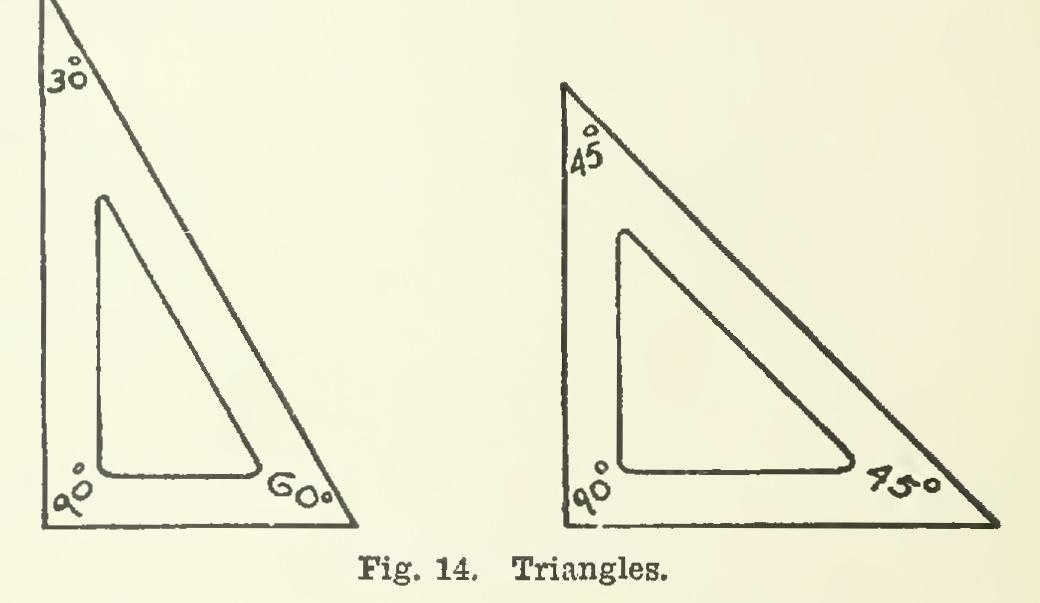
16. Of the triangles, shown in Fig. 14, probably the best for all-round work are those made of celluloid, as these are fairly accurate, light, and more or less transparent. It is per haps hardly necessary to state that celluloid is highly combustible, and must therefore be kept away from fire.
Triangles are made in different sizes, and numbered according to the lengths of the edges. A 10-inch 45-degree triangle is one with each of the perpendicular edges 10 inches long; a 12-inch 30-degree 60-degree triangle has the long per pendicular edge 12 inches long; and so on for other sizes.
For general work, one should have at least four triangles—one large and one small 45 degree, 10 or 12 inches, and 5 or 6 inches, re spectively; and two 30-degree 60-degree triangles—one large and one small. To prevent warping, triangles, when not in use, should be hung up out of the sun's rays.
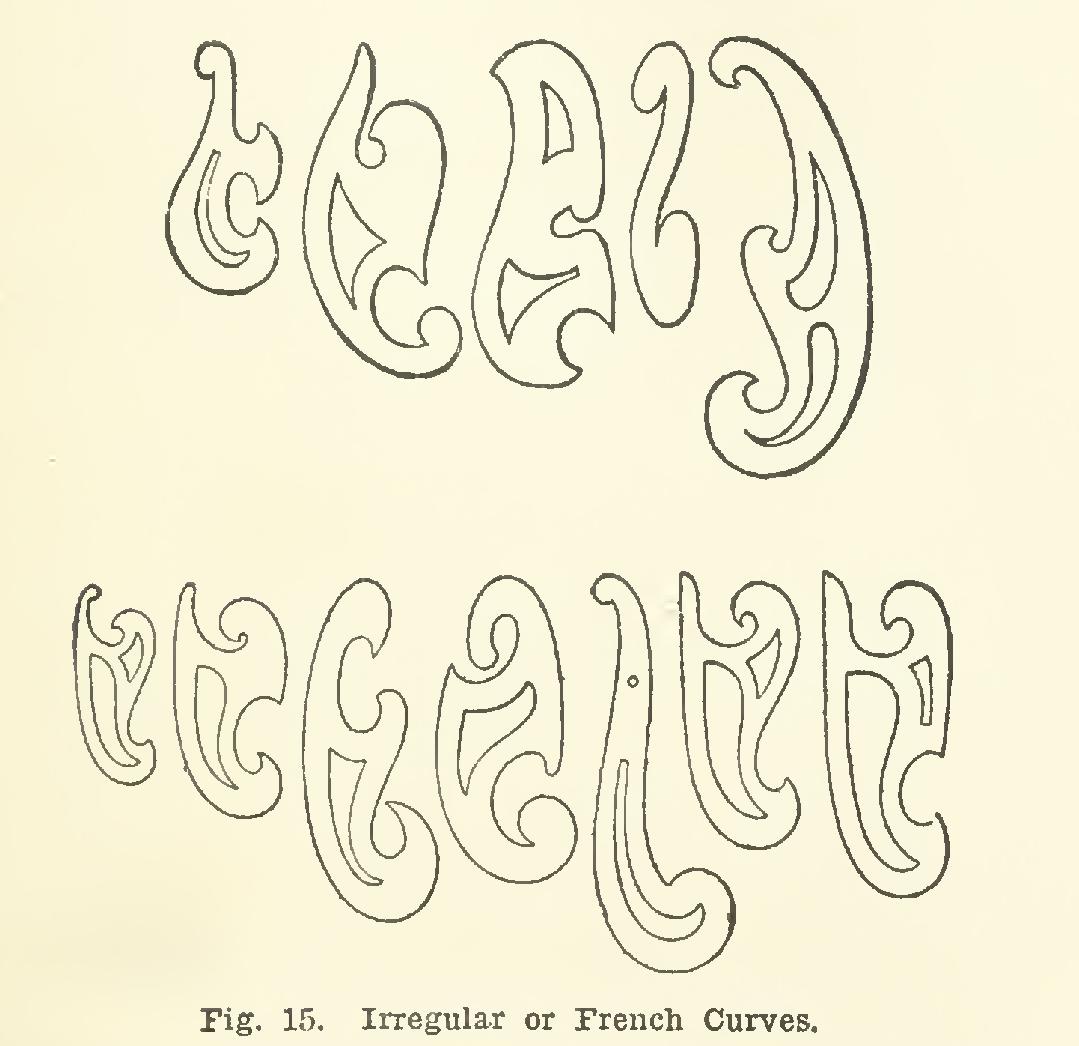
17. Irregular
or French curves of various shapes are shown in Fig. 15, and are used for drawing-in smoothly curved lines which are not arcs of circles.
18. Scales.
First of all, scales are not used for ruling lines. All straight lines should be drawn either with the T-square or with a triangle. Scales are made in different shapes and lengths, the most common, perhaps, being the 12-inch length triangular or the flat with beveled edges.
Scales are also distinguished as Architect's and Engineer's scales. On the latter, it will be sufficient to say that the inch is divided into tenths or multiples of ten, and is used chiefly in scientific, machine, and engineering work.
The Architect's scale is shown in Fig. 16. By reference to the figure, it will be seen that the scale is triangular, and therefore has six faces for division. On one side of one face the scale is marked off into inches and divided in the usual way. On the other faces are ten dif ferent scales, marked at the ends etc.
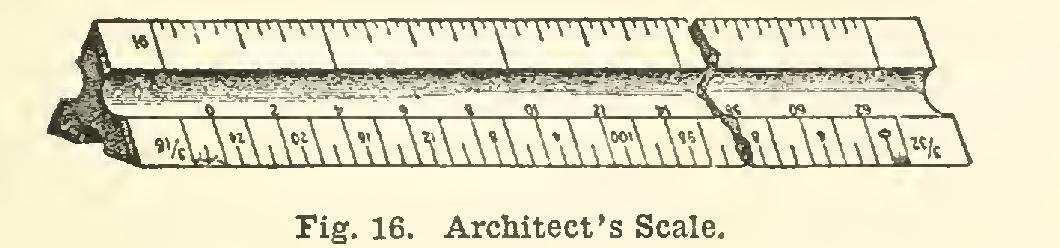
These numbers mean that the scale so marked is the scale 1/4 inch to the foot, IA inch to the foot, and so on.
Let the scale of 1/2 inch=1 foot be taken as an example. By actually examining a scale, the draftsman will see that the space at the end marked IA, which is actually one-half an inch in length, is divided into twelve equal parts, so that if one-half inch be taken to represent one foot, then each smallest space will stand for one inch. The other spaces at the right of the divided one are half-inches, and so will each represent one foot.
The use of the scale in making actual draw ings will be explained later.
19. The pricker is a fine needle-point fast ened in a convenient handle, and is used for accurately noting the position of a given point.
20. Erasers are frequently needed by the draftsman for making changes or correcting errors in the drawing. They are of two kinds— for pencil and for ink. For erasing ink lines, a eraser or a steel eraser may be used. The steel eraser is a special knife sharp ened to a keen edge. With this knife, most of the ink may be removed, then the remainder rubbed off with the sand or pencil rubber.