The Draftsmans Outfit 2
t-square, line, drawing, edge, paper, exactly and ink
21. Pencils. Special pencils are required for drawing, the ordinary kind being as a general thing entirely unsuitable. Drawing pencils are marked at one end with a number or with one or more letters, to show the degree of hardness. The hardness of the lead varies from 7 or 81I, very hard, to one or more B's, very soft.
22. Drawing ink is made in two forms—the liquid, ready for use; and the dry, in stick form. If the latter is used, it is prepared by grinding with a little water in a stone saucer until the water containing the dissolving ink is perfectly black and of the desired thickness. The bottled inks are made in black and in colors. Some of these inks are made waterproof, not being affected by moisture. For general work, the bottled ink is recommended for satisfactory results and economy of time.
23. Paper. The kind of paper varies with the sort of work to be done. Drawings from which blue-prints are to be taken are commonly made on a cheap brown detail or duplex paper, or on thin, tough white bond. For nicely fin ished drawings, cold-pressed and hot-pressed papers are excellent, the latter being especially adapted for ink work.
Another paper which is very satisfactory for ink drawing is the normal, which has a hard, smooth surface. For the highest grade of inked drawings, as for the Patent Office, for book work, etc., bristol board is preferred. This is a cardboard made of two or more layers; has a very hard, smooth surface; and gives very sharply defined and clean-cut lines.
24. Tracing cloth is used when drawings are to be reproduced in blue-prints for shop or field use. One side of the tracing cloth has a dull finish, the other side being shiny. Ink may be used on either side of the cloth. Erasers may be used as on drawing paper, except that the ink eraser or sand rubber should be used very care fully so as not to wear a hole through the cloth. Water ruins the surface for drawing.
Testing of Instruments 25. Testing the Place on the board a sheet of drawing paper at least as long as the blade of the T-square, and, with a sharp, hard pencil, draw a line across the paper close against the upper or working side of the blade, Fig. 17. Then, without changing the position of
the T-squaxe turn the paper end for end; place the line to coincide as nearly as possible with the same edge of the T-square; and draw a line again. If the second line falls exactly upon the first, the edge of the T-square is straight; but if the lines do not exactly coincide, the edge is not true, and should be made so with a plane or sandpaper.
If the edge of the T-square has been found straight, the working edge of the drawing board (the edge against which the head of the T-square slides), may be tested by applying to it the tested edge of the T-square.
26. Testing the Triangles. A common fault with triangles, especially the larger ones, is a lack of accuracy in the right angle; that is, one side is not exactly square or at right angles with the other side.
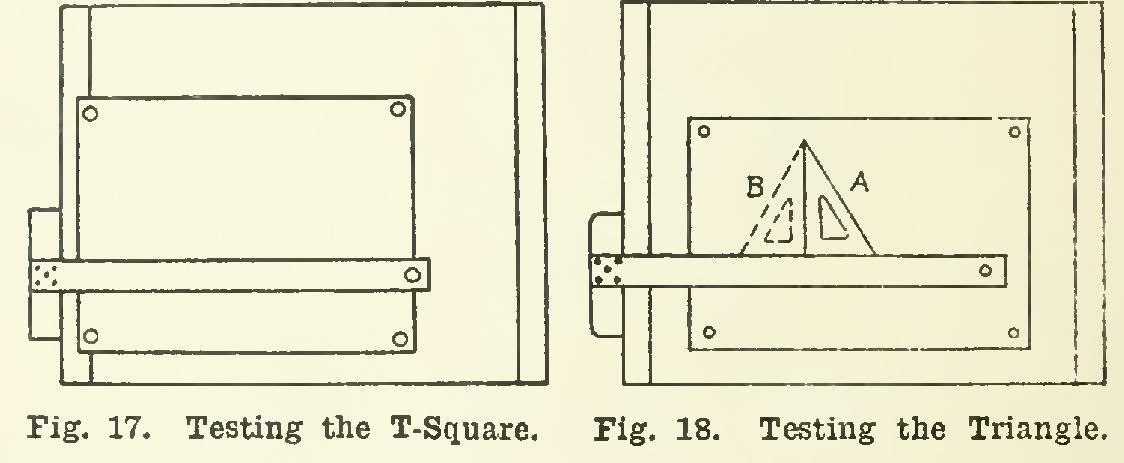
To test for squareness of the right angle (see Fig. 18), place one side of the triangle against the tested edge of the T-square as shown at A, and, with a very sharp, hard pencil, draw a line against the vertical edge of the triangle. Next turn the triangle over, face-down, in the position shown at B, and draw against the ver tical edge a second line to coincide if possible with the first one. If the two exactly coincide, the right angle is true. Both the 60-degree 30 degree and the 45-degree triangles should be tested in this way.
To test the 45-degree angles, if the 90-degree angle is found to be true, draw a 45-degree line with one of the short sides against the T-square; then turn the triangle over, and place the other short side against the T-square. If, in this posi tion, a second 45-degree line can be drawn exactly coinciding with the first, the angle is exactly 45 degrees.
The 60-degree and 30-degree angles can be tested after the right angle has been found cor rect, by first drawing a T-square line on the paper, then drawing with the triangle against the T-square two 60-degree lines so as to form a triangle having the T-square line as a base. Next test with the dividers the relative lengths of the three sides. If they ar0 exactly equal, the 60-degree and 30-degree angles are both correct.