Paperhangers Tools and
fig, water, ft, paste, top, oz, brass, trestle, cold and shown
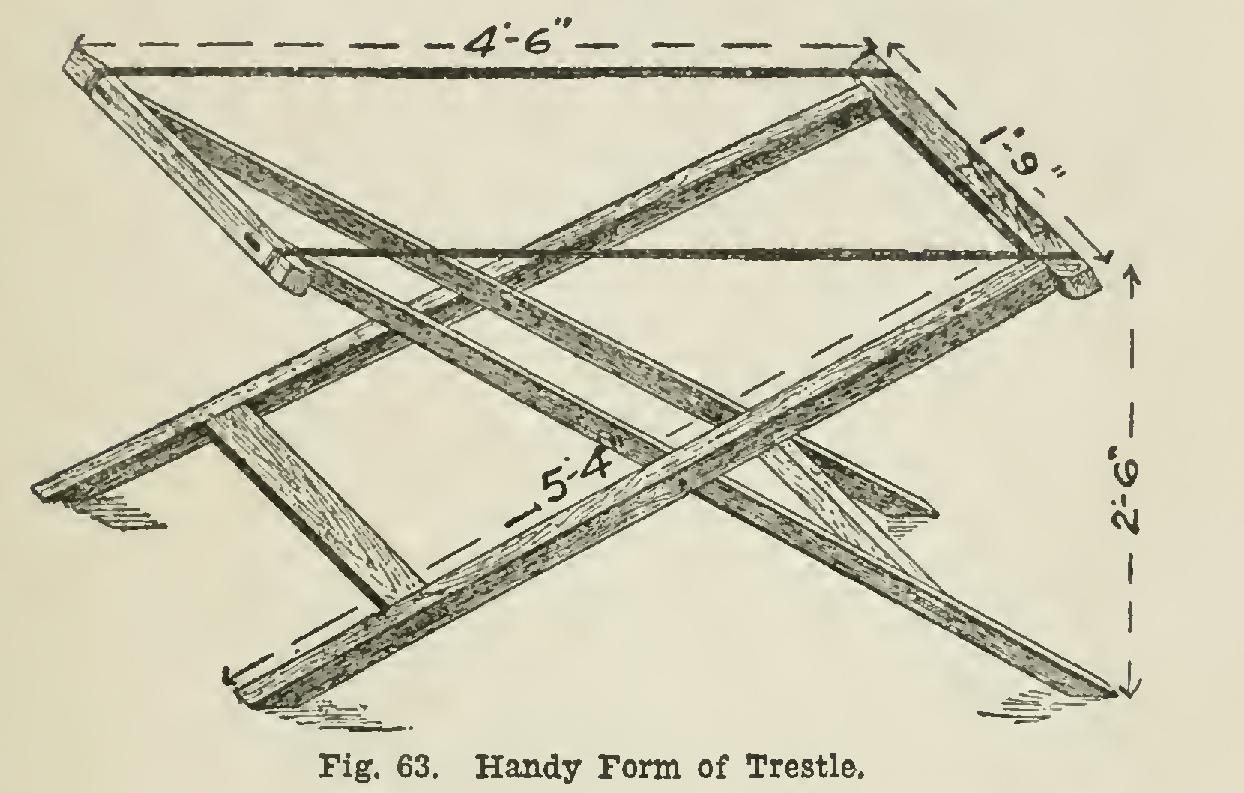
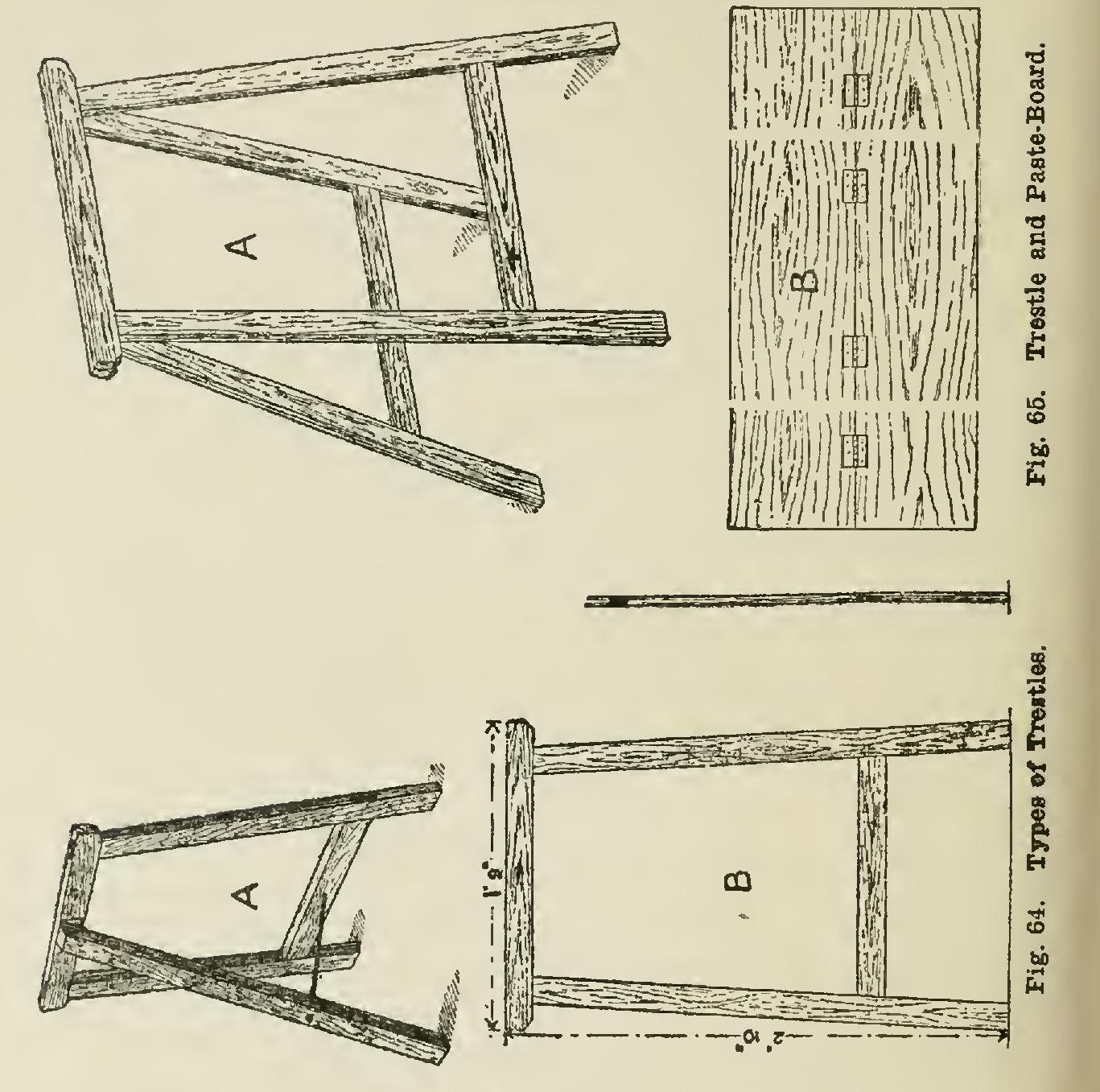
For supporting the paper while cutting, pasting, etc., a paste-board is necessary; 6 ft. 6 in. long and 22 in. wide is a handy size, with an extra flap or piece 11 in. wide to fix on the side by means of irons and slots, for use in hang ing wide papers (see Fig. 62). Many kinds of trestles are available. Fig. 63 shows a very handy form of trestle, which should be made of stuff about in. square, except the lower rails, which, if made broader, as shown, will greatly strengthen the trestle. Another useful trestle is illustrated in Fig. 64, a. Of course, two of these would be required. They should be made of 2-in. by 1-in. stuff, and mortised-and tenoned together as indicated. Fig. 64, b, is an elevation and edge view of part of another style of trestle; Fig. 65, a, is a general view of the complete trestle; the trestle should be made of about by material mortised-and tenoned, the two parts being hinged together with back flaps. The board should be formed of two pieces of pine 11 in. wide and about in. thick; these should be jointed and hinged together from the under side, as shown in Fig. 65, B.
A combined paste-hoard and trestles is shown open in Fig. 66, and closed in Fig. 67, A. It will be seen,that each trestle when open is kept in position by means of a brace hinged at one end to a block (Fig. 67, B), which is fixed to the top; the other end of the brace has a piece of iron about in. by 114 in., and 5 in. long screwed to it, the iron having a hole made through it to allow of a thumb-screw fastening it to the rail, as illustrated in Fig. 67, C. The top should be made by jointing two pine boards in. by 11 in., and strengthening on the under side with two ledges, as shown. One-inch stuff will be found suitable for the trestles, which should be mortised and tenoned together to make a strong job of them. The leading dimensions are figured on the illustrations, but of course these may be varied according to requirements. A portable table of this description will be found useful for many purposes.

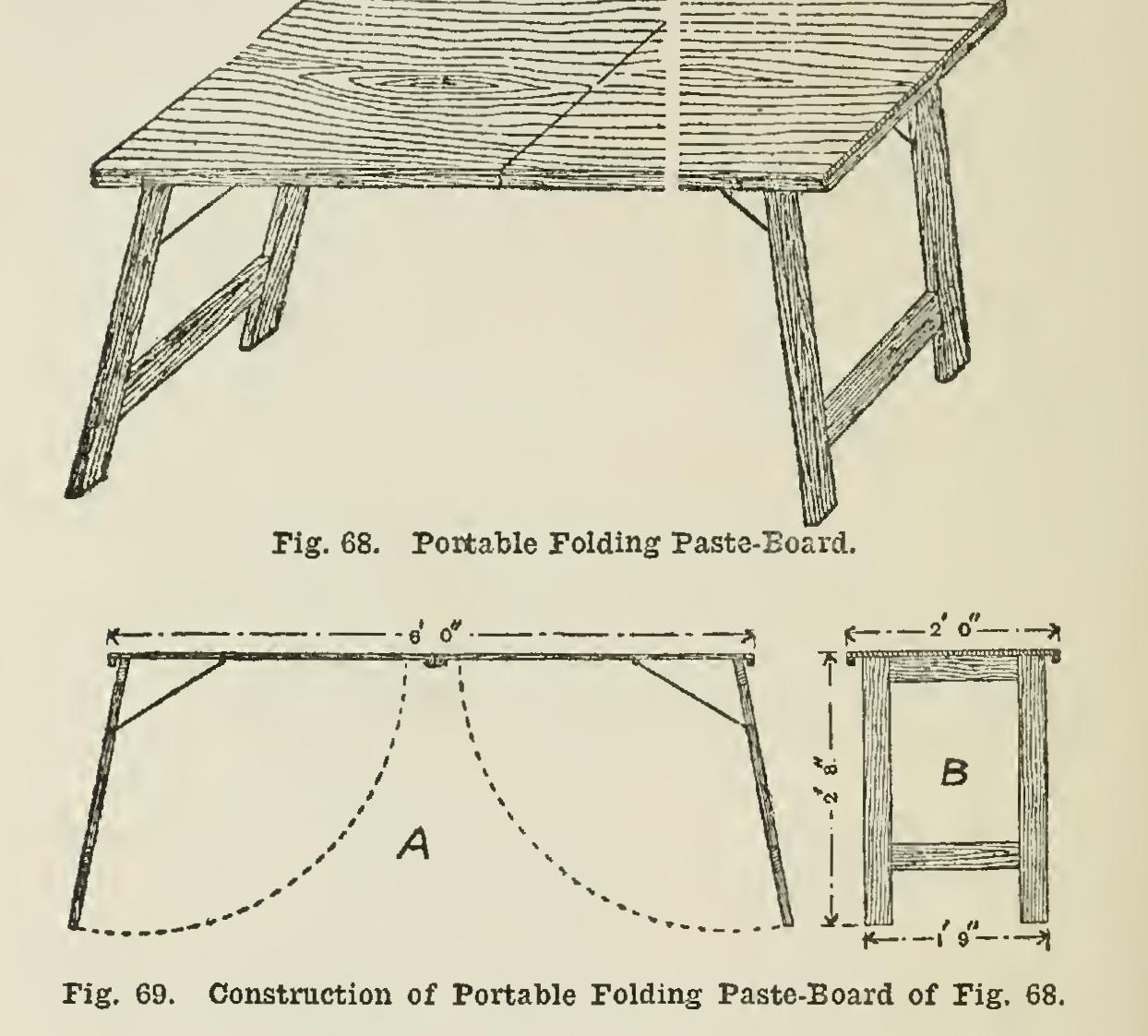
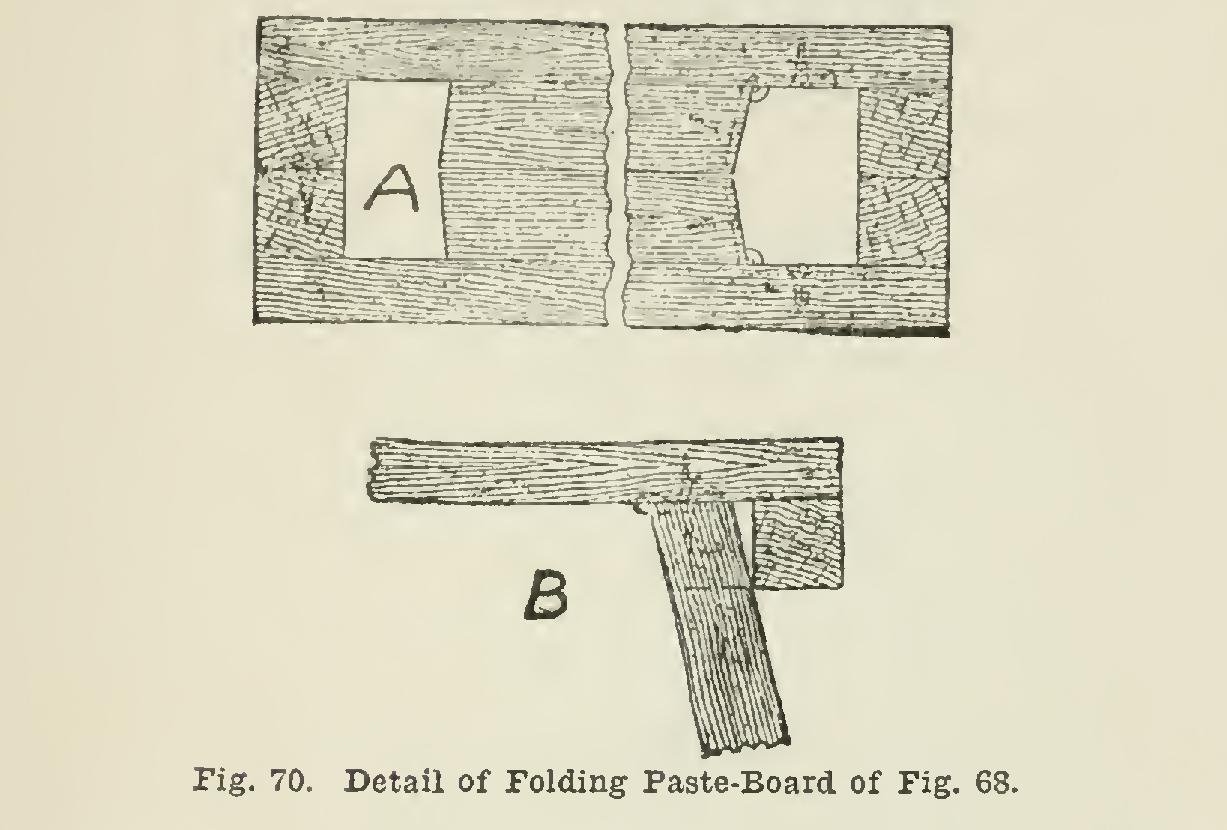
Another portable folding paste-board table is shown in Figs. 68 and 69. This is 6 ft. long, by 2 ft. 8 in. high, and, when closed, looks like a fold ing bagatelle board. The top and legs are made of clean yellow pine, free from knots and other imperfections. The top is finished in. thick, jointed and cross-tongued; the rim (see detail Fig. 70, A and B) is 1 in. square and screwed to the top with brass screws, the angles being dovetailed. The top is cut in the center; and when finished with the rim fixed on, two separate and distinct tables are shown; these are hinged together (see Fig. 70, A), the knuckle of the hinge being flush with the outer edge of the rim. The legs, 2 ft. in. high by 1 ft. 9 in. wide, are made of 3-in. by 1-in. pine framed to gether in the usual way with mortises and ten ons. These are hinged to the top (see Fig. 70, B), and are also held in position by stays formed with ordinary brass hooks and eyes; these are absolutely necessary to keep the table rigid while in use. The additional support required for the center is applied by thumb screws fixed in the rims (see Fig. 69, A) , the plates are let in and
screwed; the screw itself is safeguarded by at taching it by a chain to the top. The whole of the fittings are shut up inside the closed table.
The materials required are: Top, one piece 6 ft. by 2 ft. by 3/4 in.; rim, two pieces 6 ft. by 1 ft. by 1 in., and four pieces 2 ft. by 1 in. by 1 in.; legs, four pieces 2 ft. 9 in. by 3 in. by 1 in., and four pieces 1 ft. 9 in. by 3 in. by 1 in., all best yellow pine; hinges, three pairs of 3-in. brass; three dozen brass screws; stays, four 12 in. by brass wire hook-and-eye stays; two 1-in. brass hooks and eyes; two 2-in. brass thumb screws; three dozen in. brass No. 12 screws. The table may be either painted or varnished.
Paste for Wallpaper. Elastic or pliable paste for wallpaper may be made as follows: Take 8 oz. of ordinary starch, 3 oz. of white dex trine, 22 fluid oz. of cold water, 2 oz. of borax, 6 oz. of glycerine, and 1 gal. of boiling water. Mix the starch and dextrine with the cold water to a batter. In another vessel dissolve the borax in the boiling water, then acid to it the glycerine; then add gradually to the starch while con stantly stirring, when it will turn into a trans lucent paste. This paste will not crack, being very pliable; and may be used with advantage where flexibility is required, as on expensive papers.
Strong adhesive paste for heavy papers may be prepared by mixing 8 lbs. of rye flour into a batter free from lumps, with 1 gal. of cold water; then add steadily 3 gal. of boiling water, con stantly stirring; after which, 4 oz. of powdered resin should be gently sprinkled in, a little at a time. Should the paste become thick when cold, thin as required with hot water. This is a good paste, and may be used for hanging heavy wall papers or leather.
The following are the ingredients for the well-known Venetian paste: Fish glue, 8 oz., cold water, 16 oz.; Venice turpentine, 4 oz.; rye flour, 2 lbs.; boiling water, 1 gal. Dissolve the glue in a glue-pot with the cold water, in a water bath or over a fire; then stir in the Venice tur pentine. In another vessel dissolve or make a batter of the rye flour with 2 pints of cold water, then add while constantly stirring the boiling water. The contents of the two vessels should now be stirred well together. This makes a paste that is very tenacious, and, owing to the Venice turpentine in its composition, will make the paper adhere firmly to any painted surface.
Alum is added to paste to keep it sweet; but, as is well known, it has a disastrous effect upon those papers part of whose design is executed in metal, while it is said to affect also some colors of ingrains. Formaldehyde has advantages over alum as a paste preservative.
A good deal of illness often arises from the bad nature of the size and paste with which ordi nary wallpapers are hung, and great care should be taken that no such inferior and obnoxious materials are allowed. If necessary, a little oil of cloves, salicylic acid, or some other antiseptic agent, should be added to any material likely to putrefy and give off noxious odors.