Tools Used by Painters
fig, brushes, brush, shape, painting and bristles
TOOLS USED BY PAINTERS Brushes. The value of hogs' bristles, from which most of the ordinary brushes on the market are made, depends upon their length, strength, elasticity, and also color. White brushes are commonly preferred, not only by house-painters, but also in all descriptions of brushes, probably under the impression that adulteration is less prevalent than with grey- or black-haired brushes.
The accompanying illustrations have been selected chiefly to show the peculiarities of each class or make of brush, without consideration of the exact size or scale. They include exam ples of most descriptions of brushes in ordinary use for painting and varnishing; and with all these the painter should be familiar. Fig. 10 will convey a fair idea of the appearance of an ordinary good paint-brush of the usual form. The bristles are about six inches long from the binding to the point, and each brush requires to be bridled—that is, tied up with string some two or three inches higher—before it is used for painting. As the brush wears down, the string binding is untied, until eventually the extra bridle is entirely dispensed with. Fig. 11 is a similar brush, but oval in shape. Fig. 12 represents a shape in which quantities of cheap brushes are made. Good hair makes a good brush, made up in either shape.

Fig. 13 shows a small round-handle brush, called a sash tool—that is, for painting the small bars of a window-sash. It requires tying up short for using in oil paint. The German paint tool (Fig. 15), both for wear and quality, com pares very unfavorably. An assortment of sash tools are illustrated in Figs. 13 to 18.

Fig. 19 represents a brush of recent date, made purposely for sash-painting; it is an as sistance to quick and clean work, where a great number of window-panes have to be painted, but for ordinary work the string-tied sash tool will suffice. Figs. 20 and 21 are termed fitches, consisting of short bristles bound in tin, with long wood handles. They are much used for all kinds of decorating and gilding; and nearly all painters, artistic and otherwise, find them indispensable. Fig. 23 is a somewhat similar
brush, useful to gilders, scene-painters, etc., as well as to decorators.
Painters' varnish-brushes are usually old and well-tried tools that have been worn-in with painting; and these, ir properly cleaned and looked after, cannot be improved upon for pro fessional use. Figs. 24, 25, and 26 represent brushes specially made for varnishing; the first. shown edgewise, it will be noticed, is made to the shape or a partly-worn paint-brush. Fig.

25 is a shape occasionally used by the operative house painter; certainly not by reason of its suitability. This and Fig. 26 can be used to ad vantage only on the finest work, and on broad, flat surfaces.
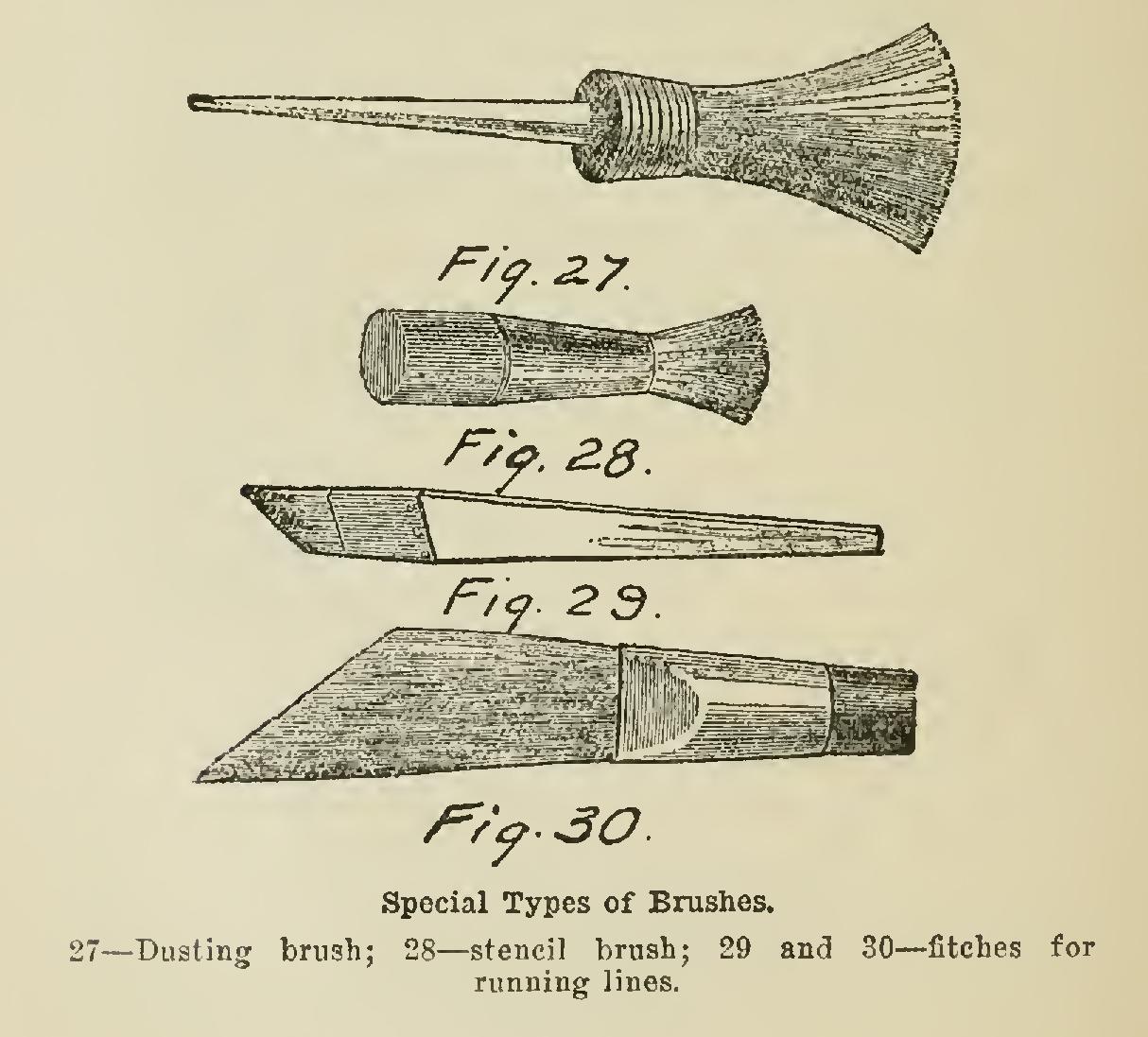
Clean and good work cannot be done with out dusting-brushes. Fig. 27 shows the best shape, the pointed handle is useful to remove dirt from corners. Somewhat similar in shape to Fig. 10, it is rather larger, and the bristles are much longer and spreading, so that dust and dirt can be brushed out of any crevice and corner with ease. Brushes like Fig. 12, made only for painting, should not be used for dusting.
Fig. 28, a 4tencil-brush, and Figs. 29 and 30, fitches, are brushes more used by decorators than by painters. The former is for stenciling, and the latter for running lines with the aid of a beveled straight-edge.
Fig. 31 shows a section of the straight-edge used to guide a lining fitch. A is the side laid against the surface; the fitch is guided by the edge C; and the space B prevents paint spread ing.
Figs. 32 to 36 show a variety of larger brushes specially made for distemper painting and prep aration. Fig. 32 is the distemper-brush, such as is used by the leading decorators for the best kind of work. This form of brush is fitted with a strong brass band. The best and finest are made with yellow and grey bristles, which are about 6 inches long. . These brushes are with out doubt the most suitable size and shape for spreading properly prepared distemper.