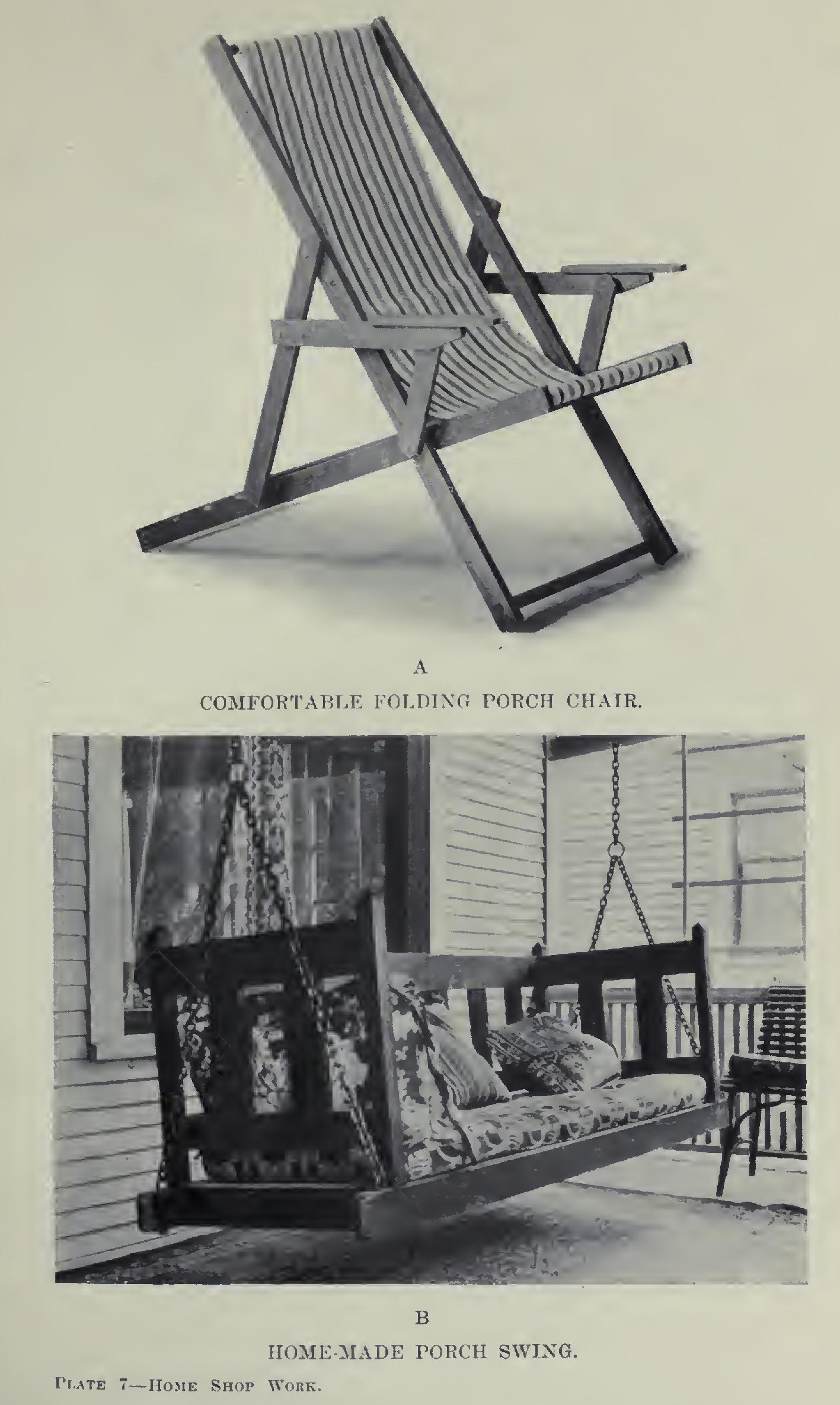
A Folding Porch Chair
inches, pieces, bit, wood, measure and one-half
A FOLDING PORCH CHAIR A folding porch chair such as is shown in the photograph Plate 7 (A), may easily be made, and is well worth the effort. The con struction is so simple that any home craftsman ought to be able to make it with but little trouble.
Almost any kind of wood will answer. If the chair is to be made of an open-grained wood, such as oak or chestnut, the parts should be filled with a paste filler, shellaced one coat and waxed or varnished just before assembling the parts. If of a close-grained. wood, such as white wood, maple, etc., the parts may be treated as for the open-grained wood, except that the filler is not necessary. A liquid filler may be used if convenient. If the natural color of the wood is not desired, the wood may first be stained, the filler being colored somewhat darker than the stain.
Two different thicknesses of wood. are re quired for the flat pieces, seven-eighths and five-eighths of an inch. The rods will require still another thickness, one inch. Since none of the pieces are over two inches in width, it is quite likely that material enough may be found in the scrap-pile. Every carpenter shop has a corner or place where are placed for pos sible future use the long strips often left after ripping.
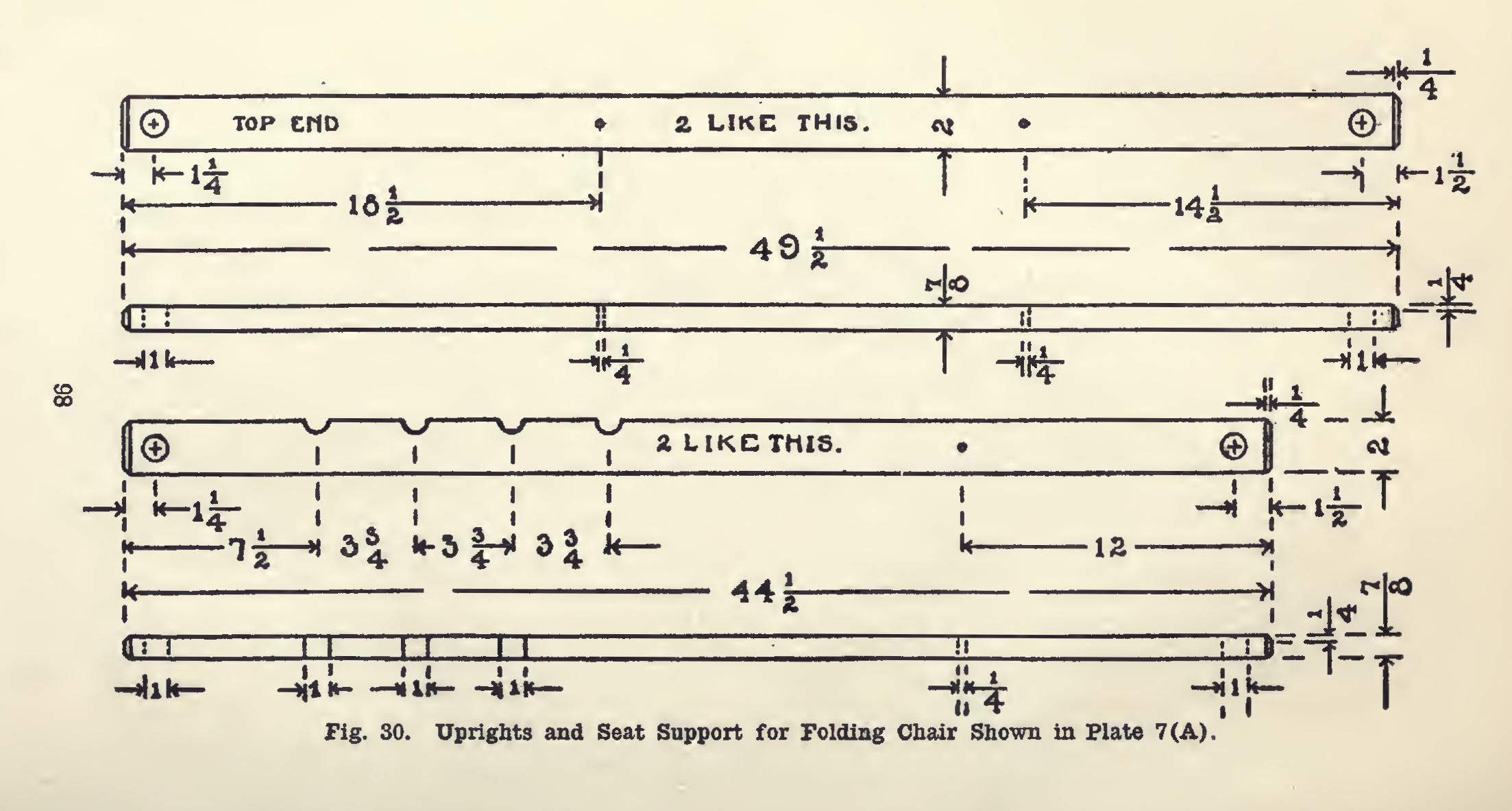
For the uprights (Fig. 30, upper part), square up in the usual way two pieces seven eighths by two by forty-nine and one-half inches. Bevel the ends on sides and edges to one-quarter of an inch each.
Measure from what is to become the top end of one of them one and one-quarter inches, and make a light pencil mark. Make the marks on one of the edges. Again measure from the same end eighteen and one-half inches, and mark.
From the other end, measure one and one half inches. From this same end, measure four teen and one-half inches, and mark.
Place the two pieces side by side, the edges up, and even the ends with the try-square. hold them firmly in this position, and square light pencil lines across the two pieces at the marks laid off on the edge of one of them. Take the pieces apart, and square these lines across one face of each piece. Next set the gauge to one
half the width of the piece, and mark across each pencil line. Be careful not to gauge beyond what will be covered later by the bit when the holes are bored.
Bore the holes nearest the ends with a one inch bit, the cross-lines of pencil and gauge in dicating the points at which to set the spur of the bit. The two remaining cross-lines are to be bored with a one-quarter-inch bit.
In boring such as this, where care must be taken to keep both edges of the holes clean and sharp, the holes should each be bored until the spur shows; the bit should then be withdrawn, and the rest of the boring be done from the other side.
For the seat supports (Fig. 30, lower part), square up two pieces to seven-eighths by two by forty-four and one-half inches. Bevel the ends to one-quarter of an inch.
From one end of one of the pieces, measure one and one-quarter inches, and place a light pencil mark. From this same end, measure seven and one-half inches; from this last point, measure three and three-quarters inches; from this point, three and three-quarters; from this last point, lay off the same dimension again. From the other end of the piece, measure one and one-half inches. From the same end, meas ure twelve inches.
Even the ends of the two pieces, and square light pencil lines across the two edges at the marks just laid off, as was done with the first two pieces made. Square these lines across one face of each piece.
Gauge for the middle of the piece across the lines measured one and one-quarter inches from one end, and one and one-half and twelve inches from the other.
Bore the end lines with the one-inch bit, the other one with the one-quarter-inch bit.
The other holes, or rather half-holes, are made by placing the two pieces edge to edge in the vise, and placing the spur of the bit in the 'crack. The one-inch bit is used. As it will be impossible to finish the boring of these blocks from the second side, the parts remaining must be cut out with the knife after the pieces have been separated.