A Footstool
inches, cut, line, pieces and top
Square the legs to a length of eight and one half inches and a width of ten inches. The grain of the wood is to extend up and down so that the length, which is always measured along the grain, is less than the width. The curves on the bottom may be laid out and cut now, or they may be marked off with the pattern at the same time as the other curves. To make this pattern, draw an oblong on rather stiff paper eight and one-half by ten inches. Draw a cen ter line along the grain. At the bottom, meas ure two inches from this center line. Also, measure from the bottom, along the center line, two and three-quarters inches. With a three and three-eighths inch radius, draw a curve that shall pass through these two points.
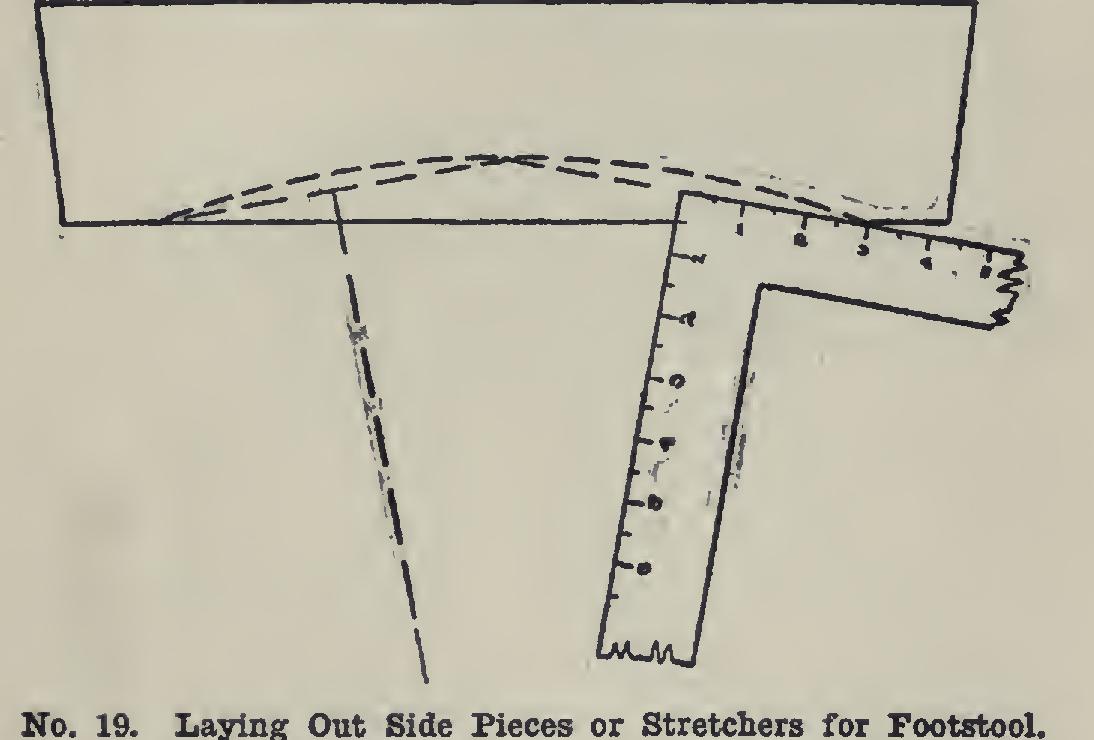
The curve for the side should be sketched freehand, as nearly as possible like that in Fig. 18. When one-half has been drawn, the paper may be folded on the center line, and the second half traced from the first.
The grooves on the legs should be laid out and cut before the sides are cut. Set the gauge to one and three-eighths inches, and gauge from each edge, on each surface of each leg, a line three and one-half inches long. Reset to two inches, and gauge as before. Square knife lines across these pairs of lines at three and one-half inches from the top. Rip to the lines, and chisel across the grain.
The pattern may now be applied, and the curves cut and smoothed. If a band-saw or jig saw is to be had the like parts should be nailed together lightly and cut out together. The nail ing must be done in the wood which becomes waste.
Clean and smooth all of the pieces, and put together the legs and side pieces. Bore the holes for the dowels which pin the parts together, with a one-half-inch bit. The first hole should
be one and three-sixteenths inches from the top; the next, one and three-sixteenths below this. Drive a one-half-inch dowel into each hole, and cut it off one-quarter of an inch from the leg. With knife and sandpaper, round the ends of the dowels.
For fastening the top to the frame, two pieces of seven-eighths square stock will be needed. Cut them to a length that will just fit between the side pieces. Drill and countersink two holes in each direction. Screw the pieces to the legs first; then turn the stool upside down, place the top, and fasten (Fig. 18). If desired, two addi tional screws may be placed through the rails into the top. It will be necessary to bore part way with a bit large enough to take in the head of the screw, then to drill the rest of the distance with a smaller bit.
The stool shown in the photograph was fin ished in the ever-popular brown Flemish. The wood was first stained with Brenig's Flemish water stain, diluted by adding an equal volume of water. When this had dried, the surfaces were lightly sandpapered with 00 paper to re move the fibers which the water stain had caused to rise.
Care must be taken not to "cut through" on the corners. Thoroughly brush the pores full of paste filler; and, when it has flattened, or when it has lost its gloss, which will be in a minute or two, rub the filler off across the grain with excelsior, and finish the rubbing with waste. A sharp-pointed stick should be used to clean the corners. Allow the filler to stand over night; then apply a very thin coat of shel lac. The shellac must be thin, or it will "scratch" when shoes are placed upon it.