A Large Mission Rocker
inches, pieces, posts, piece, top and front
A LARGE MISSION ROCKER Plate 16 is a photograph of a large, roomy mission rocker, designed on the popular Morris chair lines. A detailed working drawing is given in Fig. 64. This is not an easy problem, and only home craftsmen of experience and considerable skill are advised to undertake it.
Only the best grade of thoroughly seasoned white oak should be used. It may be quarter sawed or plain, just as the worker desires.
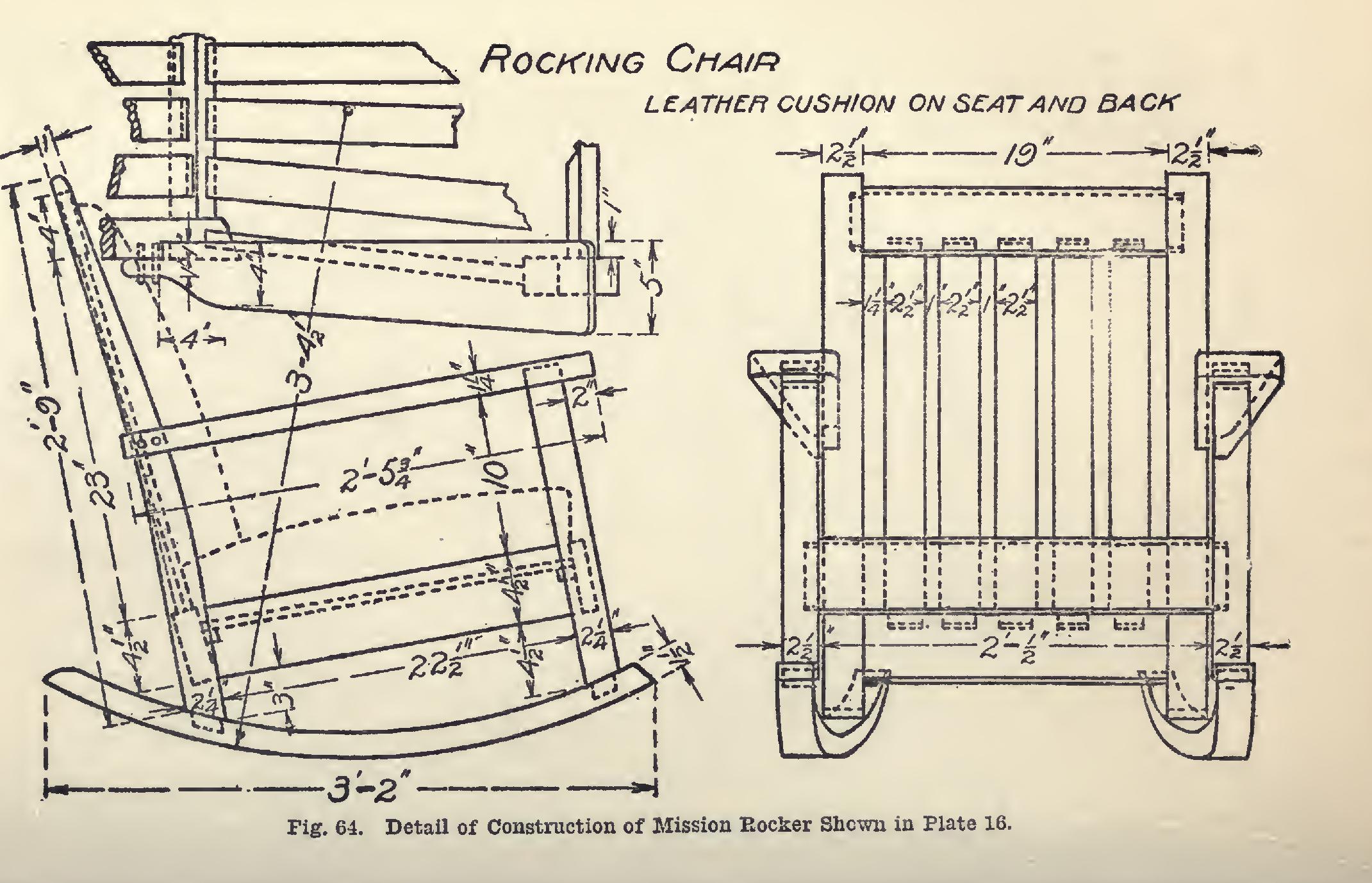
Quartered oak for the arms and the other flat pieces will look very pretty when finished.
To save unnecessary labor, it is suggested that the stock be ordered mill-planed as far as possible. For the front rail, one piece by inches by 2 feet inches; for the side rails, two pieces of the same thickness and width, with a length of inches. These pieces might be ordered surfaced on four sides to of an inch, and supplied as one piece, the lengths being combined.
For the arms, two pieces inches by inches by 2 feet 6 inches. Combine the lengths, and have the piece mill-planed on two surfaces to inches.
For the back, one piece by 4 by 21 inches, S-4-S; one piece by by 21 inches, S-4-S. For slats to form the seat, five pieces, % by by 25 inches. These lengths may be added in ordering, and the stock got S-4-S to % of an inch by inches.
There will be needed two strips by inches to fasten the slats of the seat to; one should be 20 inches, the other 25 inches long. Should it be desired to put in springs instead of slats, the slats, of course, should not be in cluded in the stock bill. For the rockers, two pieces inches deep throughout, by inches wide throughout, with a length of 3 feet 2 inches from end to end, S-4-S. The radius of curvature is to be 3 feet inches.
For the posts, two pieces by by 201/2 inches, S-4-S. Combine the lengths. The back posts may as well be ordered cut to shape. There will be two pieces, each inches across the front, extending the entire length of the piece. The depth of the post is inches, ex tending to a distance of one foot from the lower end of the post. From thiE point the post tapers
to a depth of one inch at the top. The amount of slant given the upper part of the back posts may be obtained by extending the front line, Fig. 65, then measuring from this, at the top end, inches.
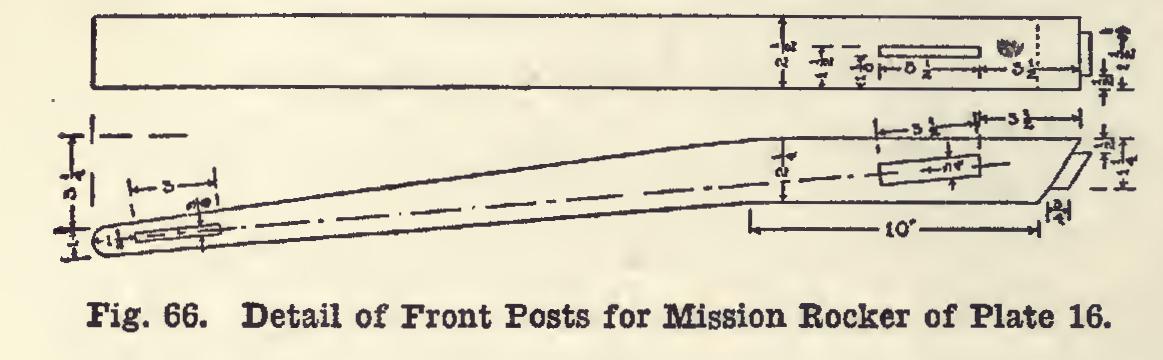
If the legs are to be sawed out by hand, get a piece by or 8 inches by 36 inches. By properly laying out the pieces so that the angles of one shall fit the angles of the other, both may be obtained from this piece.
Work may be begun on the front posts. If the wood is well-seasoned and properly mill planed, the smooth-plane may be set very shal low, and the posts be planed just enough to remove the marks of the plane knives.
To lay out these posts, begin at the top ends, which are supposed to have been cut fairly ac curate when first got out. Turn the 21/4-inch faces up; even the top ends with a try-square; and measure off consecutively of an inch, inches, inches, and 5 inches, leaving of an inch more for the tenon which enters the rocker. Square light, sharp pencil lines across both pieces at these points. Next separate them, and square these lines on the other marked faces of each piece.
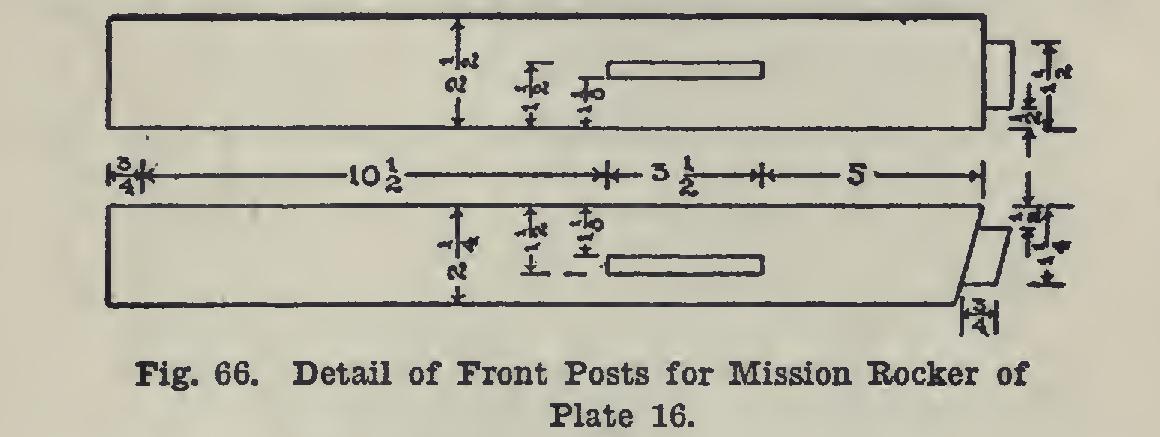
Set the gauge to inches, and gauge from the marked faces, between the marks which are inches apart on each marked face of each post. Now set the gauge to inches (Fig. 66), and repeat.
All mortises in the posts are to be chiseled to a depth of inches.
The tenons on the lower ends of the posts would best be laid out and cut after the frame has been put together.
One set of mortises on the back posts can be similarly laid out. Place the pieces side by side, with the front face surfaces up, and even the top ends. Measure from the top 2 feet 4Y, inches, inches, then inches again. Square sharp pencil lines across both pieces at these points, and gauge from the inside face edges, as was done on the forward posts (Fig. 66).