A Mission Chair
inches, legs, square, length, piece, rails and width
A MISSION CHAIR A mission chair of ample proportions is illustrated in Plate 11 (A). It is not a difficult piece of furniture to construct. Any craftsman who has had some experience in making the mortise and tenon will find this chair well within his ability. The chair, a photograph of which is shown, was made by a boy of fourteen, and was a piece of furniture that any one might be proud to own. The cushion was purchased at an upholsterer's, and is of art leather of a color to match the rich brown Flemish finish of the wood.
The four legs are of the same length, and may all be got from a plank mill-planed to one and three-quarters inches. A piece five and one-half feet long, six And one-half inches wide, will answer.
The rails are all of seven-eighths-inch mill planed stock. One board six inches wide by ten feet long, also one board five inches wide by seven feet long, should be procured. If the lum ber is to be purchased at a yard, it will be better to call for two ten-foot pieces of six-inch, as the order will be more easily and just as cheaply filled.
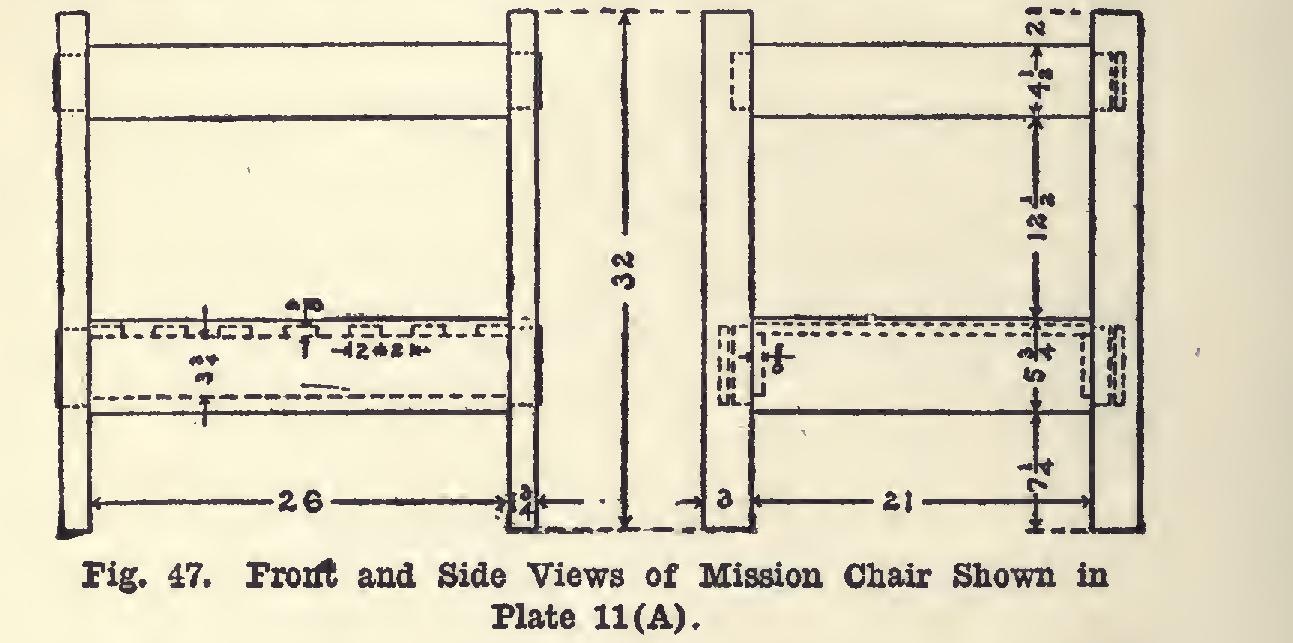
For slats (Fig. 47), three-eighths-inch stock should be used. A piece that will dress to two inches in width, with a length of fourteen feet, will be necessary.
For the pieces to which the slats may be fastened, get a piece of five-eighths-inch stock four inches wide by five feet long.
Square up the four legs in the usual manner. If the plank is not warped badly, set the smooth ing plane blade very shallow, and smooth the two broad surfaces before ripping out any of the legs. The rest of the operation will then consist of straightening one edge and squaring it to the working face, gauging, and ripping. This should be repeated until the required number is obtained, after which the rough edges may be planed to the gauge-lines. If the plank is badly warped, it will be necessary to level each work ing face separately.
Plane a very slight bevel on what is to be the lower ends of the legs, and one of an eighth of an inch on the top ends. The bevel on the lower ends will prevent the slivering of the wood. The one at the top is to take off the sharp corners. Square up two rails to five and
three-quarters inches by thirty inches, smooth ing the broad surface to a thickness of seven eighths of an inch; and two rails to the same width, with a length of twenty-three and three quarters inches, smoothing the surfaces as on the previous rails. Square up one rail to four and one-half inches by thirty inches, smoothing the surface for a thickness of seven-eighths of an inch; also two rails to the same width and thickness, with a length of twenty-three and three-quarters inches.
Square two pieces of five-eighths-inch stock to a width of three and three-quarters inches. Smooth the broad surfaces, and square one end. As these pieces will need to be fitted in place after the frame has been put together, the re maining ends need not be squared at this time.
The length should be slightly over twenty-six inches; a quarter of an inch will give sufficient saw hold.
The slats should be smoothed and squared to a width of two inches. One end of each should be squared, the remaining ends being accurately cut when they are fitted in place. The length of these slats, seven in number, should be slightly over twenty-three and one-quarter inches.
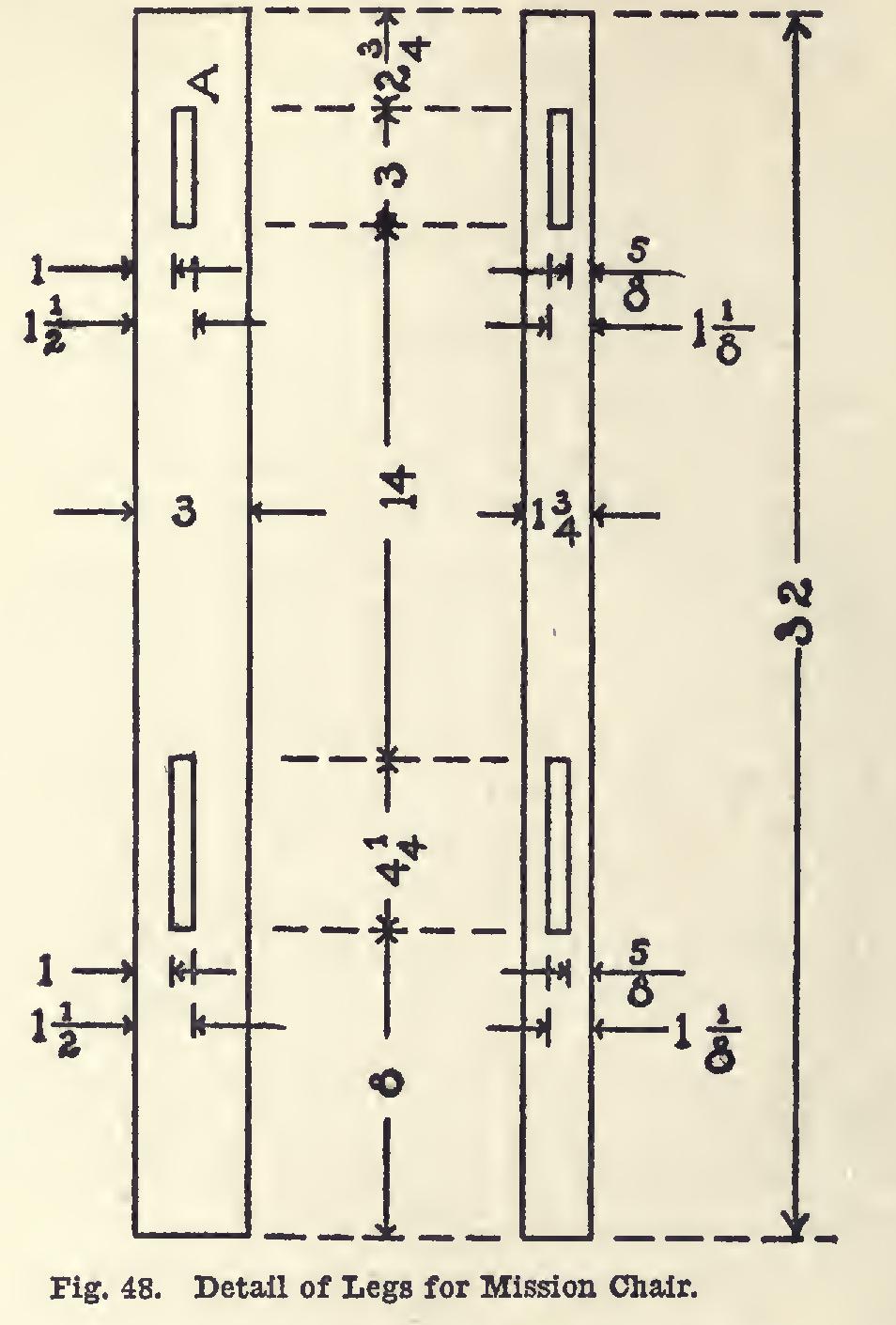
Now lay out the mortises which are to be cut in the legs (Fig. 48). Place the legs side by side, with the inner edges up, and even the ends by means of the square. Begin at the lower end of one of them, and mark with the knife a point at eight inches. From this point, measure four and one-quarter inches; from the last point, fourteen inches; next, three inches. There should remain two and three-quarters inches from the last point to the end of the leg. At each of these points, square lines across the four legs. If a pencil is used, it should be sharpened so as to make a fine, sharp line.
Next, stand the legs upright in the positions they are to occupy relative one to another, and mark with the pencil in some way to approxi mate the locations of the holes. Keep the marks just made on the inside of the legs. Remember that one rail—hence its mortises—must be omitted at the top. The mortise A, Fig. 48, is on two legs only.