A Morris Chair
inches, legs, gauge, tenons, square, one-half and mortises
A MORRIS CHAIR A Morris chair, nowadays, is almost a house hold necessity. It needs to be used but a little while to make itself appreciated.
The chair in Fig. 53 and in Plate 13 is of substantial construction, and has been found an excellent place for work as well as rest. The broad arms form a convenient place upon which to place writing materials. A drawing or sew board of the usual size will reach from arm to arm, thus placing the work directly in front of the worker. In a second of time the hinged back may be lowered, and the chair becomes an ideal place in which to recline.
It is taken for granted that a home craftsman with skill enough to make this chair has had considerable experience in handling tools.
Square up four legs so that they will measure three inches, by three inches, by twenty-five inches. Be careful to get the working face out of wind and straight. Use the winding-sticks and the straight-edge freely.
Next lay off the mortises for the rails, and the tenons which come on the top of the legs. Place the legs side by side, and even the top ends by means of the square placed against the ends and along the side of one of them. Measure from the top ends one inch, and square a sharp line across the four legs. Again, measure from this line a distance of eleven inches, and square a line across as before, for the tops of the mor tises. From this line, measure four and one-half inches. A line squared across at this point will locate the bottom, or the lower ends, of the mortises. There should remain eight and one half inches to the lower end of the legs. With the try-square held against the working face and joint-edge, carry these lines around the pieces.
Before marking the sides of the mortises and tenons, set the pieces upright and in the posi tions they are to occupy relative to one another, taking pains to place the best surfaces where they will show most; and indicate the ap proximate locations of the mortises.
The front and back rails extend entirely through the legs. The side rails do not enter at all. The mortises, therefore, are on the side surfaces only of the legs.
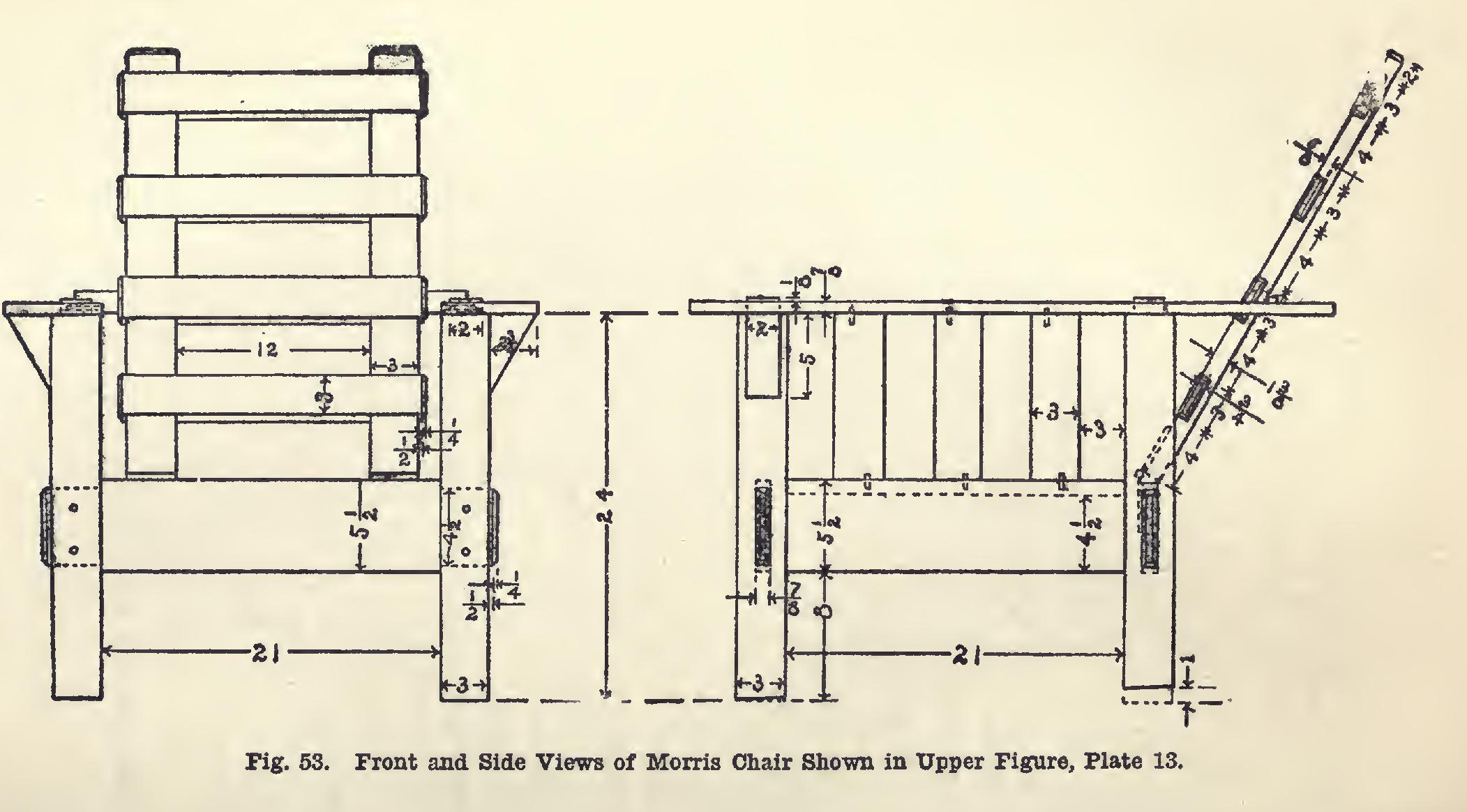
Set the gauge first at one and one-sixteenth inches, and gauge all mortises. Then set one and fifteen-sixteenths inches, and gauge again, keeping the gauge-block against the same surfaces as before.
For the tenons at the tops of the legs, set the gauge first to one-half an inch, and gauge on each of the four surfaces, also the ends. Set to two and one-half inches, and repeat. Do not make the mistake of gauging a surface from one side, or edge, then from the other. The gauge must be reset, and the gauging on any one sur face done from the same edge.
To cut the tenons, place the leg upright in the vise, and, with the tenon saw, rip along the gauge-lines. Keep the saw cut, or kerf, entirely upon the waste wood, but against the line. Next, place the piece on its side, and crosscut around the four sides to form the shoulders. Nothing less than the best will do, and the shoulders must be squared to the sides of the legs with accuracy.
Bevel the ends of the tenons about one sixteenth of an inch.
The slope on the bottoms of the legs is not to be put on until the chair has been put together.
Square up two pieces—one for the front rail, and one for the back rail—to seven-eighths, by five and one-half, by twenty-eight and one-half inches.
Place them side by side, with the edges up; even the ends, and square lines across the edges three and three-quarters inches from each end. Carry each of these lines across the faces and onto the other edge. Gauge the tenons by set ting the gauge first to one-half an inch, then to five inches. Rip carefully to the gauge-lines, and crosscut to meet these lines. These tenons, it will be observed, have shoulders on the edges only.
With the pencil gauge, gauge and bevel the ends of the tenons to one-quarter of an inch.
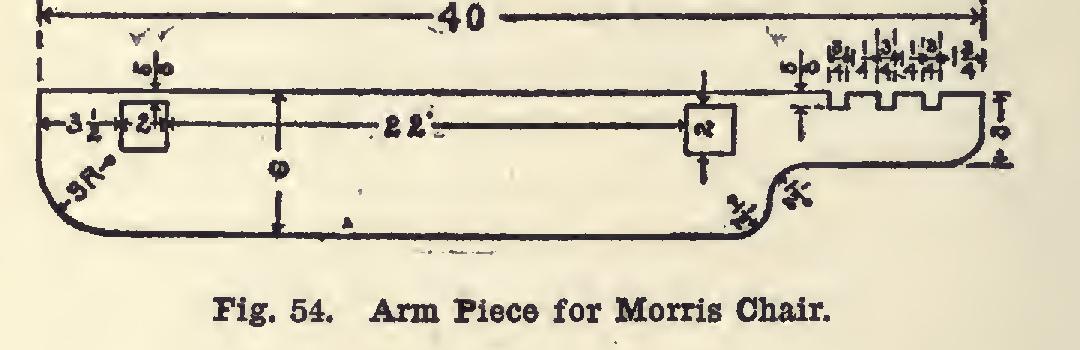
For the side rails (Fig. 55, upper part), square up two pieces seven-eighths, by five and one-half, by twenty-one inches. Also square up two pieces to be fastened to the ones just de scribed, seven-eighths, by four and one-half, by twenty-three and one-eighth inches.