A Plant Stand or Pedestal
piece, surface, inches, top, pieces, test and wind
A PLANT STAND OR PEDESTAL The stand illustrated in Plate 24 will require much less time in the making than most of the articles recently described. It is comparatively simple in its construction, and has but one joint that will require more than ordinary care. The piece is intended for a plant stand. Its height makes it quite suitable for plants such as ivy, which grow down over the sides of the recep tacle, rather than in an upward direction. It may be used equally well as a pedestal for statuary or vases. The wood should be well seasoned to prevent its warping. Oak, red or white, will work up well, finish nicely, and stand rough usage about as well as any other kind of wood. Chestnut finishes nicely; but, as it is soft, it is hardly suitable.
For the cross-pieces which form the base, se cure two pieces of such a size that each may be squared to one and three-quarters by one and three-quarters by twenty inches. The post or upright will be finished to the same thickness and width, with a length of thirty inches.
If the wood is thoroughly seasoned so that it will be straight and out of wind when finished, these pieces might be ordered mill-planed to width and thickness. Otherwise, they should be ordered in the rough, sufficiently large—in this case, two inches by two inches—to allow for straightening.
The brace will require four pieces mill planed to a thickness of one and one-eighth, with a width of four inches and a length of six inches.
For the top, two pieces of three-quarter-inch stock, such that one can be squared to twelve inches each way, and the other to nine inches each way.
Begin work by removing the mill marks from the two parts which are to form the top, using smoothing plane and scraper steel. First, plane a joint-edge. Second, mark the width with the panel gauge; the ordinary gauge will not be long enough. Third, work to the gauge line. Next, square one end to joint-edge and to working face. Next, measure the length from this end. Then square knife lines across the face at this point, and plane or saw, and then plane to the knife line.
If the stock was not obtained with its sur faces mill-planed, the first surface must be leveled as well as planed smooth. A sufficient test for trueness when the surfaces are as broad as these, is obtained by placing a straight-edge upon it in four directions and looking towards the light to see whether or not any light can be seen between the surface of the board and the under edge of the straight-edge. These four
directions are lengthwise, crosswise, and along the two diagonals, that is, from corner to corner. When the surface is true or level, no light can be seen with any of these tests.
The under side of the twelve-inch top piece should be chiseled out at the center so that it may receive the head of the lag screw which passes through the lower piece into the upright (Fig. 114).
The sides of this opening should be cut down plumb, and the opening should be made but slightly larger than the head of the screw.
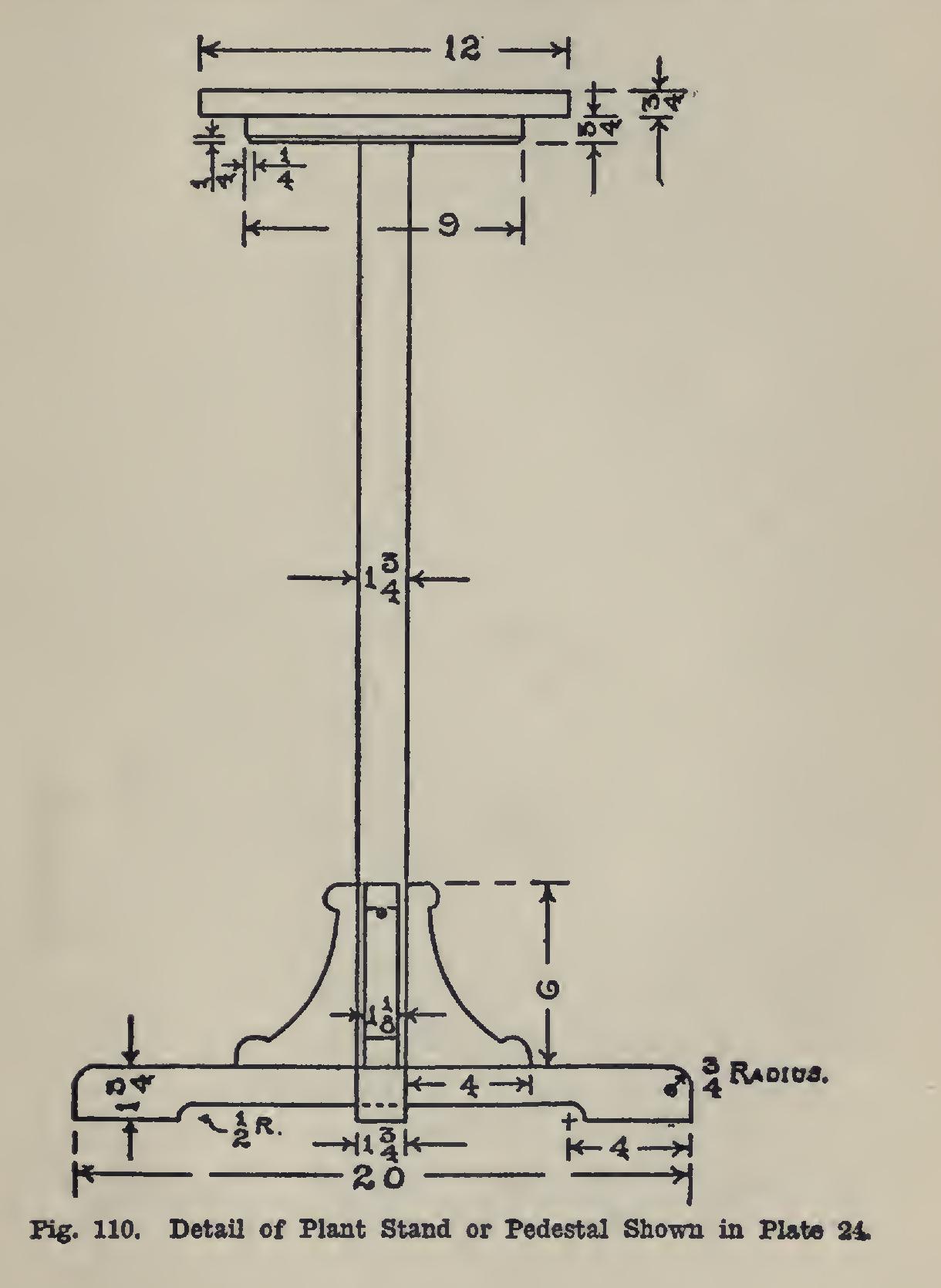
The piece below the top may have a one quarter-inch bevel on its under side (Fig. 110). Through its center there should be bored a one quarter-inch hole. Since this piece is an oblong, its center is most easily found by drawing the two diagonals—or at least enough to determine the point at which they will cross.
One inch from each edge, at the corners, there should be bored and countersunk from the under side of this nine-inch piece, holes for screws that shall pass through it up into the under side of the top. As they are not easily seen, flat-head bright screws may be used.
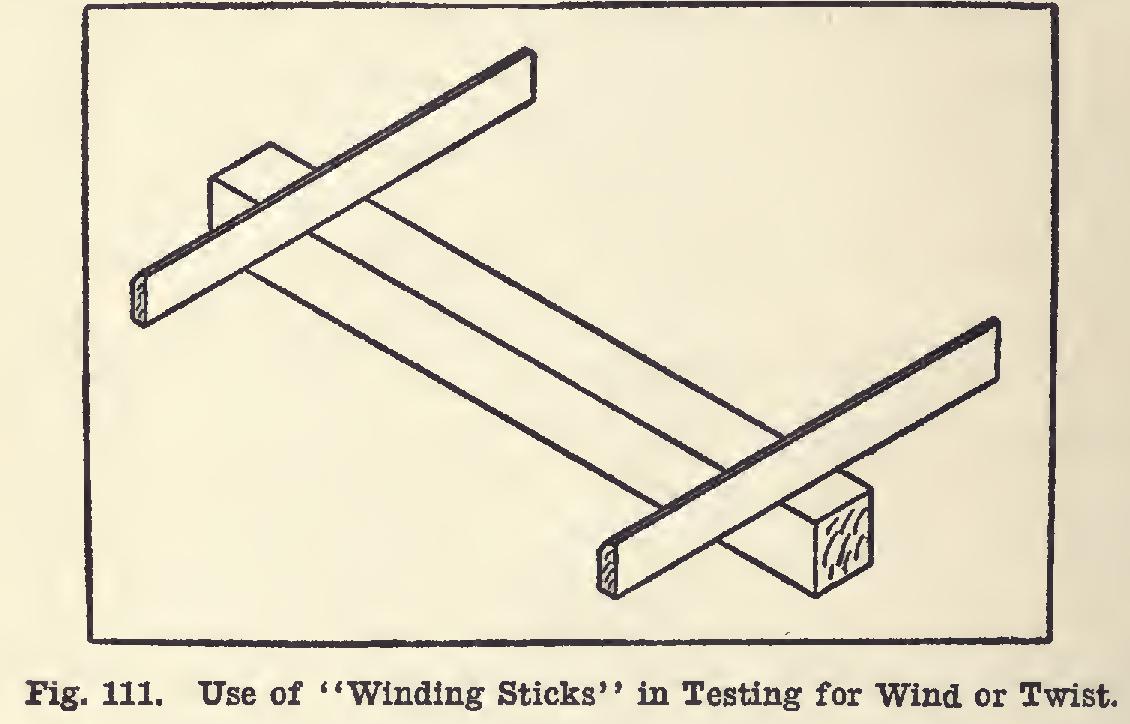
The upright may next be made. If in the rough, it must be straightened and squared. This is done in the usual way, with one excep tion. In testing the first surface, the narrow ness of the piece necessitates some test other than along the diagonals to determine whether or not the surface has wind or twist. This is done by placing two sticks, called "winding-sticks," as in Fig. 111, and sighting over their tops. These pieces are planed straight, and their edges are parallel. If the surface is out of wind, the top edges of the sticks can be made to sight as one; if not, one end of one stick will seem high with reference to the other stick, no matter what the position of the eye. This will show where the piece of stock must be planed. The test for straightness across and along the surface must be applied also. The above test is for wind only.