A Porch Swing
inches, rails, slats, tenons, one-half and mortises
The tops of the posts are to slope thirty degrees, or any other angle that may be desired.
The tenon at the lower end of the post is to be three-quarters of an inch square, and is ob tained by gauging one-half inch from each of the faces, then one and one-quarter—saw it out with the tenon saw.
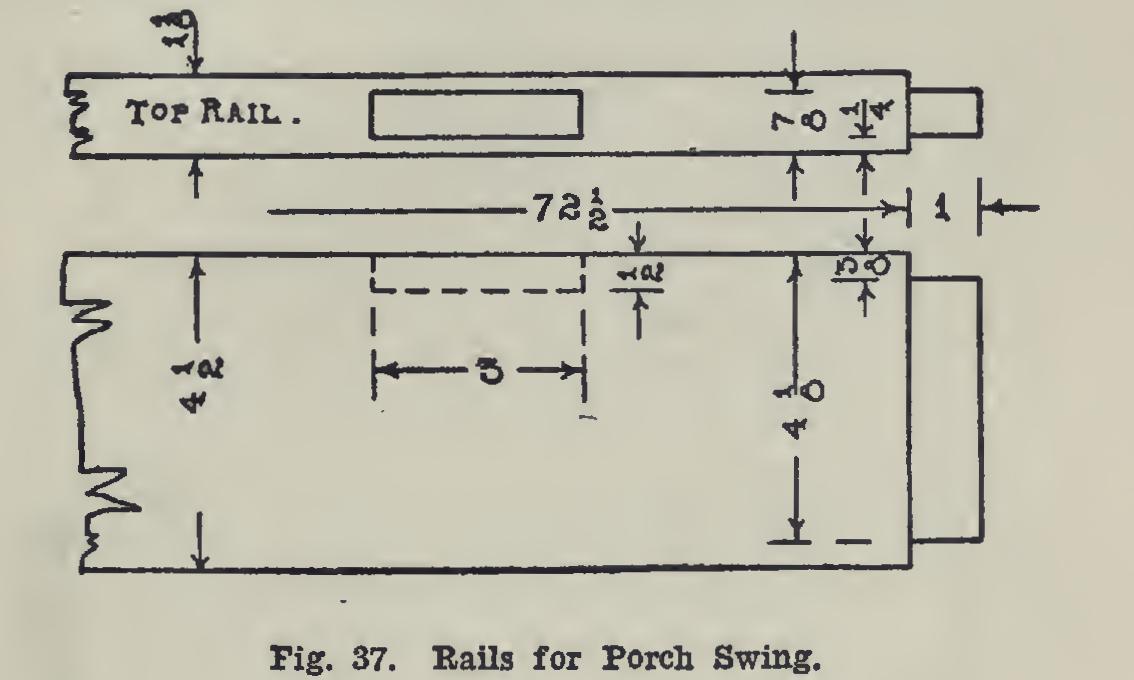
The back rails should be laid off together. The length of the long rails, including the tenons, is to be seventy-four and one-half inches. The ends should be sawed square. Measure from the middle towards either end thirty-six and one-fourth inches to locate the shoulders of the. tenons, or place them alongside the base. The ends of the mortises for the slats are to be laid off as follows: To either side of the mid dle of the length of the rail, lay off and mark lines across the joint-edges as follows: one and one-half inches, then measure from this, alter nately, first, four and five-eighths, then three inches, out to the shoulders. These measure ments allow for a three-eighths-inch shoulder on each edge of the tenons of the slats, making the openings between the slats three and seven eighths inches.
The four end rails should be laid off before any of the tenons of the long rails are laid off. Their entire length is to be twenty-four and one-half inches. The distance between shoul ders is to be twenty-two and one-half inches. They are one and one-eighth inches thick.
The ends of the mortises of the slats are located thus: Measure to either side of the mid dle of the length one and one-half inches; then from this, measure first three and three-eighths inches, then three inches; this allows three slats to each of the ends. The photograph shows a fewer number of slats in both ends and back than are here specified. If fewer are desired, the proper spacings can be readily figured.
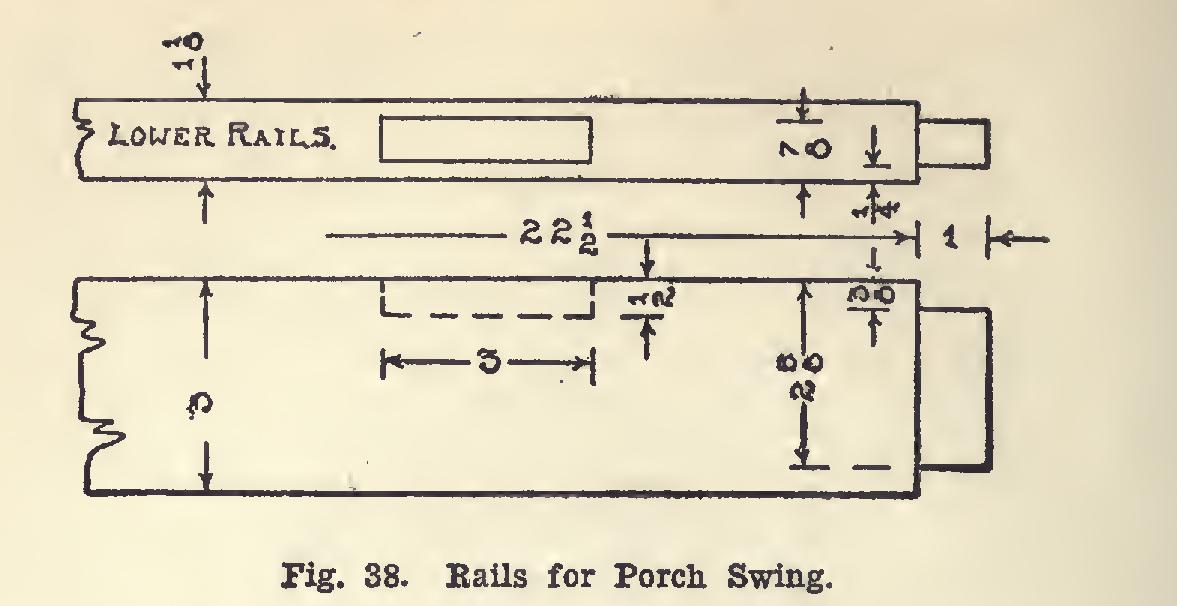
The sides of these mortises are obtained by gauging first to one-quarter, then to seven eighths, gauging from the working faces, the inside faces.
The thickness of the tenons for these pieces is obtained with the same settings and should be made at the same time the sides of the mor tises are being marked.
For the wider rails the width of tenon is obtained by setting first to three-eighths, then to four and one-eighth inches (Fig. 37). For the narrower lower rails, the settings are three eighths, then two and five-eighths inches (Fig. 38). These mortises are to be cut one-half an inch deep.
It will be necessary to miter the ends of these rails slightly; the amount can be deter mined by a trial fit.
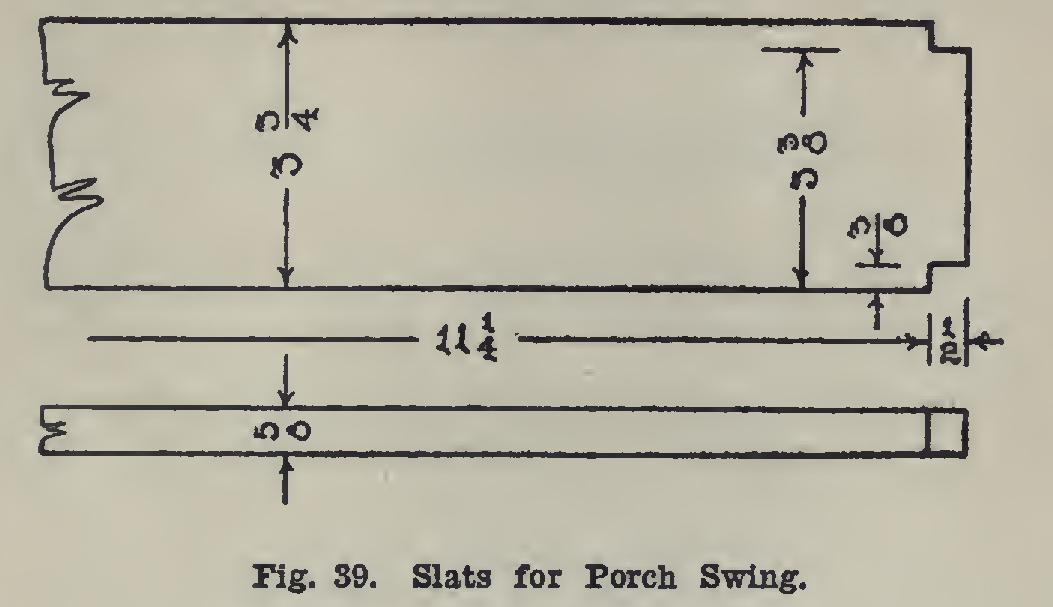
The slats are shouldered on the two edges only, gauging first three-eighths of an inch, then three and three-eighths inches. The dis tance between the shoulders is to be eleven and one-quarter inches, and the tenons are one-half an inch long (Fig 39).
Before assembling the parts, they should be sandpapered clean and smooth. The slats in the back may be glued, placed, and clamped, after which the slats, rails, and posts of the ends may be put together. While the glue is hardening on these, the base may be assembled, being doweled or nailed as suggested above. The bottom of one-half-inch boards is to be fitted to the rabbets and nailed fast.
With the setting of the glue, the back may be glued to the ends, and the posts to the base.
Since porch swings are exposed to all kinds of weather, it might be well to reinforce the glue joints by pinning the tenons in the mor tises. Three-eighths-inch dowel pins placed through the mortises and tenons will insure the swings standing the most severe usage.
The photograph (Plate 7, B) illustrates quite well the manner of fastening the support ing chains. The staples extend entirely through the base rails, and have nuts on the under side.