Hall Clock of Mission Design
inches, posts, square, measure, inch, pieces, slats and gauge
HALL CLOCK OF MISSION DESIGN It is very important that only straight grained, well-seasoned oak should be used in making the hall clock illustrated in Plate 21 (B) and detailed in Fig. 104. Begin by squaring up the sides of the posts to an inch and three-quar ters each way. Time and much labor are saved by getting a plank planed on two sides to an inch and three-quarters. Then all you need do is to straighten and square one edge, gauge and rip, and square up the remaining edge. Repeat until you have the four posts. The mill marks can be easily taken off when you scrape them just before putting together. Miter the tops to forty-five degrees on the four sides, and plane smooth. Measure the length, seventy-eight inches, and square off the lower ends. These ends are shaped on every side one-eighth of an inch back, and four and one-half inches up. The cross-bars can be got out of the one and three quarter-inch plank, as were the posts, by setting the gauge to one and one-eighth inches. There will be eight of these bars sixteen inches long, and eight of them twelve inches long. The de scription which follows is for a square butt joint doweled; but a better construction is the stub tenon as in the two preceding clocks. The slats can best be got out of lumber planed on two sides to three-eighths of an inch thick. There should be three pieces fifty-five and three-fourths inches long by two inches wide; four pieces twenty-five and three-fourths inches long by two inches wide; and four pieces twenty and one-half inches long by two inches wide. After the ends of these pieces have been squared up, the corners may be cut off, measuring down on the narrow edge and back on the ends one-quarter of an inch each.
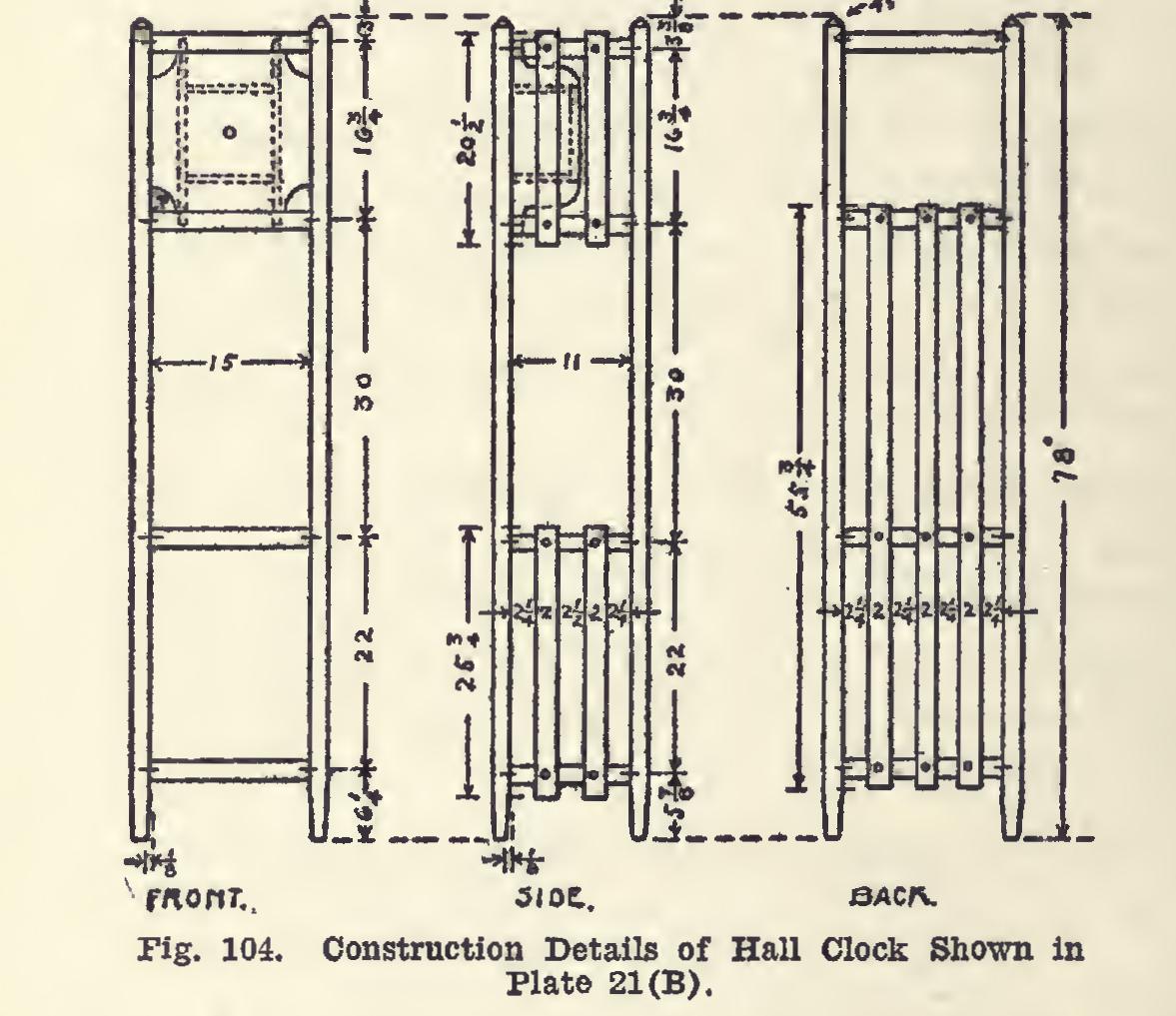
Place the four posts in the positions they are to occupy relative to one another, placing the best pieces where they will show most. Then, as you usually mark the better surfaces X X when you are squaring up the pieces, you ought to be able to get the best surfaces where they will show most, by placing the X X marks forward and out. With the four posts marked so that you can tell where they are to go—as "back left," "back-right," "front-left," "front-right" —place them side by side with the forward faces up. With the square, even the top ends. Begin at the topmost point of one of them, and measure down three and three-eighths inches, and square a line across the four posts; measure from this line sixteen and three-fourths inches, and square a line across all four posts; measure again thirty inches, and repeat; then, twenty-two inches, and repeat. If the measuring has been correctly
done and the posts are of the right length, there should remain five and seven-eighths inches.
Now place the posts side by side as before, but have the outer side surfaces, instead of the forward surfaces, up. Even the ends with the square, so that the lines you have just placed on the posts are square across. This time, measure three inches, beginning at the point, and square a line across the four posts; the other measure ments are as before, except the remainder at the bottom, which will be six and one-fourth instead of five and seven-eighths inches. Set the gauge to one-half the width of the posts, and gauge on each line for the middle. Be careful not to gauge so far that the bolt-head will not cover. Bore all of these holes with a three-eighths-inch bit. The front bars will be three-eighths of an inch higher than the corresponding side bars, in order to allow the lag screws to pass each other. Gauge the ends of the cross-bars to find the center; or draw two diagonals, and bore two inches deep into the ends with a quarter-inch bit.
Dowel the ends; then scrape and sandpaper the posts and cross-bars, and put the framework together, using lag screws three-eighths of an inch by four inches. Use washers. Care should be taken not to pull the threads off the wood by con tinuing to wrench after the bolt is as tight as it need go. A cross-bar can be held in the vise while the screw is being put into it, by beginning the work at one end of the post and working towards the other. The slats are to be fastened in the cross-bars with three-quarters byone-eighth-inch round-head blued screws. Holes large enough to allow the screw to pass through easily, should be drilled in the slats. On the longest slats, measure one and seven-eighths inches for the first hole; then thirty inches from this for the next; and twenty-two inches from this for the bottom one. On the four slats next in length, measure from one end one and seven-eighths inches; then, from this, twenty-two inches. On the four shortest slats, measure from one end one and seven-eighths inches; then sixteen and three-quarters inches. After boring, scrape, sandpaper, and put in place as indicated on the drawing, Fig. 104.