Stand
line, tenons, lines, top and inch
The tenons on the shelves are laid out by measuring from each end each way two and one quarter inches, Fig. 2, and squaring knife lines entirely around the pieces at these points. Place all four pieces in the vise; even the ends; and square across the four edges at once to insure their being all of the same length. They can then be separated, and the lines carried around each end of each piece.
The gauge marks should be carried over the ends and on each of the two surfaces. If the shelves are narrower than the sides, do not fail to make due allowance in setting the gauge.
Before cutting the tenons, lay out the mor tises for the keys. The first line is to be twenty three thirty-seconds from the sholder lines of the tenons, and is to be placed on both sides of the shelf. The next, one-half an inch farther out, measured on the top side of the shelf, and three-eighths measured on the under side. If a long key is to be used, this will be found to give too much slope, in which case the lower line should be moved out a sixteenth more.
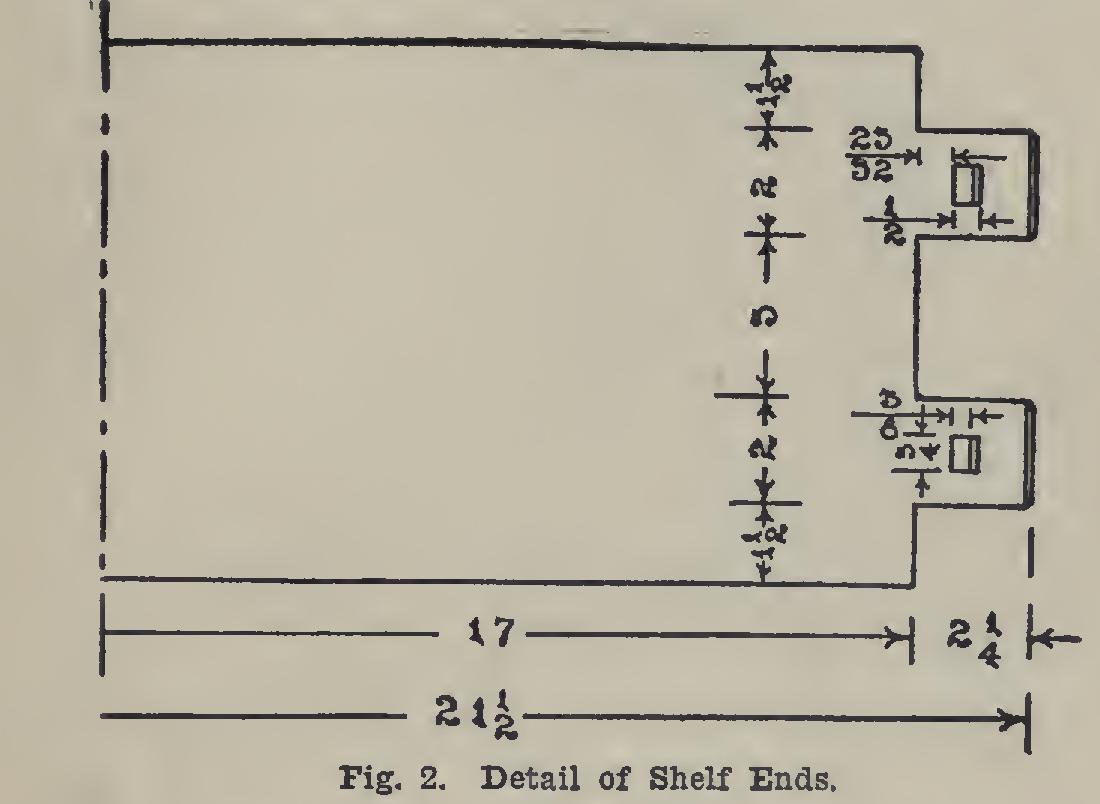
The gauging for the mortises of the keys should be done so as to allow the entrance of a key three-quarters of an inch thick, and should be placed in the middle of the tenons (Fig. 2).
In cutting the mortises in the side pieces, a series of holes almost the width of the mortises should be bored. Bore them so that the holes shall break into each other. Bore and chisel from each side, chiseling from the middle of the mortise out to the lines gradually. One hole of good size will be found sufficient for the mortise in the tenon.
The tenons of the shelf should be cut with the tenon saw, accurately to the line, so that no chiseling need be done. The shoulder between the tenons is to be got at by boring a hole on the waste wood, and inserting a keyhole saw here. Keep the saw kerf at least a sixteenth of
an inch away from the line. The rest is to be chiseled. Use a broad chisel, and set it in the knife lines. Out from each side of the board.
The keys may be made in any one of a variety of styles. The essential thing is to see that they shall fit their respective mortises without having to be made in different sizes. This may be as sured by proceeding as follows: Plane all the key pieces to the correct width, three-quarters of an inch; joint one edge, and cut the pieces to the length desired. Find the middle of the key's length, and measure toward each end three eighths of an inch. Square lines across at these points. Measure from the jointed edge along the top line one-half an inch, which is the size of the opening that was laid out on the top side of the shelf for the key. Along the lower line, measure three-eighths, or whatever the opening in the mortise on the tenon was made. The front of the key may be made any desired shape, but, whatever the shape, its edge must be made to pass through these two points.
The hand-holes at the top of the stand are three inches long and two inches from the top end. The center of the arc is not on the top line but somewhat above it.
The design at the bottom is to be laid out from a templet or pattern. Make a half of the design freehand, fold on a center line and cut the two parts alike.
A variety of finishes may be had. A pleasing dark finish may be obtained by using any one of the many arts and crafts finishes now on the market. These finishes are especially well suited to a much-used piece of furniture of this kind. Follow directions closely.