Two Tabourets
leg, square, inches and line
Next locate and bore the holes in the shelf. It will be found just as convenient, and will save time, to fasten each leg in place as soon as the holes in the shelves are bored, rather than to mark and bore all the holes before placing any.
Apply two coats of wax, polish in the usual manner, and the tabouret may be considered fin ished.
The eight-sided tabouret (Fig. 9), will re quire two pieces twelve and one-half by twelve and one-half inches for the top and shelf; and four pieces four and one-half by eighteen and one-half inches for the legs. Three-quarter-inch mill-planed oak is to be used. Prepare the sur face as described for the first tabouret.
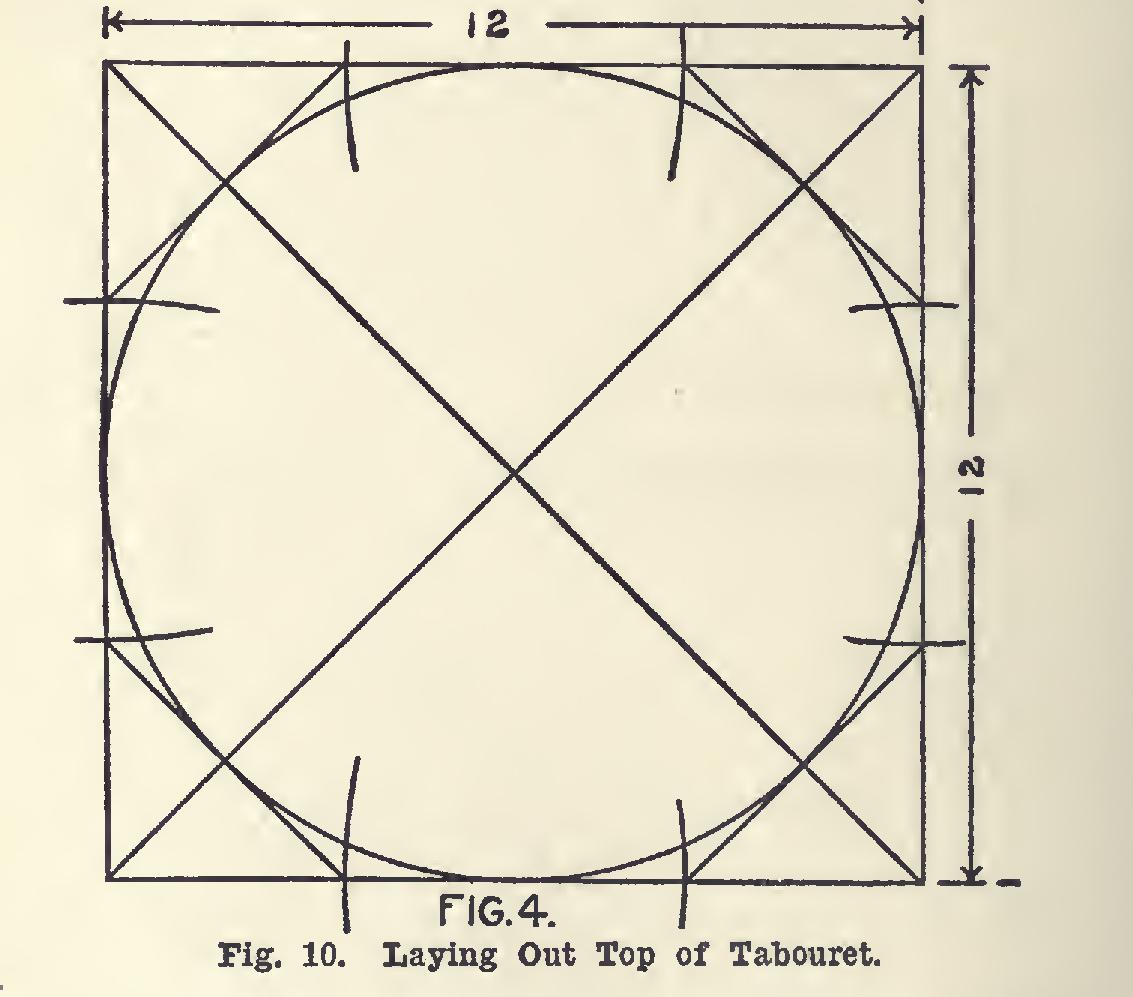
The top and shelf may now be laid out. Square up the two pieces in the usual manner, to twelve by twelve inches. Draw light lines from corner to opposite corner to locate the center (Fig. 10). Next set the dividers so that the distance between the points shall be equal to one-half that of the diagonal, or equal to the distance from the center of the square to one of its corners. Set one point of the dividers suc cessively on each corner of the square; and with the other, cut the sides of the square. Connect the points at which the sides of the square were cut, and the octagon is formed.
The circle (Fig. 10) suggests another way in which tangents to an inscribed circle complete the sides of the octagon.
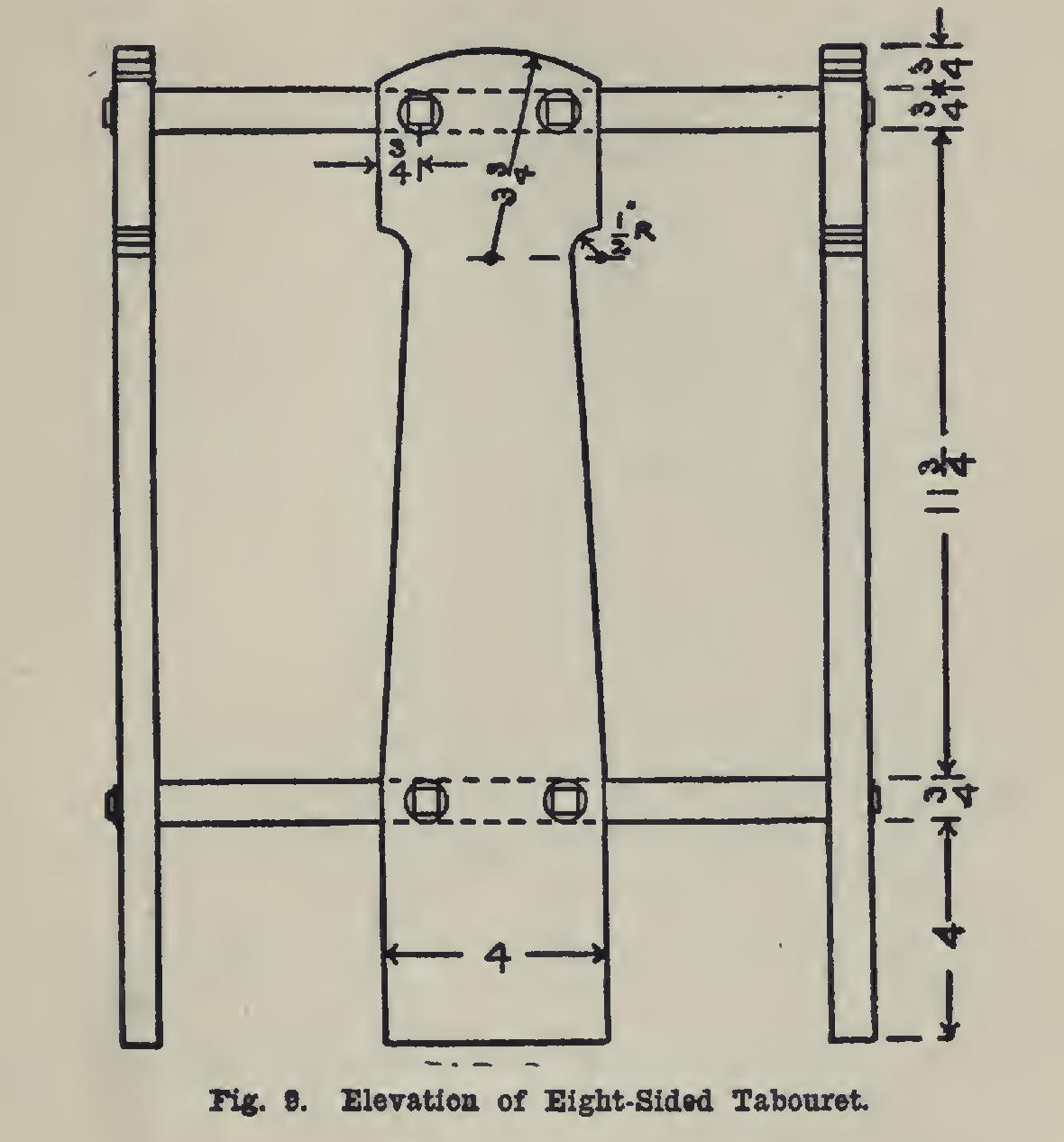
For the legs, plane one edge of each straight and square; gauge to four inches, and plane the remaining edge to these gauge lines.
Having located the middle of the leg with a straight line near the top, set the dividers to three and three-quarter inches, and, with one point on this center line, describe an arc of a circle which shall reach almost to the end of the piece.
From the top of this arc, measure eighteen inches, and square a line across for the bottom of the leg.
To lay out the sides of the leg, measure from the bottom four and three-quarter inches, and square a light pencil line across the face. At the top of the leg, square another light line across, at the point from which the arc at the top of the leg was described. Set the dividers to one-half an inch radius, and, with one leg of it centered on the intersection of the pencil line last drawn and the edge of the leg, describe an arc of a circle on each of the sides successively. Connect these arcs by straight lines to the points where the light pencil line, squared across three and three-quarter inches from the bottom, intersects the edges of the leg.
Cut out the curves with the turning saw, and the straight lines with rip or crosscut saws. Smooth with spokeshave, and scrape.
The staining, filling, and finishing are to be done as described for the preceding tabouret. The parts also are assembled in a similar man ner, lag screws one-quarter inch by two and one quarter inches being used in each case.