Fittings for Windows and Transoms
sash, transom, fastened, fig, hold and bottom
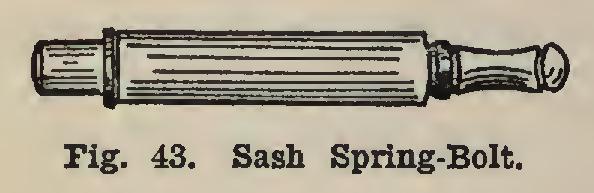
Fig. 43 shows a type of sash spring-bolt which was used at one time as a protection, and also as a means of holding a sash without weights at any desired height of opening.
Many patented forms of fasteners which are applied to the side rail of a sash are to be had, but their merits in many cases are doubtful. One form of side rail fastener which allows the sash to be raised by inches and held in place at each point, consists of a bar fastened to the side rail of the top sash and containing pockets cut to fit the head of a spring bolt which is fastened to the top of the bottom sash. By pulling this spring bolt clear of the first pocket, the lower sash can be raised a few inches for ventilation and held in this position by the bolt head enter ing another pocket in the bar.
For cellar windows, which are generally hinged at the top of the sash and fastened at the bottom, Fig. 44 shows a common form of fastener. These windows should swing inward, and are in most cases provided with a hook which can be fastened into an eye in the wood work of the floor above. The turning part, as shown in the figure, is fastened to the sash, while the catch is fastened to the sill or frame.
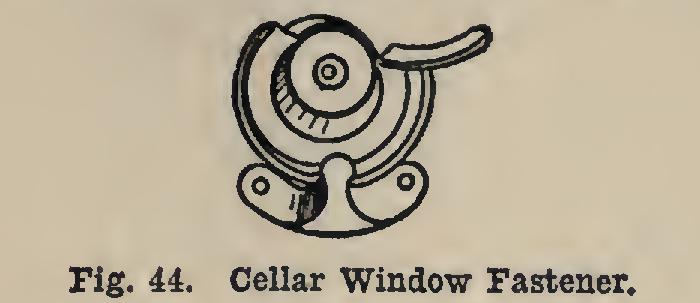
Another form of fastener consists of a swing ing bar pivoted like the cam in Fig. 44. In this fastener the bar part is fastened to the sill or frame, and turns up over a plate having a handle connected and fastened to the sash. This affords a handle for raising heavy sash or starting a sash which has stuck.
If a single sash window hinged at the side is used, a casement adjuster should be employed to hold the window at any desired angle of open ing. These adjusters consist of a pivoted bar and a clamp. The pivoted end of the bar is screwed to the bottom rail of the sash, while the clamp is made fast to the sill. Such a win dow should be arranged so as to swing outward, and care should be taken that the clamp is always tightened on the adjuster.
Special bolt fasteners are used in this type of sash. They are of both rim and mortise type.
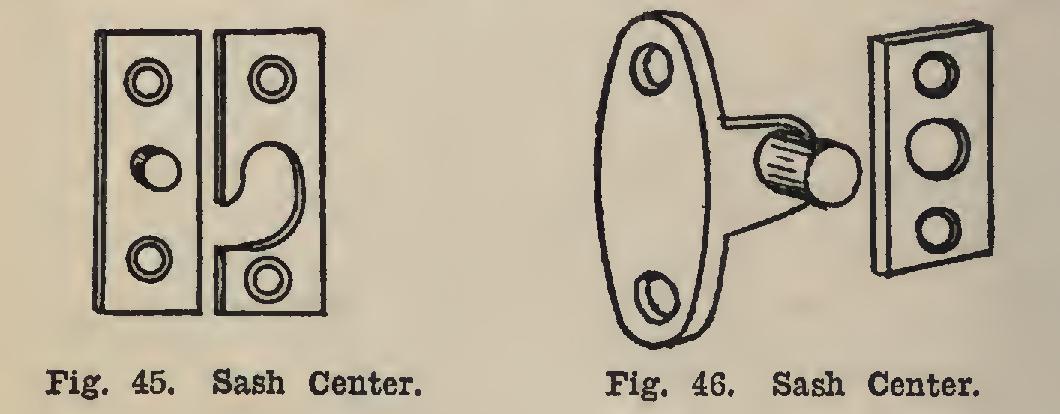
' When swinging transoms over doors are used, they are either top-, bottom-, or center-hung. For top- or bottom-hung transoms, regular butts are used; but when center-hung, a type of sash center as shown in Fig. 45 or Fig. 46 is neces sary. It is generally believed that a center-hung transom is the most satisfactory form, especially as far as the action of the transom lifter is con cerned. With top- or bottom-hung transoms, the lifter often gives trouble on account of having to lift the weight of the transom sash. This is avoided in a well-balanced center-hung transom as shown in Fig. 47.
A common form of transom lifter, and one which embodies the general principles upon which most of the types on the market are founded, is shown in Fig. 48. An inspection of this figure together with Fig. 47 will explain the mechanism very clearly—a sliding rod pass ing through guides screwed to the door casing; a pivoted arm connected to a plate fastened to the transom sash; and a clamp at the lower end of the rod to hold same in any position.

Although the clamp at the bottom of the rod on the transom lifter is supposed to hold the transom shut, such is not always the case. Fig. 49 shows a catch which represents one of many types used to hold the transom sash shut when such a device is needed. These have but little strength as a protection, and are mainly used to hold the transom closed.
When a transom is not fitted with a lifter and is hinged at the bottom, a form of transom chain consisting of a 14-inch long chain with an attachment at each end for fastening to the door casing and the transom rail, is used to hold the sash in its opened position.