Covering of Roofs
shingles, hip and roof
COVERING OF ROOFS The problem of covering a roof involves in reality two separate problems—first, selection of the kind of material to use (shingles, slate, tile, tin, etc.); second, proper placing of this material. Choice of material will be determined by cost, appearance, durability, fire resistance, etc. The structural application of the material calls for the exercise of special care. The main thing is to avoid the possibility of leaks, even through the water backing up during a driving rain or through the formation of ice in winter.
Shingling Hip Ridges.
In slating or shin gling a roof, great care should be taken at the hips, ridges, and valleys. Where the roof is shingled, two or three courses should be left off at the ridge until the two sides are brought up; then the courses left off should be laid on together, and in such a manner as to have them lap over each other alternately. In valleys, the tin laid in should be sufficiently wide to run up the adjacent sides far enough to prevent back flow running over it. Ample space should be left in the gutter to permit the water to flow off freely. There is a general tendency to make these waterways too narrow, which is fre quently the cause of the water backing up under the shingles, causing leakage and decay.
222 There are several methods of shingling over a hip=ridge; one is the old and well-tried method of shingling with the edges of the shingles so cut that the grain of the wood runs parallel with the line of the hip, as shown in Fig. 158. Here it will be seen that the shingles next to those on the hip have the grain running up and down at right angles with the eave. In Fig. 159 we show a front view of the same hip, which will give a better idea of what is meant by having the grain parallel with the line of hip. abed show the cut of hip shingles and nnnn the common shingles.
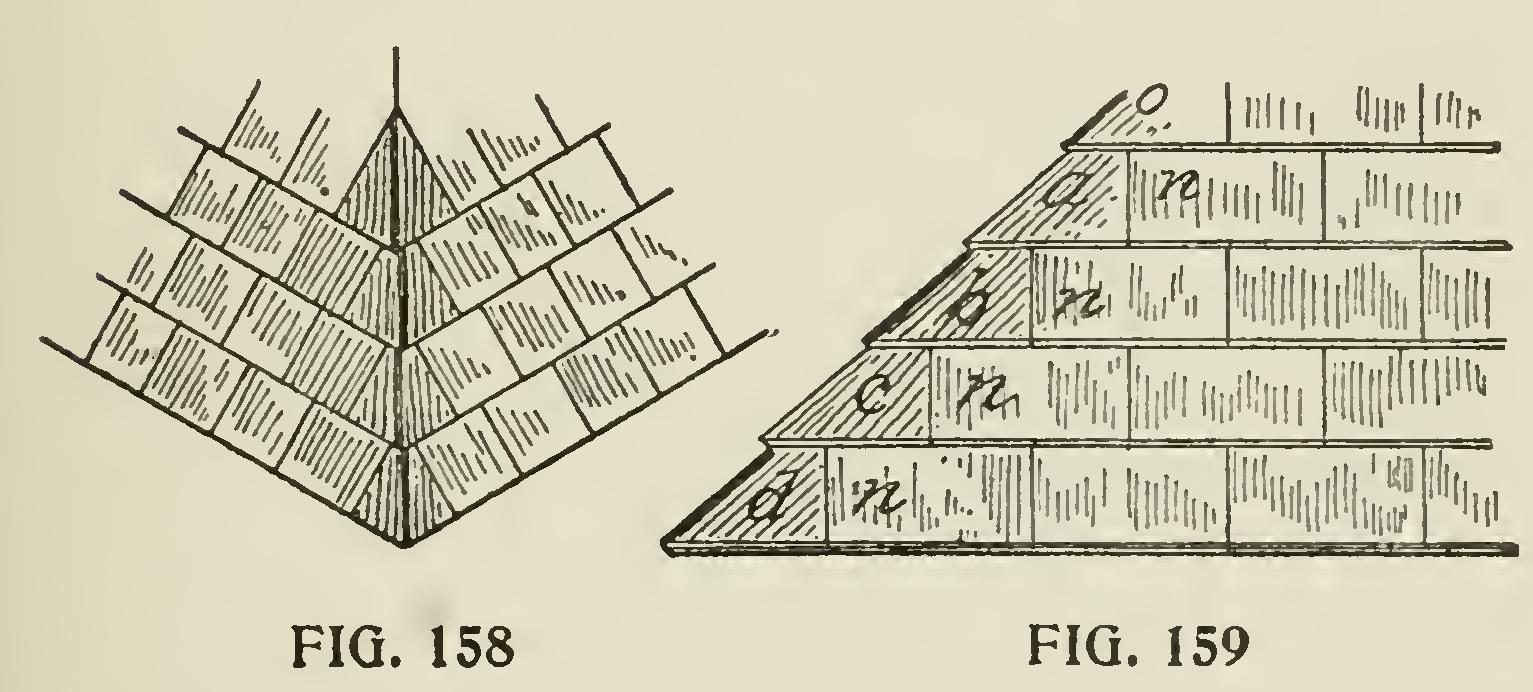
The proper way to put in these shingles is to let the ends run over alternately and then dress them to the bevel of the opposite side of the roof ; this is shown better at obd, where the edges of the shingles are shown that are laid on the other side of the roof, and are not seen in the drawing. Another method now frequently used is to cover the hip with strips of tin ; this is used quite exten sively and found to be one of the best methods in