Elements of House Framing
cut, shown, putting, gable and boards
After the gable rafters are raised, before put ting in the gable studding, cut in a piece of a 2 by 4 long enough to extend from the _plate up the roof as far as the rafters will be plastered.
Put it in flat way directly under the rafter and flush with the outside of rafters, as shown by A and B in Fig. 130. By doing this all those short pieces which are required in the old way are put in at once, with only one cut to make, whereas the old way may require six to eight cuts.
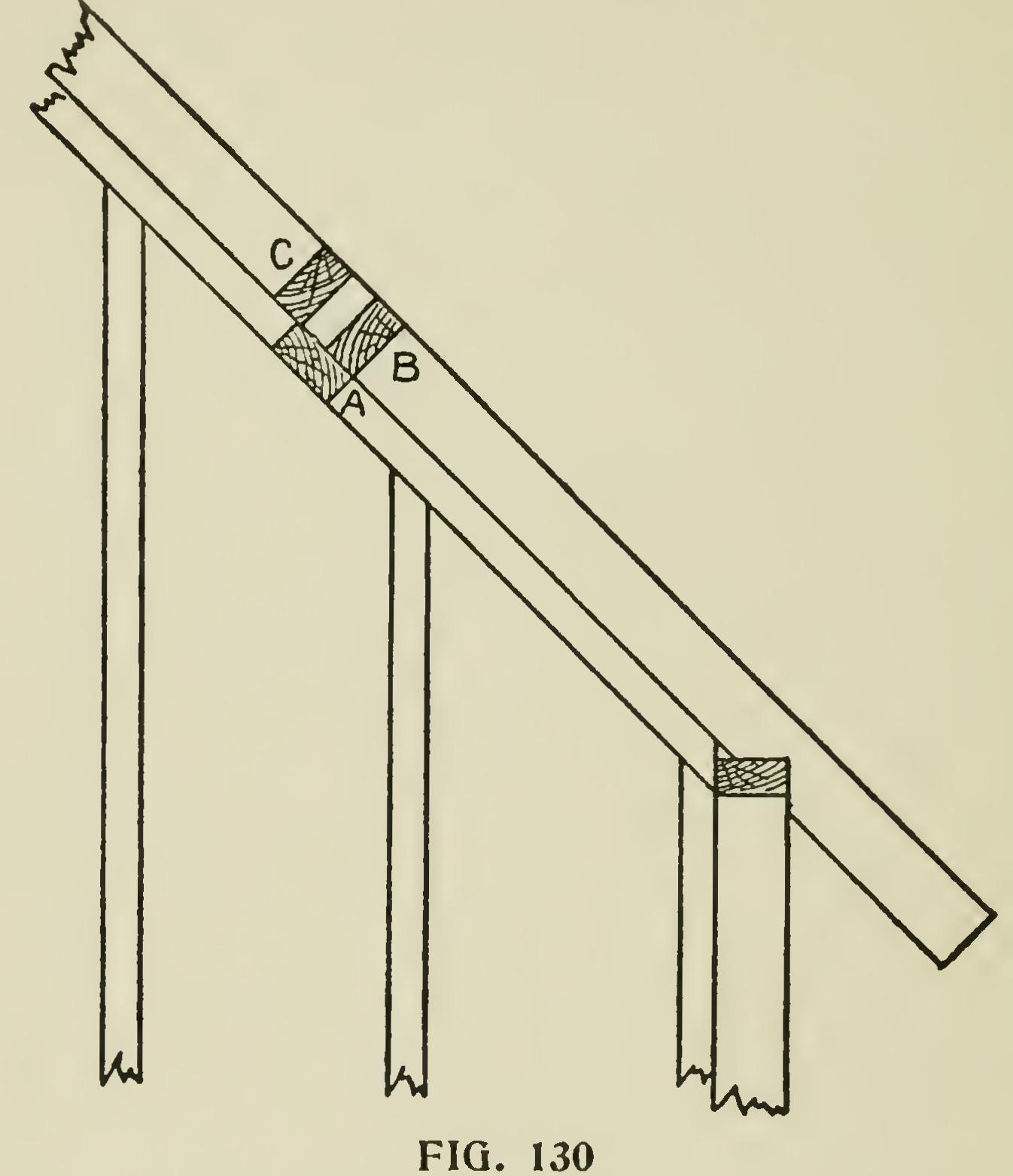
After the 2 by 4, A, is put in under the rafter, then cut in the gable studding in the usual man ner. At B is shown a short rafter which need extend only so far as the plastering goes, and which should be set as shown in the sketch to receive the lath that are nailed to the studding. This is not an extra piece, for by the old method it should be there just the same. The improve ment is in putting in A in one piece as shown, thus doing away with a large number of small and troublesome pieces to cut and nail between the studding, along up the gable.
Putting on Cornice.
In this age of close com petition, contractors cannot afford to work on a building to a disadvantage. In putting on cor nice it is customary for two men to work together; this is all right so far as it goes, for one man can not handle long boards to any advantage.
With many contractors it is the custom to work one good man and one helper, just to hold the boards while the other man does all the cutting and fitting. We do not believe this is profitable, for the reason that the man who has about all the work to do is obliged to climb and chase around from one end of a board to the other and watch every joint and corner to see that it is right. This makes it twice as hard for
him and consumes much more of his time than it would if he had a man to help him who was equally as good as himself. Either man could then cut and fit a joint whenever necessary. In this way one would not be obliged to wait for the other so much. In putting on cornice one has to wait for the other more or less, but this is unavoidable.
On the average job we believe that three men working together will accomplish as much as four men working in pairs. The way to work three men is to have the man who understands the cut ting best, work on the ground, making all the cuts and passing the boards up to the two men on the scaffold to nail on. The boards can be passed up and down and cut on the ground much quicker and better than they can on the scaffold. The men on the scaffold should, of course, have a saw and square and occasionally cut a board for them selves when they can just as well as not; but mainly let the man on the ground do almost all of the cutting. If he understands his business he can make nearly all the cuts right the first cut, and keep the two men on the scaffold constantly at work, and there need be but very little loss of time on account of one waiting for the oth r. In our opinion this way of working is far more satis factory than the way men usually work at put ting on cornice.