Joinery
fig, boards, match and moulded
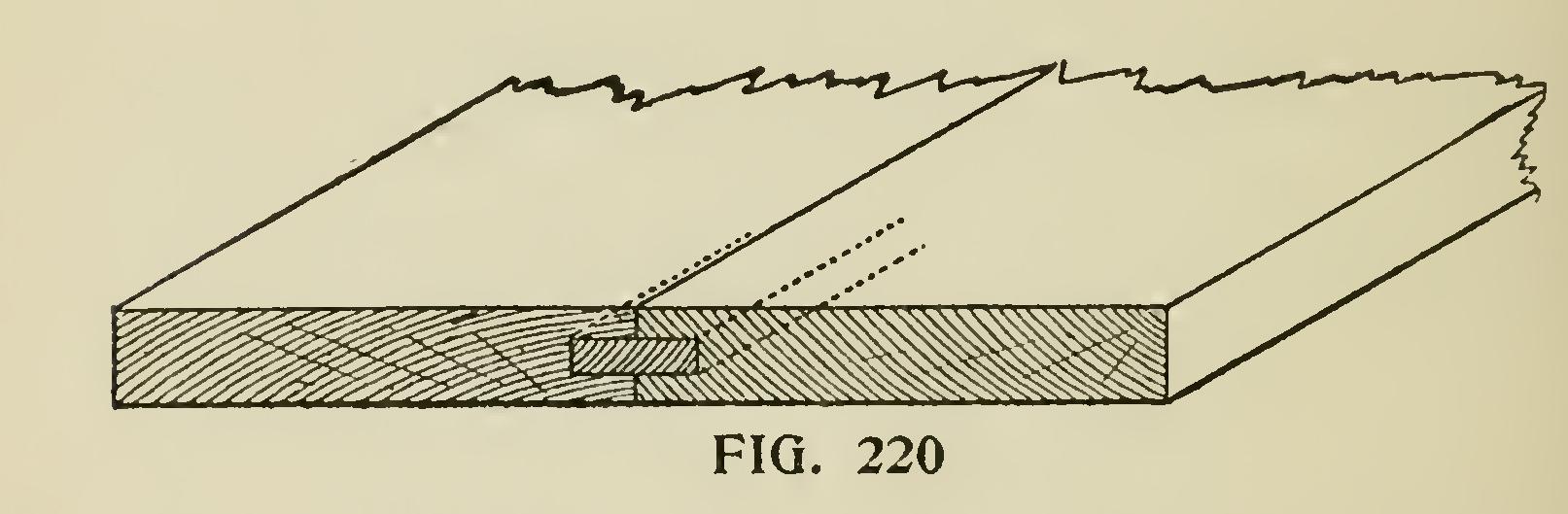
Cross=tonguing is the method of joining two or more boards longitudinally, a loose tongue being glued and let into a groove on each board, as Fig. 220. This loose tongue is sometimes called a slip feather, and is made of wood across the grain. Long tongues have the grain of the wood in the direction of their length.
Clamping
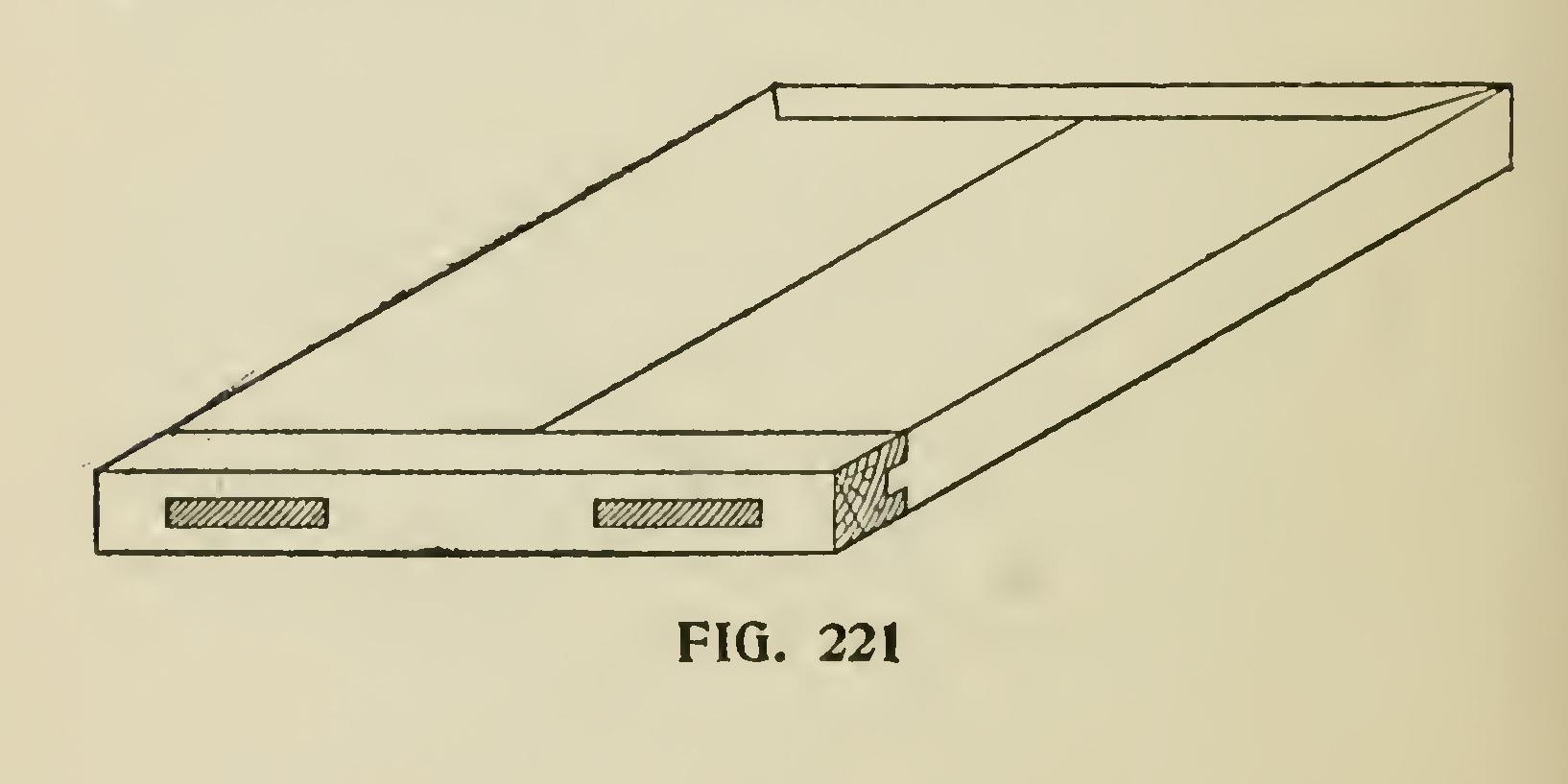
is the method by which the ends of several boards are fastened together, as shown on the left hand of Fig. 221, while the right hand side of the same figure illustrates miter-clamping, by which the cross-grain end of the ordinary clamping is obscured.
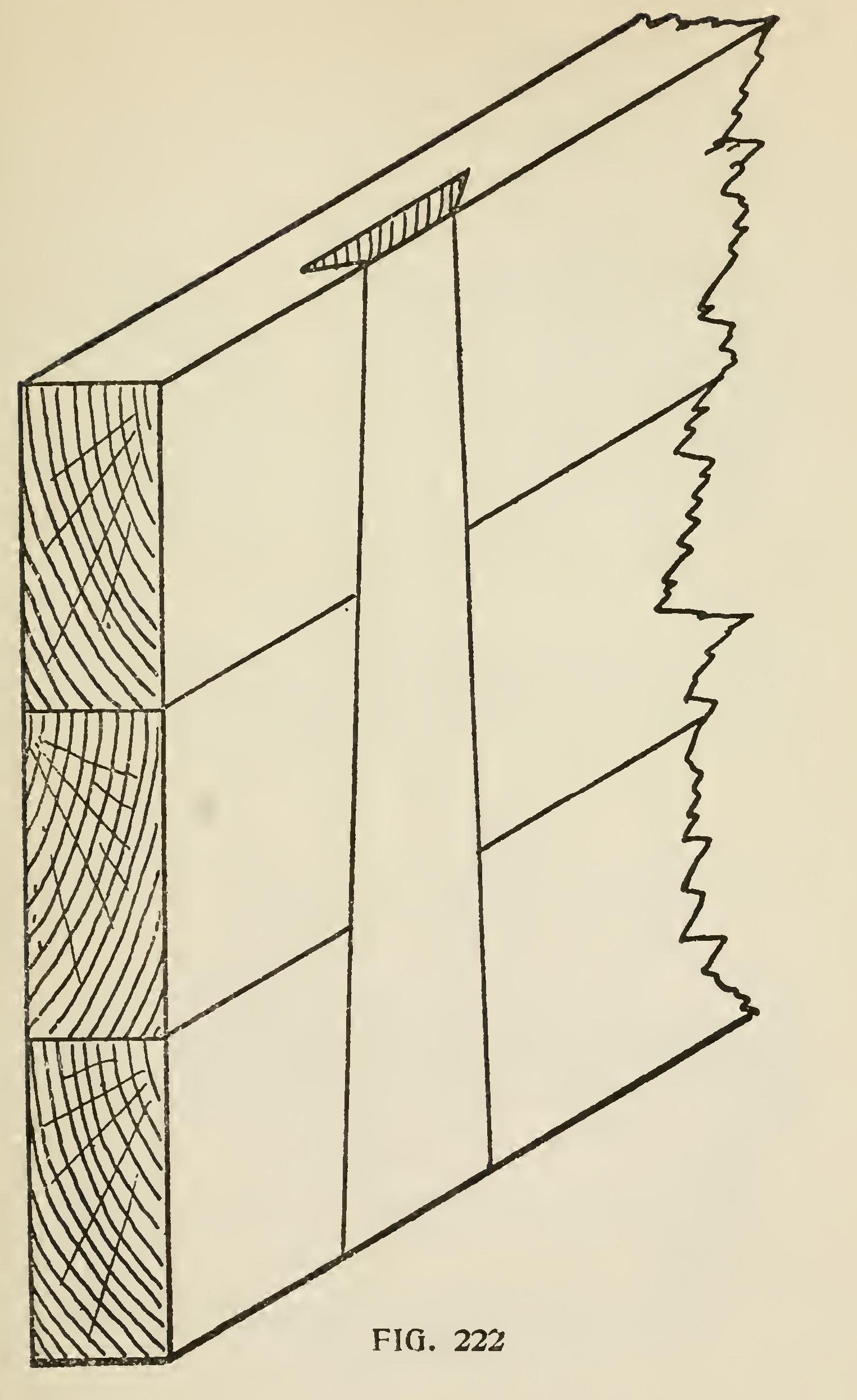
Keying (Fig. 222) is a means of securing several boards together by a flush key, let in at the back in lieu of a projecting ledge, where the latter would be inconvenient on account of a level face being required on each side. This is often used for wide door casings.
Keyed joints are also used to connect circular with straight or two pieces of circular wood, such as door frames, etc. A shallow mortise is cut out of each part, and a hardwood key, (in the form of the letter I) connects the two together.
Scribing
is the cutting, out of the face of one moulding, a hole of the contour of another to form a joint. It is chiefly used in joints of sashbars, internal angles of moulded skirtings, etc., andreally is a moulded mortise cut into another moulding to receive a moulded tenon of the same section as the mortise, but in a converse form. For instance, in Fig. 223, it will be noticed that on A a moulded mortise or notching is cut out, with the ovolo hollow, as it were ; and on B, which we will call the tenon, the cutting has the ovolo convex or projecting to fit and fill up the hollow on A.
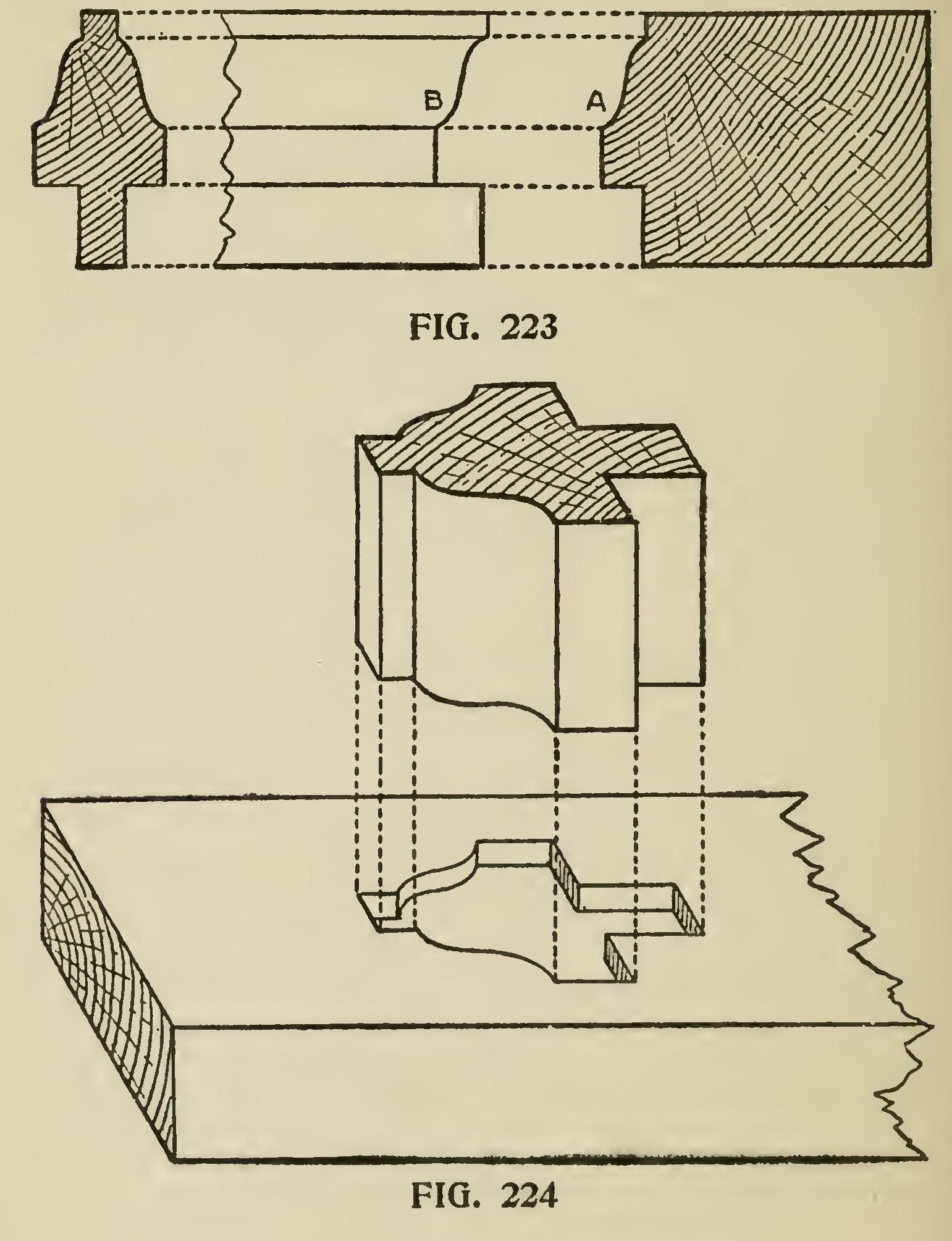
A scribed housing is a housing made to the contour of the moulding it is going to receive (Fig. 224).
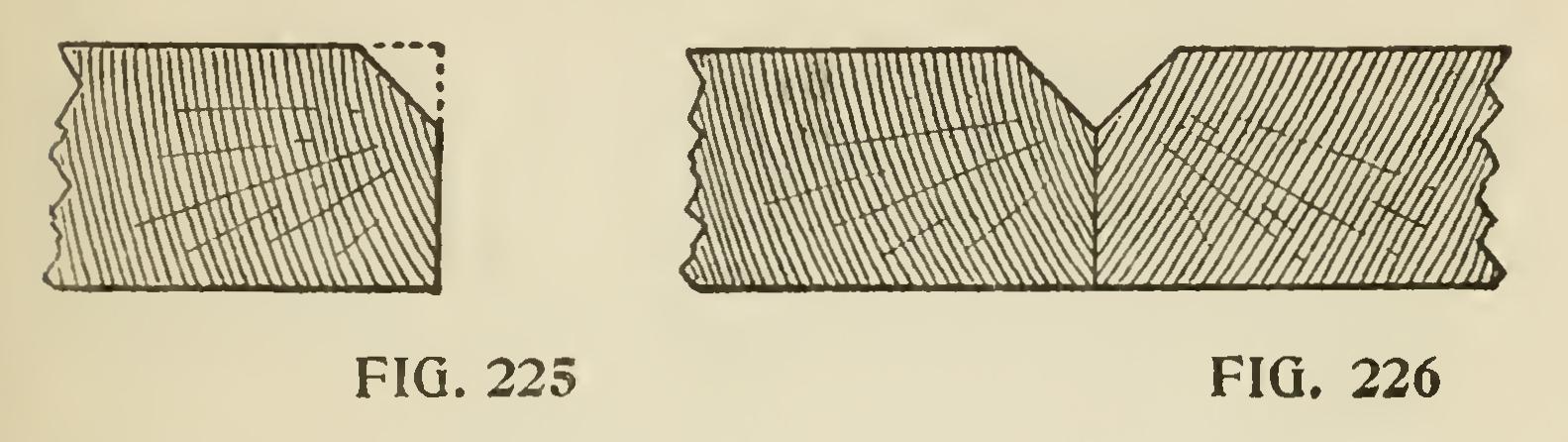
Chamfering is the taking off of the arris or sharp edge of an angle, as Fig. 225, the angular groove formed by the meeting of two chamfered angles (Fig. 226) being called a V-joint.
Match Boarding.
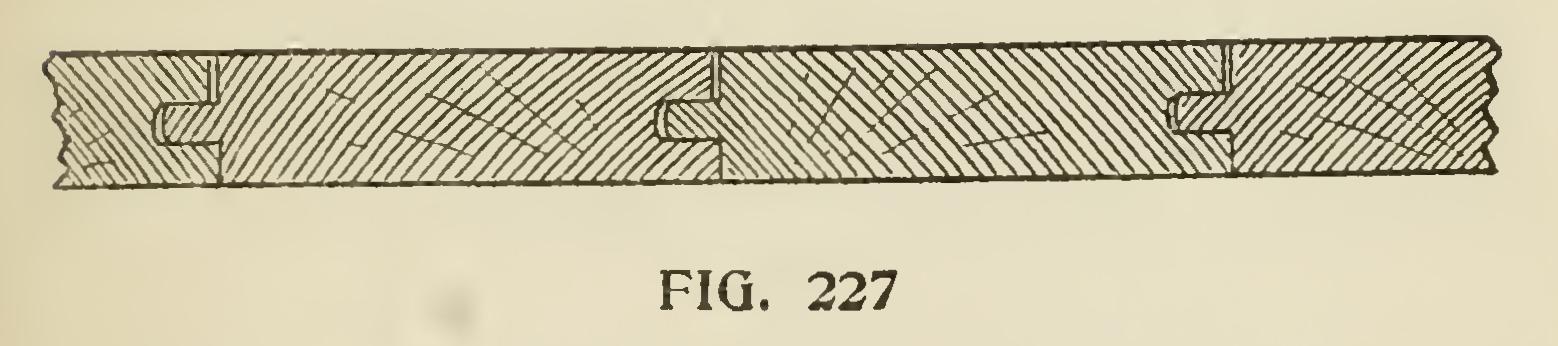
This is an arrangement of boards matched and put together with grooved and tongued joints, and their edges "shot" or planed truly, so that a fine joint can be made. Match boarding, otherwise called cleating, is of several kinds, the chief of which are: Plain matched boards (Fig. 227).
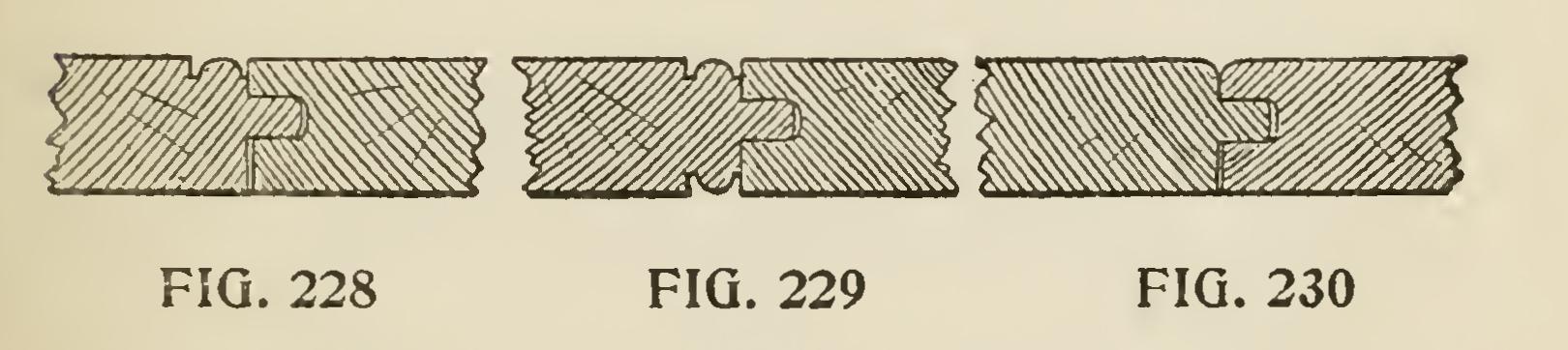
Beaded-one-side match boarding (Fig. 228). Beaded-both-sides match boarding (Fig. 229). V-jointed match boarding (Fig. 230).