Straps Joints
joint, beam, bolts, times and fig
The following are some maxims that will be sufficiently accurate for practical purposes : In oak, ash, or elm, the whole length of the scarf should be six times the depth or thickness of the beam, when there are no bolts.
In fir the whole length of the scarf should be about twelve times the thickness of the beam, when there are no bolts.
In oak, ash, or elm, the whole length of a scarf depending on bolts only, should be about three times the breadth of the beam; and for fir beams it should be six times the breadth.
When both bolts and indents are combined, the whole length of the scarf for oak and hard wood may be twice the depth; and for fir or soft woods, four times the depth.
Building
two plain pieces of timber were laid upon one another, and supported at the ends, the pressure of a weight applied in the middle would cause them to bend, and the surfaces m contact would slide against one another, the upper piece sliding towards each end upon the lower one. This sliding is effectually prevented by indenting the surfaces, as shown in Fig. 236, when the pieces are bolted together; but if the same indents be reversed, as in Fig. 237, they produce scarcely any effect, and nearly the whole strain is upon the bolts.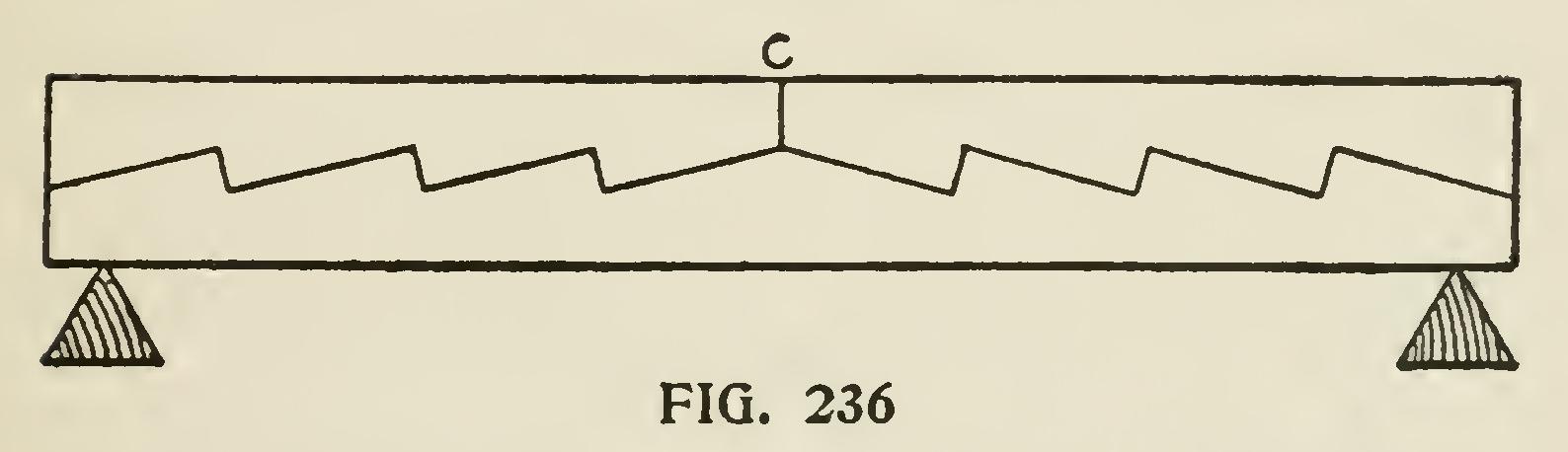
Wherever the principal strain on the beam may happen to be, to that point, as at C, Fig. 236, the indents should direct their square abutments ; that is, toward the straining force. When the beam is uniformly loaded, the greatest strain is at the middle.
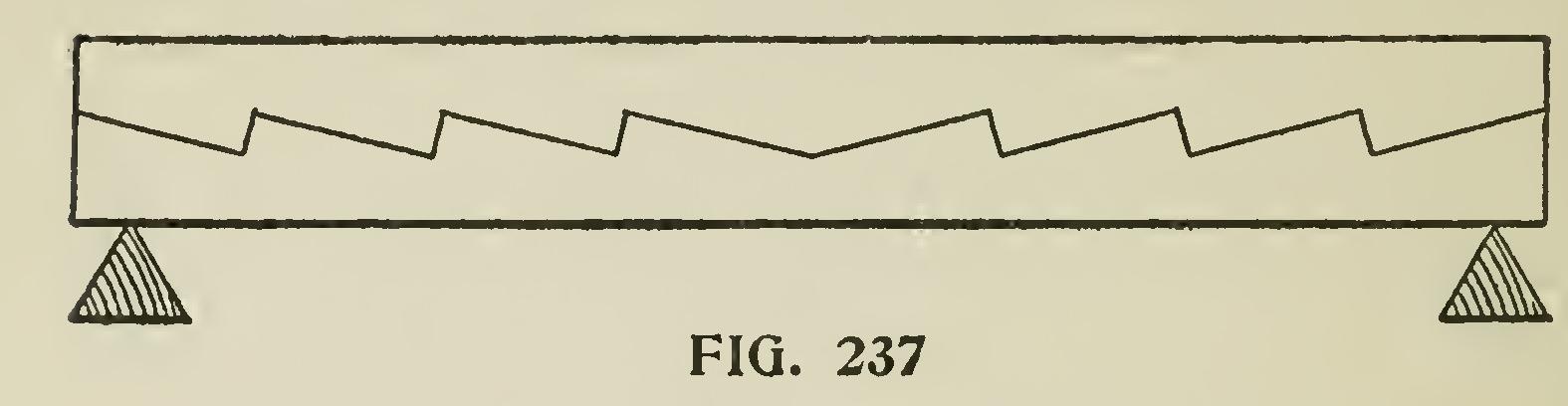
In drawings we frequently see all the indents put the same way, and sometimes as in Fig. 237, otherwise the preceding remarks would have appeared to have been unnecessary.
We will now proceed to describe some of the joints of most common occurrence, and endeavor to point out improvements that might be made in some of them.
When one piece is perpendicular to another,
as, for example, a post upon a sill, the usual, as well as the most easy method, is to make the joint square, with a stub or short tenon of about one fourth of the thickness of the framing, to retain it in its place.
But if the joint be not very accurately cut, the whole load will bear upon the projecting parts; consequently, the center of pressure will seldom coincide with the axis of the post, and its power of resistance will be much lessened.
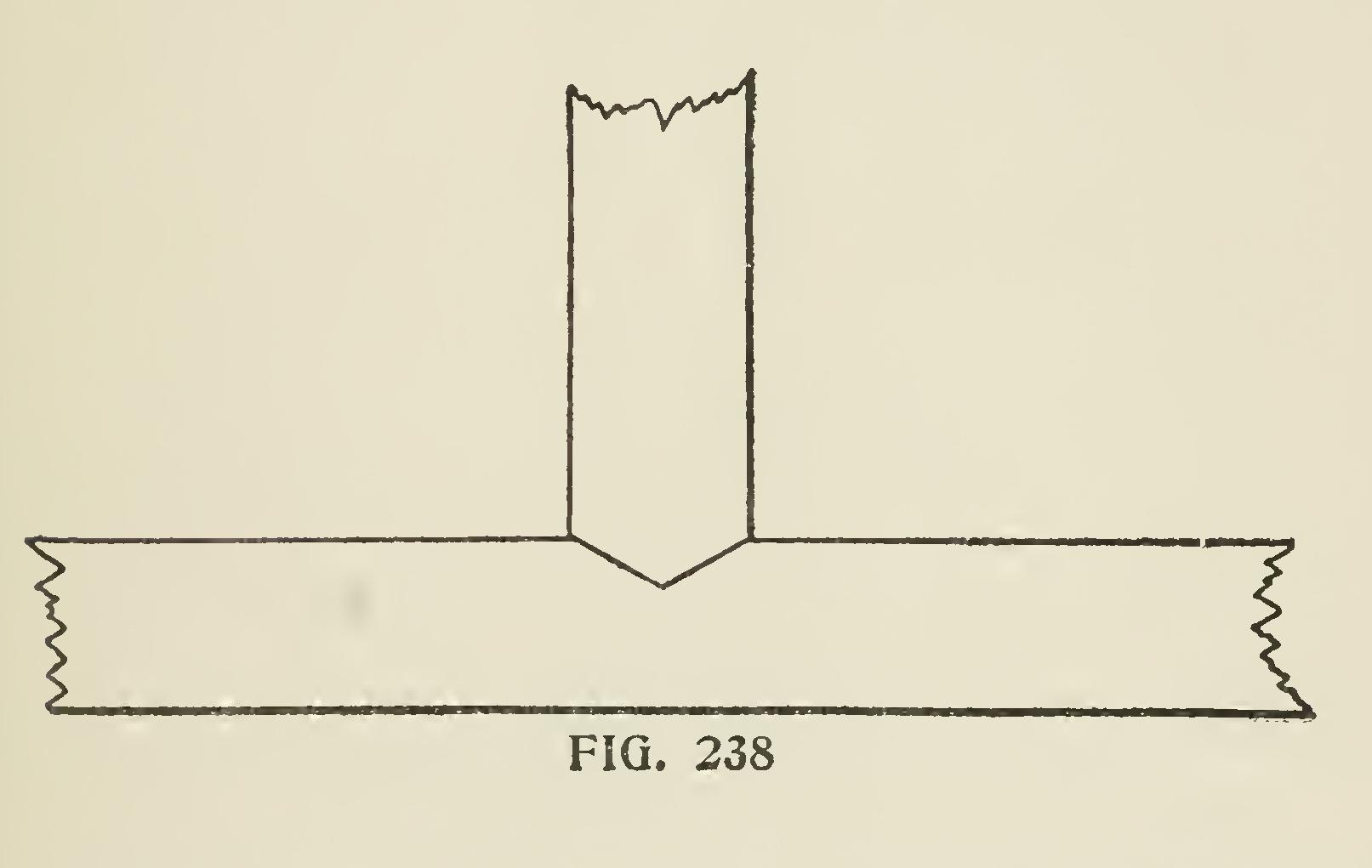
If, instead of cutting the joint square, it were cut to form an angle, as shown by Fig. 238, then a very little care in cutting the joint would make the center of pressure coincide with the axis.
When the pieces to be joined are not at right angles to one another, the joints may be similar to those used for the principal rafter of a roof.
It is necessary to state that the direction of the strains, as well as their magnitude, remains sen sibly the same, whatever may be the form of the abutting joints, except so far as the form of the joint alters the points of bearing ; which may in some cases cause the pressure to act with a lever age nearly equal to half the depth of the beam. The strength of the joint itself depends upon its form, as it may be so made that there will be a tendency to slide, which it would be well to avoid, without having recourse to straps.
The resistance at the joint is always most effectual when the abutment is perpendicular to the strain, but where the angle formed by the inner sides of the pieces is very acute, this kind of abutment cannot be obtained, at least not without wounding the tie too much.