Concrete Stable Floors
inches, sand, floor and foundation
CONCRETE STABLE FLOORS. For the basement story of modern barns where the horses and cows are usually stabled, concrete has been adopted quite generally for the flooring. This is either left bare, or is covered with plank.
For a floor built on sandy soil, no drainage or foundation is necessary. If the soil is clay or spongy, however, eight inches of coarse gravel, stone, or cinders should be well tamped and leveled before placing the concrete; but if the soil is porous, then tamp the soil under the center driveway.
When a foundation for floor is necessary, drainage to conduct the water gathering in the foundation is also required; therefore the foundation must have large stone in the bottom to afford ample air space, and the excavation must have a slope to one or more points. These low points have tile drains leading the water from the building. This will insure dry floors, and prevent cracking from frost.
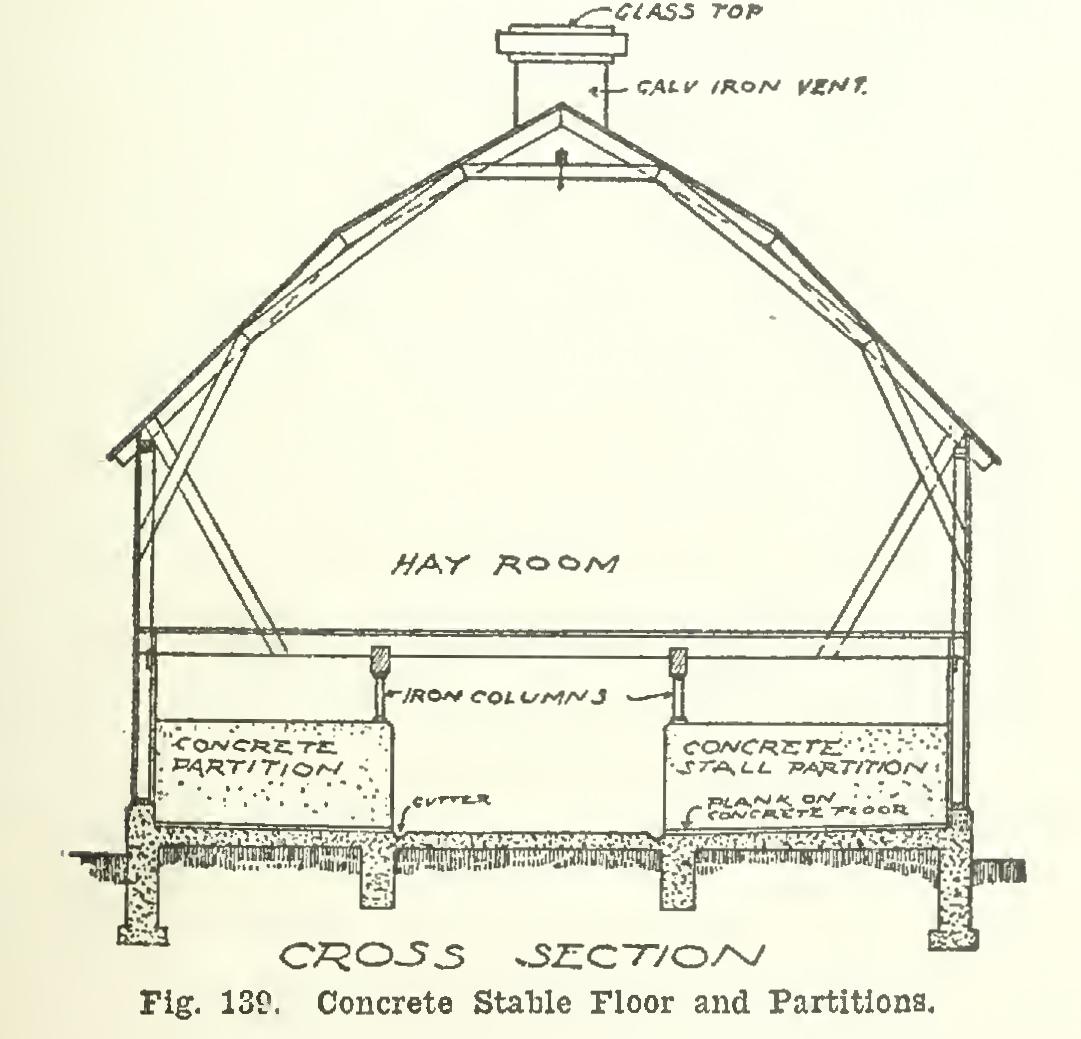
Four inches of concrete for horse and cattle floors is ample; and five inches for driveway will do, though some are made six inches thick. The proportion of concrete depends on the kind of sand and aggregates. One of the following will prove desirable: Cement one, sand two, gravel three, makes very sound work. Cement one, fine sharp sand one, coarse sharp sand two, gravel or crushed stone four parts, will equal in strength the first formula, and save much in cost. Add sufficient water to make a stiff grout,
and tamp well into place so that the top will be one-half to one-quarter inch lower than the top of floor; before this has set, apply the top coat, which should consist of one part cement and two parts sharp sand, and trowel smooth. After this has set for one hour, tamp with stiff scrub brush or wire foundry brush. This will produce a non-slipping surface. These floors will be uninjured by the sharpest shod horses after four weeks.
In large barns, a tile drain is necessary, and an outlet from every other stall to this drain is sufficient; but in small barns the gutter alone is sufficient. This gutter is eight inches wide for horse floors, and six inches wide for cattle, both gutters being two and one-half inches deep. For the mangers, 2 by 4-inch scantlings are bolted to the floor with half-inch bolts eight inches long, embedded five inches into the con crete. Manger partitions are boarded on both sides and filled between with tamped concrete four feet high, so that when the wood partition has served its purpose a solid concrete wall will remain. Use 4 by 4 timbers for framing stall partitions (see Fig. 139).
I