Constructing a Circular Porch
fig, ceiling, shown, soffit, joists, framework and boards
CONSTRUCTING A CIRCULAR PORCH Fig. 41 shows a method largely used for a number of years, which is probably as good as any other. The central part of the illustration shows the framework of the floor-joists, with a portion of the flooring in position.
There should be supports at C, B, and D. From C to D is one-quarter of a circle; and this is divided in the center, as at B; then the straight lines C-B and B-D are equal to the sides of an octagon with a circumscribed radius of seven feet and eight inches, which is the width of the framework of the porch; and the length of the sides may be found by the method shown in Fig. 42. By placing the square on a board from which the segment is to be cut, with the figures that give the octagon cuts, and laying off the radius in line with the blade, as shown, describe the arc, and it is ready to cut. The figures shown on the square will give all the cuts required in the framework about the octa gon, as the blade will give all the cuts at B, Fig. 41, also at the other end of the side pieces at C and D. The tongue will give the cut at e and e. The other cuts are the square or on the 45-degree angle. Thus it will be seen that all the pieces can be successfully framed with out first building a part of the framework and scribing the other pieces to it, as is the general custom.

There should be four of the segment pieces got out, setting one flush with the top edge, and one at the lower edge of the joists. The upper ones should be of one and three-fourth inch stuff, same as the joists, while seVen eighths will be sufficient for the lower member. Set blocks between these segments, nailing them well to the joists; also set a few blocks flush with the face of the segments, which makes an excellent form to secure the base.
The ceiling joists are usually put on the narrow way of the porch with an angle piece same as at A-B, on which to form the miter joint of the ceiling.
To form the soffit, use seven-eighths by six or eight inch sized boards, and spring them to their proper place just the same as building a circular girder. The first board should be sprung to a form, and the next board well nailed to this one, and so on, till the soffit is the required thickness or strength. It is not always necessary to build to the full width desired, as it can easily be furred out to the required width.
The soffit should be continuous—that is, for the straight part, as well as for the circle. Long boards should be used so as to lap well around the circular part, being careful not to break joints on the circular part or at C or D.
A soffit, if properly built in this way, will not necessarily need a column set at B, as it will be self-supporting. If straight columns are used, the outer face of the framework should be flush with the framework below; but if tapered or colonial columns are to be used, then the center of the soffit should rest over the center of the column, as shown in Fig. 41.
In case a deep frieze is wanted, it may he had by building on top of the soffit girder with Fig. 43. Floor Construction—Circular Porch.
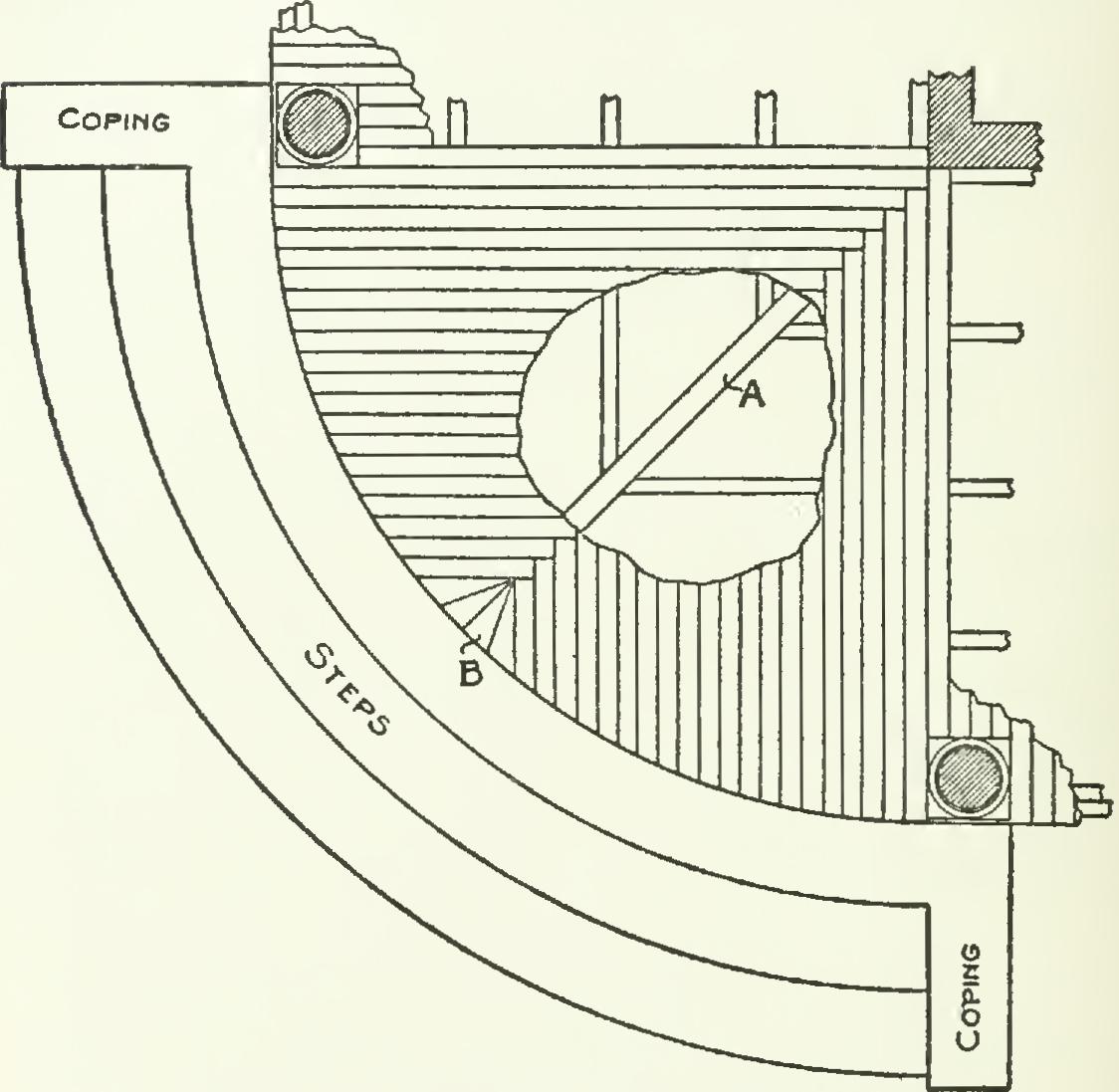
blocks, and putting a formed plate on these. For all circular mouldings, it is better to have them solid, and they will then always stay in place, as there will be no kerf joints to open up after the work is completed.
Another circular porch is shown in Figs. 43 and 44. It looks better than the mitered seam, is perhaps as good, and is cheaper.
At A, Fig. 43, is a 4 by 6-inch timber, which gives a good bearing for the ends of the flooring boards. B shows the method of finishing the Fig. 44. Ceiling and Roof Framing—Circular Porch.
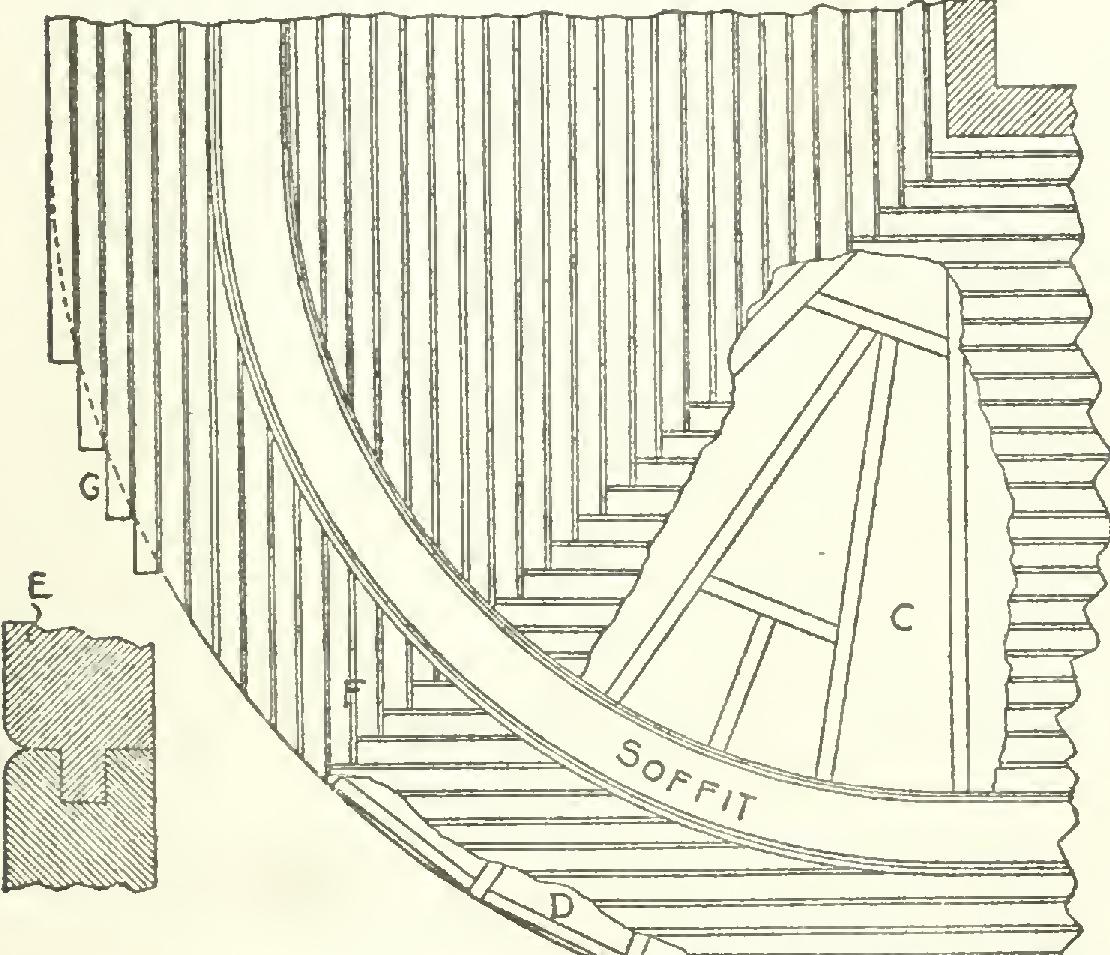
floor where steps come on the circle.
Opening C, in Fig. 44, shows how the heels of the ceiling joists are put in to give support for the heels of the rafters.
F
in Fig. 44 shows the method used for put Wag a ceiling plancher on a quarter-circle porch. D shows cripples fitted in between the joists to which the ends of the ceiling boards are nailed. Put the plancher on, and saw to the circle after wards as shown at G.
The ends of the ceiling boards are pared with a gouge to match the boards running the other way. E shows a neat way to make a ceiling.
A good miter joint for a porch plate is shown in Fig. 45. It is especially good for the miter in a solid porch plate, or other places where it is desired that the mitered sides shall show and where the edge cut is not exposed. The timbers are often crooked, and this joint will allow for considerable variation from the square.