Door Framing
set, sliding, jambs and pocket
Panels should be set loose so.that expansion and contraction will not split them. The mould ings are nailed to the stiles and rails and a pine fillet is set in between them.
The trim is worked out of seven-eighths-inch material, and has a moulded back-band. The little tongue left on back edge of back-band may be planed to fit the unevenness of the plaster.
Hanging Sliding Parlor Doors. There are now many patented hangers for sliding doors on the market, each possessing more or less Fig. 38. Sliding Doors—Construction at Jamb.
merit. Full directions are furnished with each set. Any average workman should be able to put up the work. The main thing is to see that the partition rests on substantial bearings to prevent settlement, as this will necessarily throw the track out of level and affect the free working of the doors. Be sure to set the stud ding plumb and properly spaced for the pocket. Never set the studding flatwise with the door.
Never allow a hot-air pipe to run up beside the sliding door, when it is possible to place it in some other partition. Always double the stud ding at the jambs; and be sure to make proper calculations for the opening so that when the finished work is in place, the full face of the door will show when closed. Be sure to have the woodwork over the opening perfectly rigid. Two well-seasoned joists spiked together and set up edgewise, make a good truss or lintel, and an excellent surface on which to secure the track. The short studs may rest on this lintel,
and may be retrussed by cutting in cross-braces, or truss-shaped braces may be put in above the hanger. In this, the workmen should take into consideration the load that is to be carried above, and build accordingly.
In good work, the pockets should be lined with tongued-and-grooved boards, which may be done with thin stuff; but whether this is done or not, be sure to have the pocket openings cut off at the back end so that there will be no connection with other openings in adjoining partitions and outer walls. This should be done for several reasons—first, to heat the house, because these openings will create a draught; then again, if a fire gets started in a partition, these openings furnish an excellent draught to fan the flames.
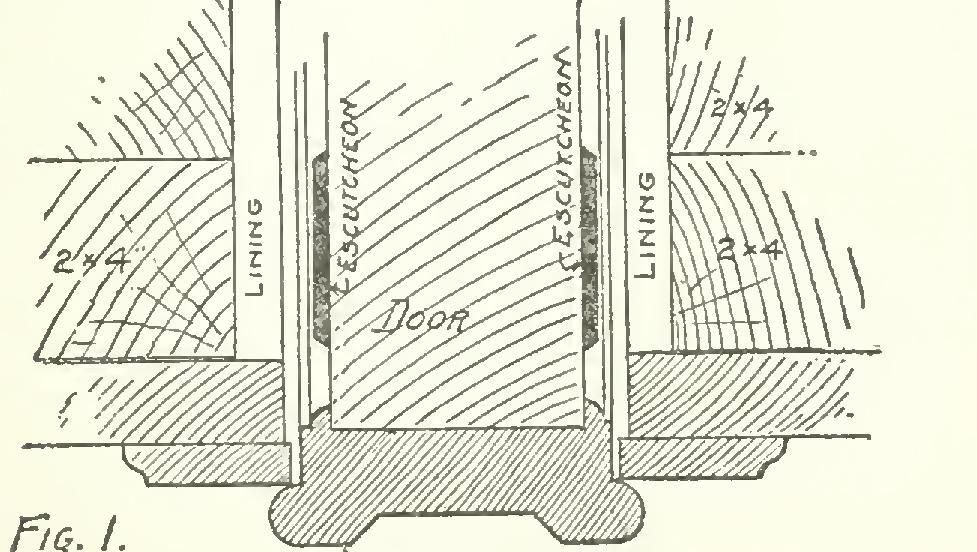
Another point we might call attention to is the unsightly notching-out of the stops to allow the raised escutcheon to pass into the pocket.
This can be avoided by running a stop around both sides of the door, and membering with the astragal as shown in Fig. 38. The stops on the jambs are set as shown. Thus, it will be seen that the escutcheon is cleared; and that, when door is shoved back, the astragal will cover the pocket opening, and to all appearance is simply a mould made fast to the jambs. The Fig. 39. Sliding Doors—Construction at Head.
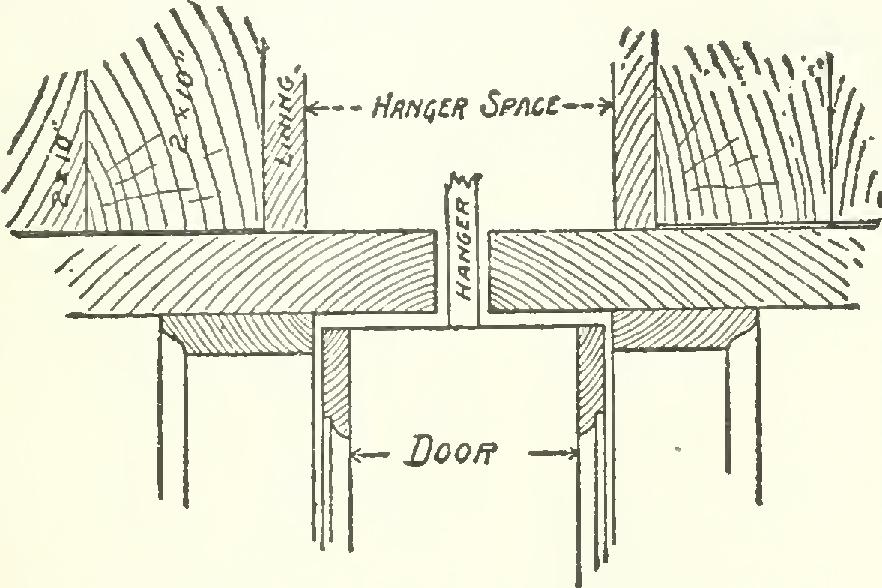
head jambs should be set to allow only for the free working of the hanger, as shown in Fig. 39.