House Framing
door, shown, studs, partition, paper and double
This only goes to show to what lengths it is necessary to go to secure absolutely sound-proof walls.
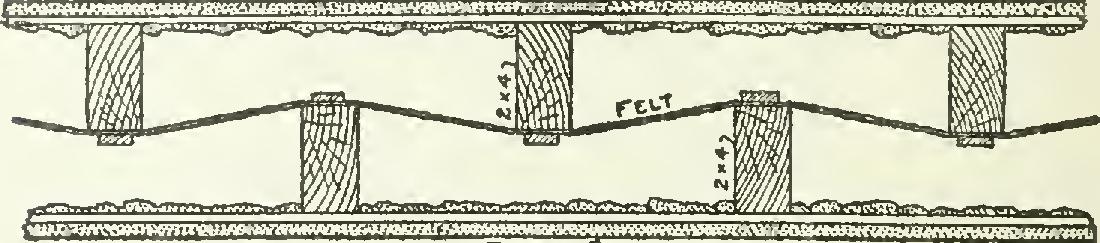
A method sufficient for all practical pur poses, and one that is very often used as a cheap way to deafen the center wall in a double house, so that the occupants of one side cannot hear the other, is shown in Fig. 14. Set a double row of studding, as shown; they are of 2 by 4 inch stuff, set in the usual way, but set stag gered, so that the face lines will be 6 inches apart. This will leave a space of 2 inches) between the studs and the plastering. Then, on the inner edges of the studs, heavy felt paper or hair insulator quilt should be stretched, and made secure by nailing a lath over the stud, as shown in the section. Two by six-inch plate can be used at the top and bottom. The floors should be deafened, and this can be done very satisfactorily by putting down a rough floor of shiplap, and after all rough work is done, cover this with felt or hair cloth and lay the finished floor. As to back-plastering the wall to deaden the sound, it is not as effective as the above method.
Substitute for Back Plaster.
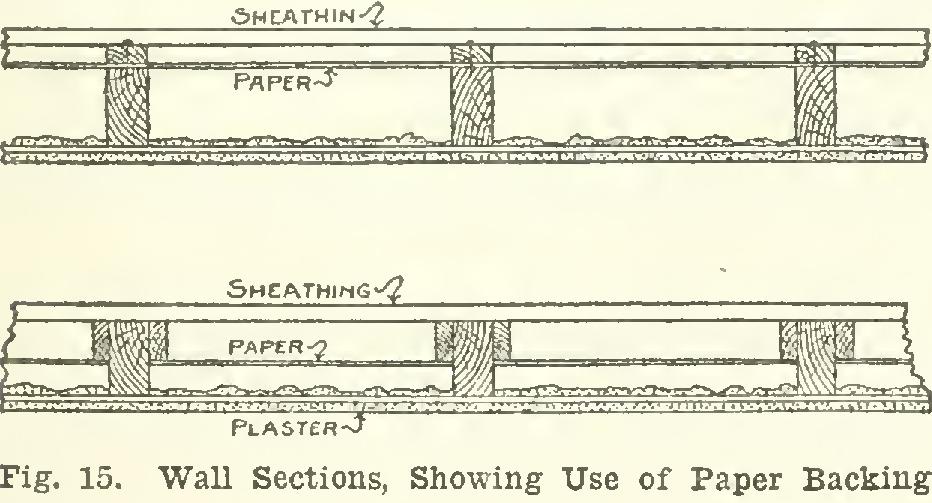
Tar paper may be used to very good advantage instead of back-plastering a house, provided it is tough enough. The ordinary tar paper, such as is used for covering the sheathing, is generally too soft and is very liable to while the work is being carried on. The accompany ing sketch, Fig. 1.5, shows two ways of doing the work. In the first, by using 32-inch paper and putting it on vertically, it will cover two spaces. All laps should be on solid bearing. Then strip with pieces, and put on the sheathing, which should also be covered with paper, and sided in the usual way. Or it may be done as shown in the second sketch in the figure. This, however, requires more cutting and fitting of the paper. The former is preferable in many cases, on account of giving a wider fall at win dow jambs. The object in this construction is to give as nearly a dead-air space as possible. Therefore every part should be made thor oughly tight, or the object sought will be of no avail.
Double, Trussed Partition. In framing the wide door opening and double partition for a large sliding door, the first thing to be consid ered is the foundation on which to rest the jambs at the sides of the door. If it is not convenient to have a partition under the door, the joist should be doubled, and especially so if the joist above the door rest or break over the same. If there is great weight there, the joist should be doubled under both partition walls of the sliding door. Fig. 16 shows good construction where the joists run at right angles with the door opening. The truss may be omitted where the joists run parallel to the door; but it is a good idea to put in the double joist at the head of the opening, as it furnishes an excellent bearing on which to fasten the track.

Braced Partitions. Quite recently the writer noted for the second time only, in a somewhat wide experience of construction, a very curious and mistaken way of putting braces in a parti tion. The carpenter had placed the head and sill in position, and then cut and nailed up all the studs in position before the braces. The latter were cut in between the studs, as shown in Fig. 17 (left sketch) ; and while they did their duty, perhaps, in preventing to some extent the racking of the partition, yet they were not nearly so effective as if they had been fitted in first in one piece, and the studs cut in after, as shown in the right-hand sketch in Fig. 17.
By putting the braces in first, not only is their full strength obtained, but the frame of the partition can be properly squared by meas uring or testing the diagonals with a rod in the usual way, and adjusting if necessary—an almost impossible thing to do if the studs are all spiked into position first. Numerous small details of this sort mark the difference between the thoughtful craftsman and the bungler.
Such mistakes come from carelessness or lack of knowledge.