How to Apply the Wood Trim
floor, ing and strips
HOW TO APPLY THE WOOD TRIM. There are a number of features in connection with modern fireproof construction that are of particular interest to carpenters, especially to those work ing in the larger cities where steel, tile, and cement are now so generally used. A question very frequently heard is—How do they nail on the finish to make a good job of it? The detail sketches (Figs. 117 and 118) show the answer with special reference to plaster partitions—a type of wall, by the way, which is often very serviceable in small wooden store and office buildings.

In order to economize floor space as much as possible in fireproof buildings, thin parti tions, as a rule about 2 inches thick, are intro duced.
Fig. 117 shows methods of framing for doors in this kind of partition. The rough wood frames are set in place before the partition is erected, and to these the metal studs are secured with screws. The partitions themselves are usually erected by the plasterer.
The difference in the various styles of fram ing shown is principally in the character of the finish. Naturally, those sections which have the widest door jambs will be found the stiffest.
Various modifications of these details, to suit the judgment or taste of the architect, may of course be made.
Fig. 118 shows the method adapted for secur ing the base-board. The rough 2 by 3-inch piece is laid on the line of the partition and secured directly to the floor strips, and the partitions built on this piece.
After the floor is laid, the base is nailed directly to this strip. For securing picture moulding, strips of wood may be laced to the metal lath at the required height, before the plastering is done. These are sufficiently firm, after the plaster has dried, to hold the picture Fig. 118. Baseboard and Floor Construction.
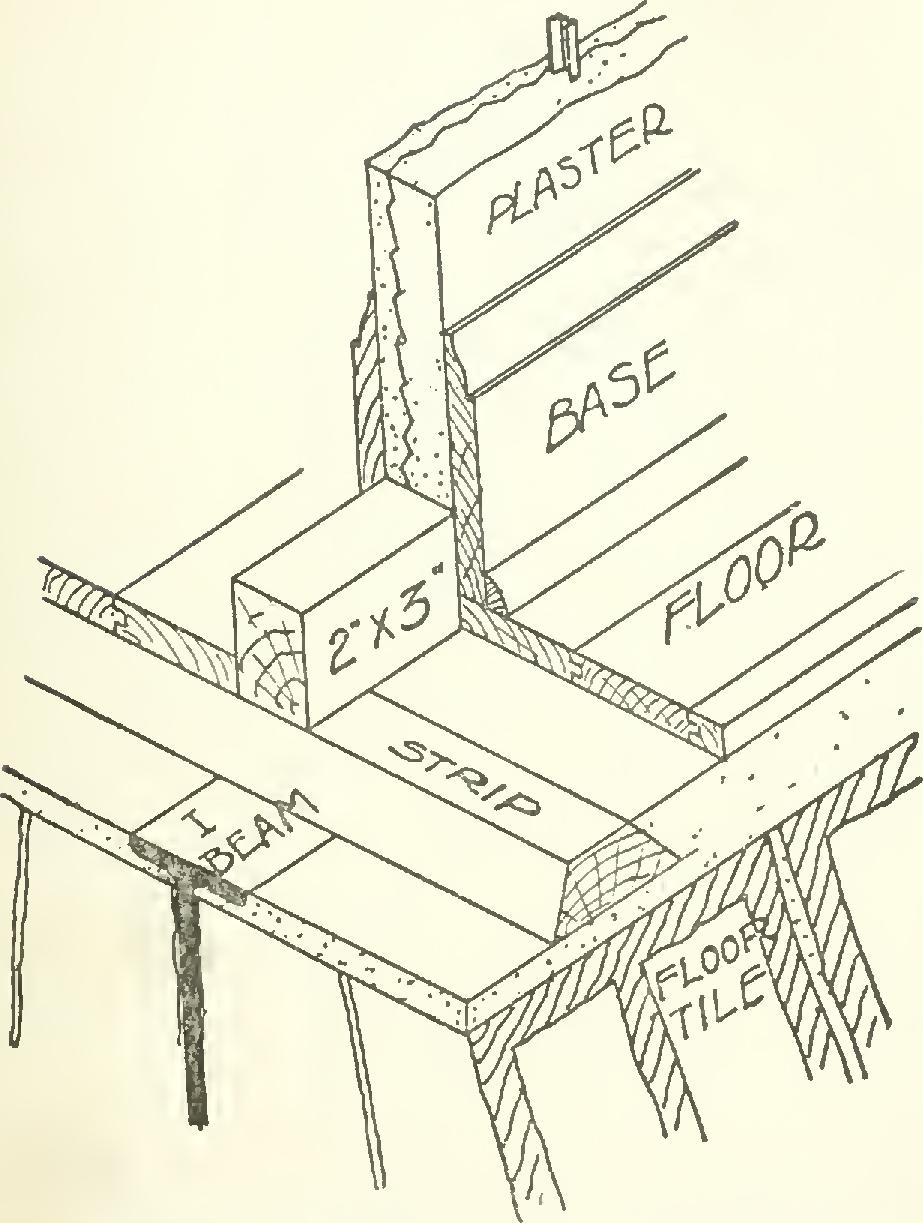
moulding, which should be put up with screws instead of nails. In case close-warp metal lath ing is used, the screws will engage the meshes of wire work sufficiently to hold the picture moulding without any preliminary strips.
With slight modifications, the methods shown for door framing could be adapted to hollow tile partitions.