Lath Furring Strips
sashes, frame, window, sash, head and size
The sashes are channeled at X so that any water which may beat in between the sashes and frame during driving rainstorms will be caught and conveyed to the window-sill. The lower rail of sash has a lip and undercut to pre vent water from entering at that point.
The wooden sill should be well bedded in mortar; and any spaces about frames should be wind-proofed by calking with oakum or filling with mortar. The sizes given for sashes and frames are suitable only for ordinary windows. For larger windows, both frame and sash would have to be increased in size; or, if this would be objectionable, would have to be made of hardwood. In any case, the stiles and rails of casement sashes have to be larger than for the sashes of a corresponding double-hung window, for the reason that there is a greater strain on them, owing to their being hinged on the side. For the same reason, it is preferable to bed the glass in putty and secure it in place with wood beads, rather than to use putty only.
A casement window opening outward in a sixteen-inch brick wall is shown in Fig. 98. It is such as would be used in the better class of work, and the dimensions of the members are about right for an ordinary size window. For larger windows, the frame would have to be increased in size, and the sashes made of cherry or other suitable hardwood, rather than the dimensions of stiles and rails increased, which would be objectionable in that it would show too much wood. The thickness of sashes, however, should be increased. In any case, the dimen sions of stiles and rails for casement sashes are greater than for double-hung sashes in win dows of similar size, owing to the greater strain on them caused by their being hinged on one side.
The frame shown is built as the masonry a 11 s are carried up, in a rebate formed in the wall, so that too much of the frame will not be exposed to view; and is secured firmly in place by means of lugs housed into the jamb and built into the brickwork. All spaces between the frame and the brickwork are calked so as to be wind-proof, the calking consisting of oakum well compacted and plastered over, or scratch coat mortar slushed in when the plastering work is being proceeded with. Calking should never
be omitted in important work. Frames, after being built in, should be well protected with boarding so as to prevent them from being dam aged in passing materials through the openings.
The interior treatment of the window open ing is, of course, subject to innumerable modifi cations, as the taste of the architect or owner dictates and purse affords. The architrave shown is quite effective, and not so costly as the finished effect implies. The trim is moulded and worked out of seven-eighths-inch material, and is blocked at the back to make it heavier in appearance. A moulded back-band adds to its massiveness; and a small flexible wall-mould covers the junction with the plaster work, and is easily bent to follow the unevenness of the fin ished plaster.
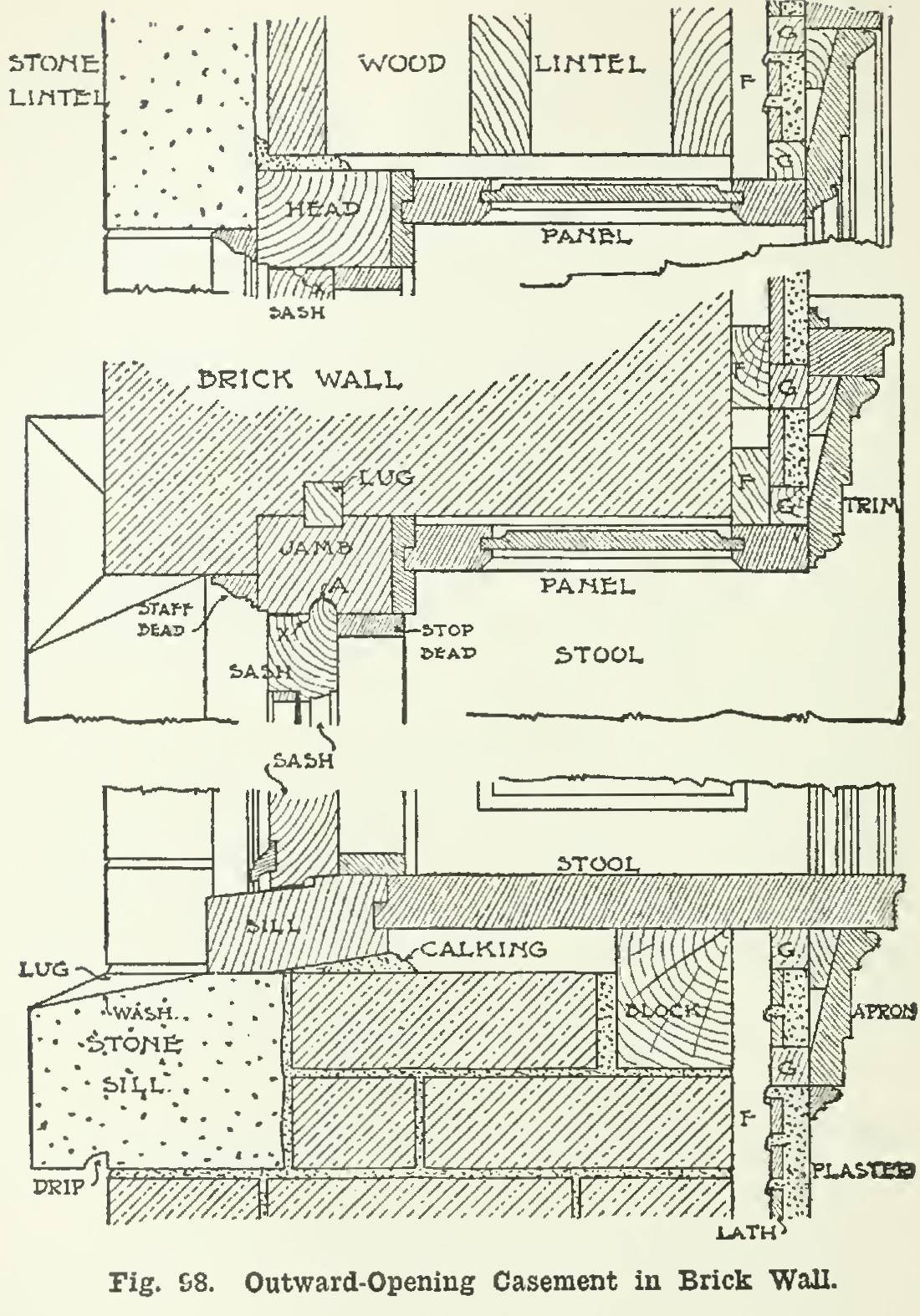
The exterior of the window consists of brick imposts showing a three-inch reveal, a stone lintel spanning the top of the opening, and a stone sill across the bottom. The sill has a bed of five inches, a projection of two inches, a thick ness equal to two courses of the face brickwork, and a length sufficient to tail four inches into the masonry at each end. The upper surface has a wash and stools at either end, and the projecting portion has a drip cut on the under side.
The inside of the wall is furred with one by-two-inch strips, indicated by F, to which grounds G and lath are applied. The head of the window has a paneled head lining tongued into the finishing woodwork which is provided to cover the rough frame. At x, on the top rail of the sash, a channel or gutter is provided to catch any rainwater which may beat in between the sash and the head of the frame. This channel is continuous across the head, and con veys the water to a similar groove on the sash stile.