Roof Framing Simplified
square, inches, rafter, cuts, run, length and pitch
Here the span is divided into several parts.
The dotted lines are shown Fig. 53. Roof Pitches on the Steel Square.
in the transferring of these parts to the rise line. In Fig. 53 these parts are shown in connection with the steel square. Twelve is used on the tongue, because it represents a one-foot run.
The span would therefore be two feet, or 24 inches, which is equal to the length of the blade. It is then a very easy matter to fix in the mind what figures to use on the blade for any pitch, as 6 is of 24; 12 is 18 is a pitch, etc. A 24-inch rise would necessarily be a full pitch. A 30-inch rise would be pitch; and so on.
There seems to be some uncertainty as to which should be given first, the run or the rise, when telling what figures to use on the steel square to find the bevels for rafters. Some give it one way, and some another. The same man will give the run in one place first, and the rise in another. For example, take the one third pitch. He will say, 12 and 8 for the seat and plumb cuts of the common rafter; then he will say 8 and 17 for the corresponding cuts for the hip or valley.
Now, it has long since been the recognized custom to give the width first for all kinds of mill work, such as doors, sash, etc. The same rule should apply to framing work, because the run represents width or space covered by the rafter, and it should therefore be given first. For the example in question, we should say 12 and 8 for seat and plumb cuts of the common rafter, and 17 and 8 for the corresponding cuts for the hip or valley. It is better to always take the figures 12 and 17 on the tongue, because they are standard for any regular pitch; the blade will admit of from 1 to 24 inch rise per foot, besides giving a greater range of side cuts without change of figures on the tongue. Then, again, it helps to familiarize the mind as to which member of the square gives the desired cuts.
How to find the cuts for rafters, no matter what the pitch, is a point that gives trouble, yet there is nothing sim pler when properly understood. Take, for instance, how to find the cuts for hips, valleys, and jacks when the com mon rafters are 6 to 12, 7 to 12, 8 to 12, 9 to 12, 10 to 12, etc.
Take the first example, 6 to 12. The formula given applies to all alike, whether it be a six-inch or a fifteen inch rise to the foot. Fig. 54 will show why certain figures are used on the square to obtain the cuts. Of course other figures can be used, but they must be in the proportions here given. Twelve on the tongue is used because it represents one foot, and 17 because it is the length of the diagonal of a foot square, and represents the correspond ing run of the hip or valley to one foot run of the common rafter. These figures are standard or fixed points for any pitch desired.
Taking the 6-inch rise to the foot, the com mon rafter is inches, and the hip or valley 18 inches for a one-foot run. Now, suppose we wish to find the length of the common rafter for a building 22 feet 6 inches wide. Since the run is one-half of this amount (11 feet 3 inches), all that is necessary is to place the square at 12 and 6 along the edge of the rafter eleven times (see Fig. 55); and as there are 3 inches more, lay off that amount from 12 along the Fig. 55. Getting the Length of Rafters.
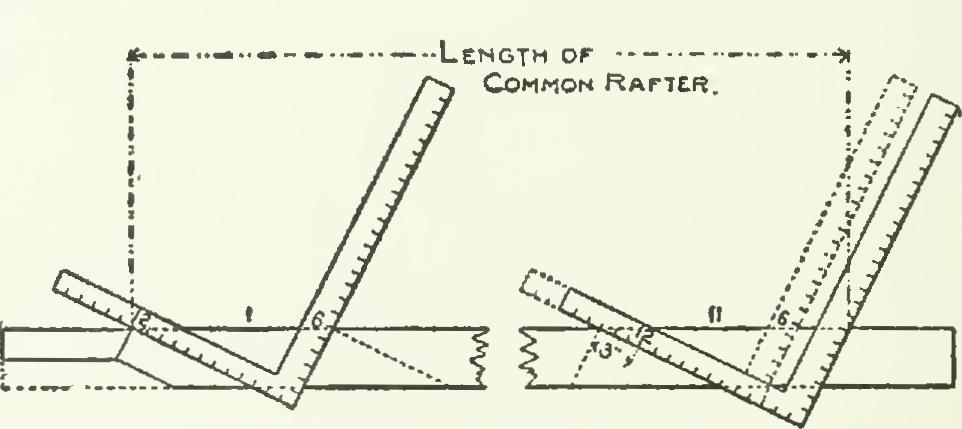
tongue aiid check. Then slide the square along till the 12 rests at the check, and mark along the blade, which will be the proper point for the plumb cut.
Proceed in like manner for the hip or valley, taking 17 and 6; but, at the last placing of the square, instead of measuring off 3 inches, take inches, which is the length of the diagonal of a 3-inch square. This may be reckoned as follows: Since 3 inches is one-quarter of 12 inches, one-quarter of 17 inches equals inches. Thus, the length of the rafters is obtained without any further measurement, and that, too, without knowing their actual length.
The jacks being a part of the common raft ers, their lengths may be found in the same way. Or, if they are to set on 16-inch centers, place the square at 12 and 6, as for the common rafter, and mark along the tongue; then slide the square along till 16 rests at the edge of the rafter, and the length will be indicated by that part of the rafter covered by the square, which represents the common difference of the jacks.