Screen Framing for Casement
sash, transom, rebated, sashes and frame
FRAMING FOR CASEMENT, SCREEN, AND BLIND. Fig. 100 shows the construction of an inward opening casement window in a brick wall, with insect screens placed outside of the sashes, and with blinds placed outside of the insect screens. It is also arranged so that when the screens are removed in winter, storm sashes may be installed in their place.
The frame is set in a very slight rebate in the masonry wall, and is secured in place by means of the lug on the jamb of the frame. This lug is built in as the brickwork is carried up.
The window-frame is rebated for the sash, and is also rebated for a tongue on the edge of the sash. This tongue is quarter-round, to allow for the play of the sash when opened. The jamb lining is tongued into the frame, and should be placed sufficiently back from the jamb of the frame to allow for the window-shades, which, in the case of inward-opening casements, are placed on the top rail of the sash.
The top edge of the sash is slightly beveled Fig. 100. Casement, Screen, and Blind in Brick Wall.

so that there will be no chance of it striking the transom bar when being closed.
The sill construction is similar to those shown previously, with undercuts and drip-mould to prevent the entrance of rain water at the joint of the sash and sill. This joint is usually the weak point of inward-opening casements, but, if constructed in the manner shown, will resist driving rainstorms. The inside stool is rebated over the sill.
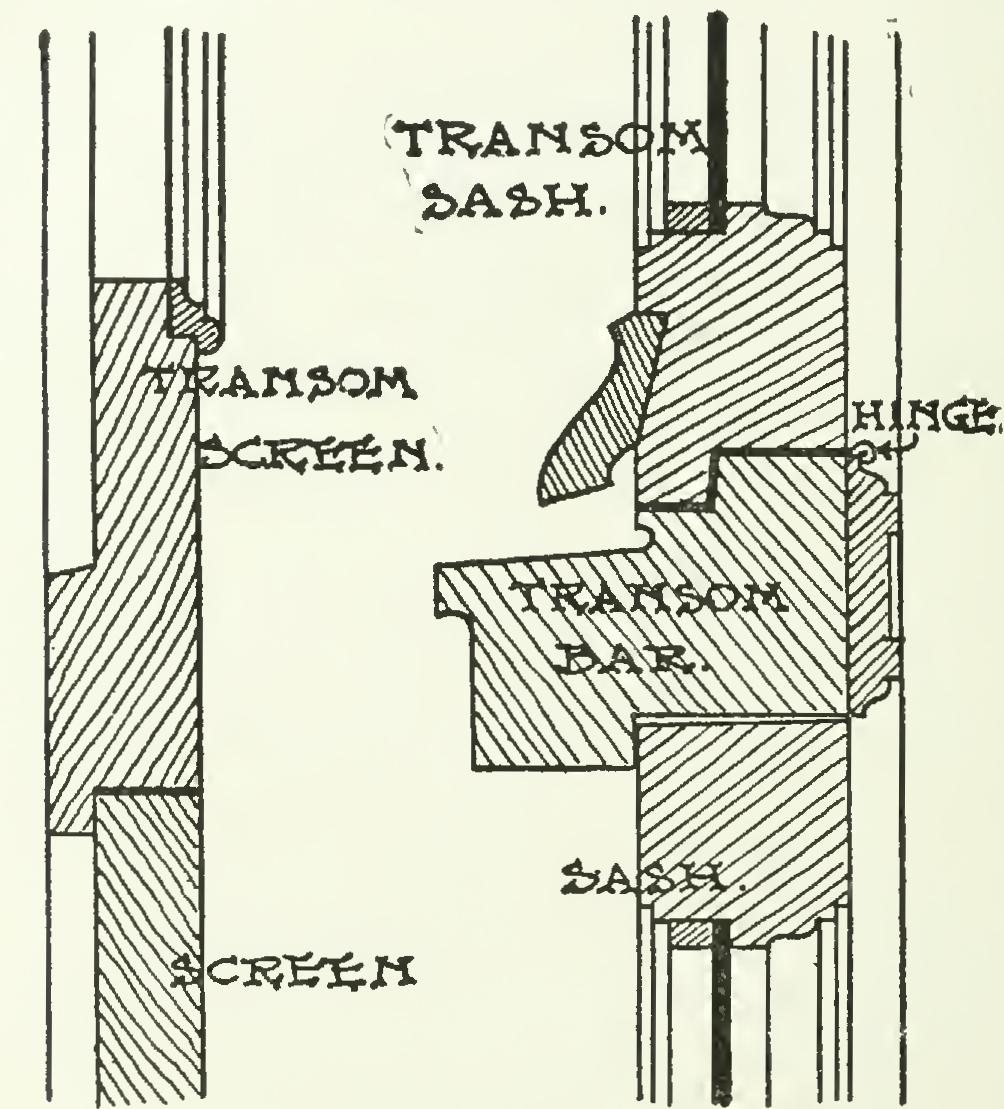
The transom sash, which is hinged at the bot toth and swings in at the top, is rebated over the transom bar and provided with a drip-mould similar to the lower sashes. The top edge of the sash is slightly beveled to allow for the up ward throw of the sash when being opened. The transom bar is moulded, and has an undercur rent just below the transom sash to cast off any water which may be driven against the joint (see Fig. 101).
The meeting rails are rebated and beveled, and have inner and outer astragals or cover moulds. At X the sash is grooved to catch any water which may work partly in at the joint.
The window-frame is rebated on the outer edge for the mosquito screen frame, which is se cured in place by means of brass lag screws. These screws are so arranged that they may be used to secure storm sashes in place when the screens are removed in winter. When the storm sashes are in place, the blinds cannot be op erated from the inside; so they must remain open, unless the blinds are fitted with a device to open them from the inside of the house.
There are several of these opening devices on the market, and they consist of a worm-gear apparatus which opens the blinds by the turn ing of a crank within the room, and without the necessity of opening the sashes. These devices are thoroughly practical and very useful, even rig. 101. Section at Transom.
in cases where they are not absolutely necessary. They permit of opening and closing the blinds in stormy weather without opening the window and subjecting the person and the room to the storm.
The screens are rebated, and hinged at the side to open in. The opening in the frame at A, bottom of Fig. 100, is covered with netting and allows any water which may come through the screen to pass out over the sill. The transom screen is stationary.
Figs. 100, 101, and 102 respectively show sec tions through the head, jamb, and sill; transom bar; and meeting rails.
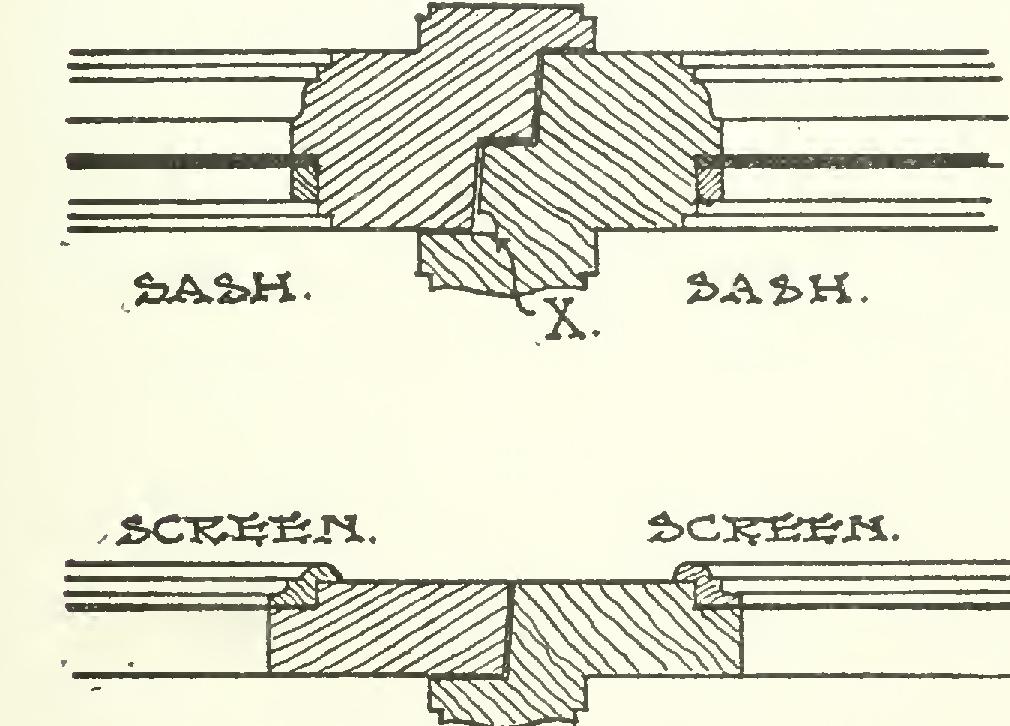
Fig. 102. Section at Meeting Rails.