Short Cuts in Stair Work
miter, shown, string, panel, line and angle
SHORT CUTS IN STAIR WORK. Short cuts and simple methods of laying out work are always interesting and valuable. Here is a method for laying out strings for a plain, straight flight of stairs.
The sketch, Fig. 86, shows how to get the lengths and cuts—that is, by using the plumb and level at each end of the string, and scribing as at a and b. Then, by changing the string end for end, it will be found to fit.
First find what rise is wanted; this depends on the space available. If there is sufficient room, steps with 7 or rise are good. Make, for example, the height between the floors 9 feet 2 inches, or 110 inches. Dividing this by 7 gives 15 or 15 spaces; and by dividing 110 by 15 will give the exact rise, which is inches.
Since there is plenty of room on the floor for the run, the tread can be made any chosen width. Suppose 9 inches is the desired width. By multiplying 15 by 9, the run on the floor, 11 feet 3 inches, is found, at which point it will Fig. 86. Short Cut for Laying Out a Straight Stair.

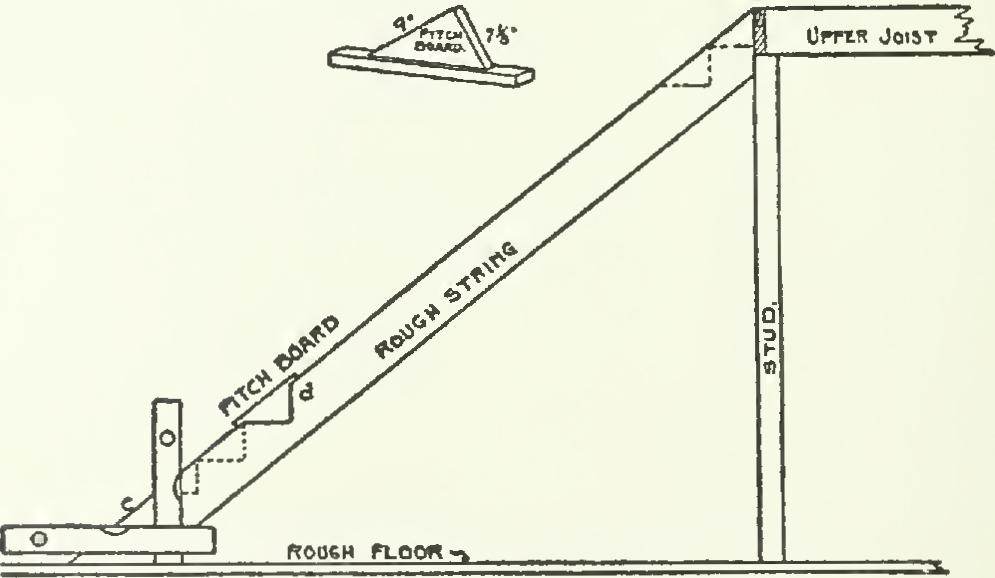
be seen that the lower end of the string has been placed. Then proceed, as already stated, with plumb and level.
After obtaining these cuts, lay the string off into 15 equal spaces with dividers, and again use the plumb and level in laying off the first notch, as shown at C. Then carefully cut this out and use the piece for the pitch-board, from which proceed to lay off the rest of the string, as shown at d.
Paneled Moulding for Stair Finish. Mould ing applied in panels to the stair string makes a very effective finish. In Fig. 87 is shown the face of a stair string with diamond-shaped panels. To begin with, all cuts of mouldings of this kind should be made in a miter box. Then the question is, how to find the angle on the square by which to make the proper cut on the miter box.
In the lower part of the figure is shown an enlarged panel with the application of the square for finding the miter line, or the line of juncture of the moulds. In this, it will be seen that there are two angles in the panel. The sharper one is known as an acute, and the other as an obtuse angle. The former is less than 90, and the latter more than 90 degrees. However, by this method, finding the miter line for one, also gives the other, because when the blade is giving the miter line for the acute, the tongue is giving it for the obtuse.
In this figure the application for both is shown, and it will be seen that the blade and tongue of like squares are resting parallel with each other. Now, as to the placing of these Pig. 87. Paneled Finish for Stairs.
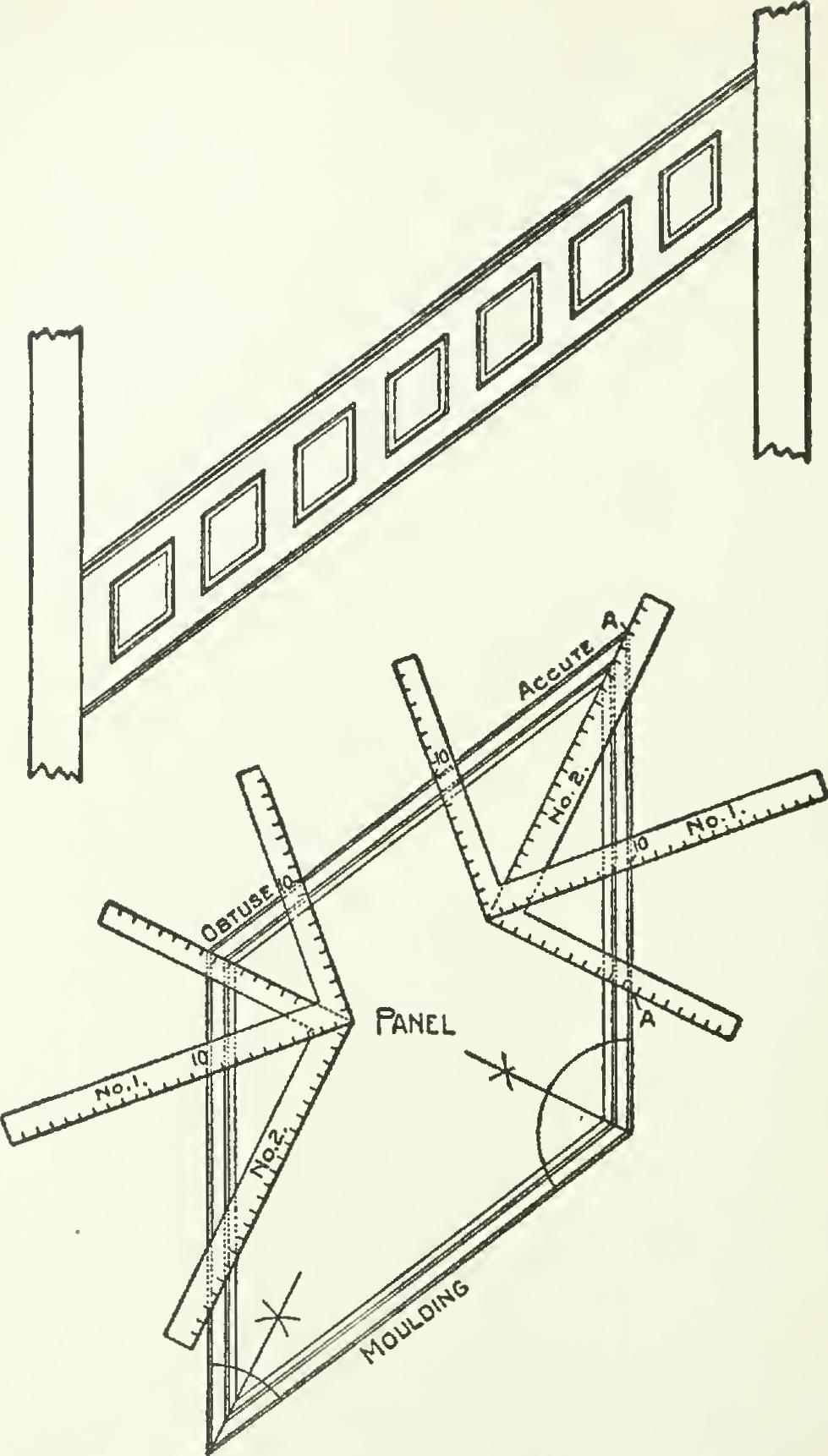
squares to get the proper angle, simply take like figures on square No. 1, say 10 and 10; place them so that these figures are at the edge of the panel, as shown, and with the heel of square No. 2 resting on the former, and with the blade intersecting the corner of the panel, the figures intersected by the edge of the panel, as at AA, will be the figures to use to make the cut on the miter box for either angle.
The same results may be obtained by bisect ing the angle with the compass, as shown in the two lower corners of the enlarged panel in the lower part of Fig. 87, and setting a bevel square to the angles thus formed. This will give the miter. A more common way, however, among workmen, is to take a block of any con venient width, and, with parallel edges and with it set each way in the corner, mark along the outer sides, the crossing of these lines will be the point for the bisecting or miter line.