Stair Building Simplified
stairs, rule, rise, inches, trimmer and run
STAIR BUILDING SIMPLIFIED.
Rules for Proportioning. Until about the time of Queen Elizabeth, the staircase, now so important a feature in all houses, was of small note. Previously, stairs were built in every case on a circular plan, revolving around a central axis or newel. These were known as turret or corkscrew stairs. Stairs with wide, straight flights were introduced during the sixteenth and seventeenth centuries, and were made the lead ing feature in the mansions of the Elizabethan style. They were very massive in design, with heavy oak balusters and enormous carved newels with ornamental panels. Many staircases of similar design but of lighter construction now exist in England, many of the more modern ones having cast-iron railings. In most houses built to-day the stairway is a most important fea ture, nevertheless its construction is frequently, and in fact usually, left with little thought as to design or convenience.
In planning stairways, care should be taken to have sufficient room so that the height of the riser is not too great. The distance from floor to floor in inches should be divided into a cer tain number of vertical distances, each of which is termed the rise, and which is usually from 7 to 8 inches. A rule frequently applied in pro 128 portioning the rise to the width of the tread is, that the rise in inches multiplied by the run or tread in inches shall be about 70 or 75. Accord ing to this, a 7-inch riser will call for a 101/2-inch tread. The workman will readily see from this rule that the greater the rise the less the run, and the less the rise the greater the run, the pro portions varying to suit different conditions.
Another rule is based on the fact that an easy pace on the level is 23 inches. In going upstairs, however, a person passes upward as well as for ward at the same time, and the rule is that "twice the rise, plus the tread, should equal 23." This gives very good results in practice.
Head
Room. A good rule for getting proper head room in a flight of stairs is to count down 13 or 14 steps from the top, and plumb up for the face of the trimmer. This gives good clearance for a tall man.
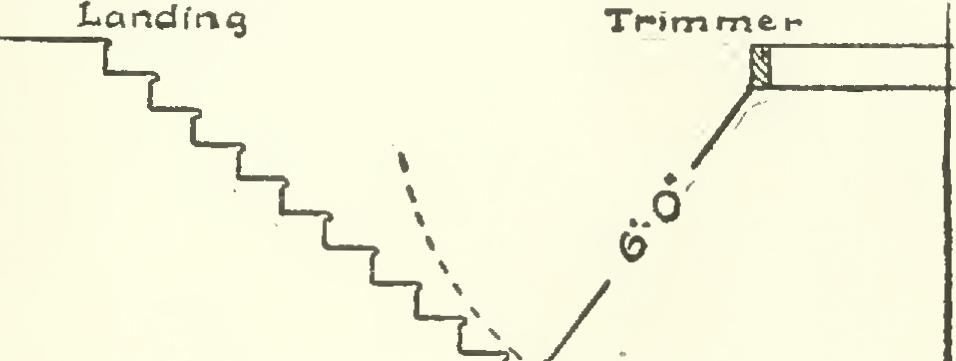
Nicholson's famous old Scotch work on build ing construction (1805) gives another good rule, which is illustrated in Fig. 70. With the bottom front edge of the trimmer as center, and a radius of 6 feet, describe an arc of a circle, from which the nosing line must be kept clear to give good head room under the trimmer.
Nicholson's rule for finding the thickness of trimmers is also useful. It was "to add to the thickness of trimmer one-eighth of an inch for every joist set into the trimmer." This works out very well indeed.
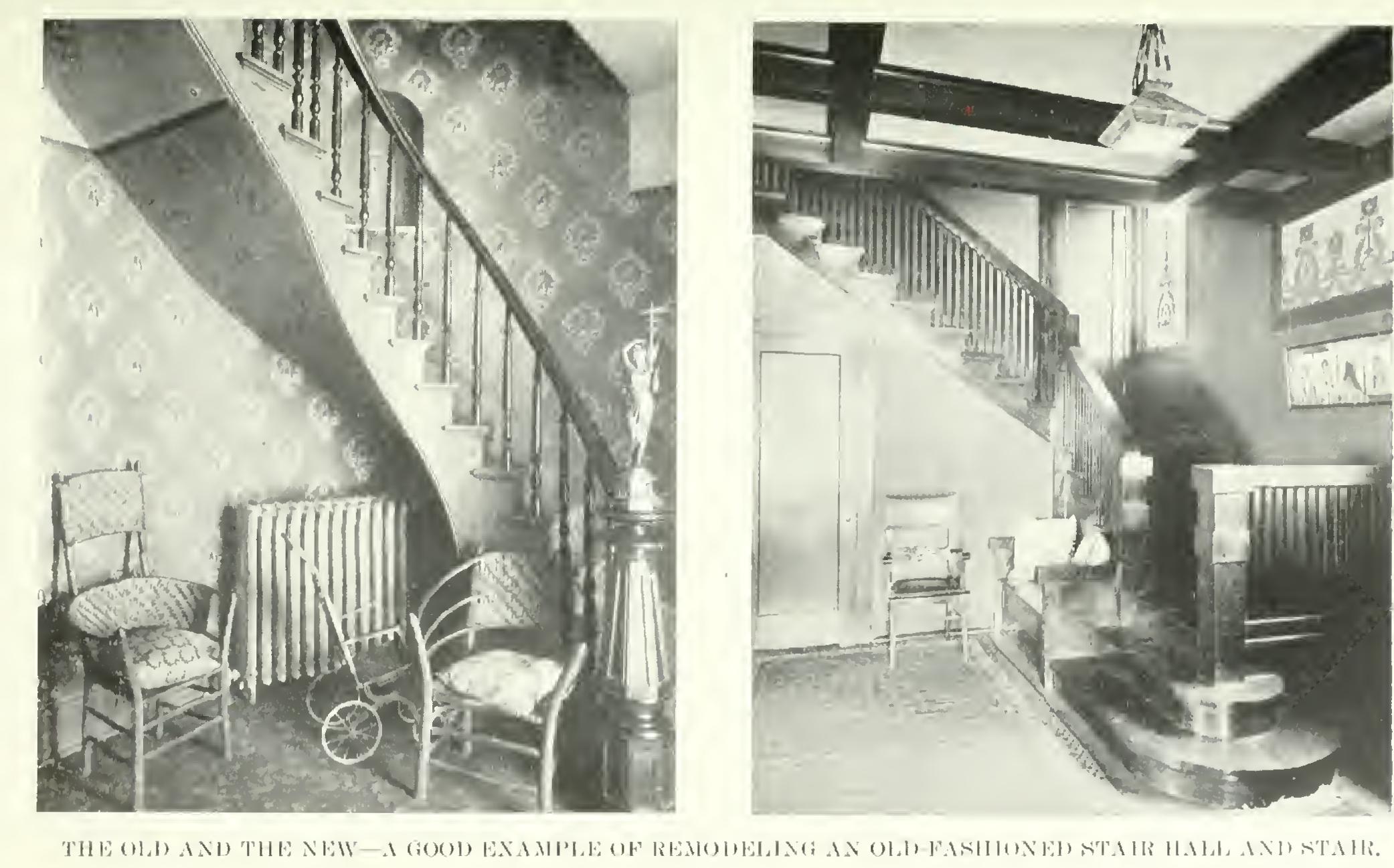
How to Lay Out the Stairs. Stair-building is a branch of framing that is well-nigh in a class by itself. In the larger cities there are men who make a specialty of stair-building, from the plain, straight run, to the more complicated plat form and winding stairs. It is the latter class of work that taxes the ingenuity of the workmen to work out the railings, newels, etc., so as to rest in the proper planes with the pitch given the stairs. To do this successfully, requires one well up in detail drafting and having a practical knowledge of geometry to lay out the turns and easements on the rough timbers, so as to be able to work them out in the finished product. How ever, the old-fashioned winding stair, with its ever winding rail, is no longer considered, from an architectural standpoint, to add to the beauty of the interior of the house, to say nothing of the added expense that must necessarily follow in the construction of circular stair work. Of course, there are times where winding stairs conform to certain space better than stairs with square turns; but even then, in most cases, it would be better to allow room for a good easy stair with square turns, and make the rooms and hallways conform to it.
So the question is how to lay out the neces sary room for a comfortable and convenient stair.