Steel 13
bessemer, output and open-hearth
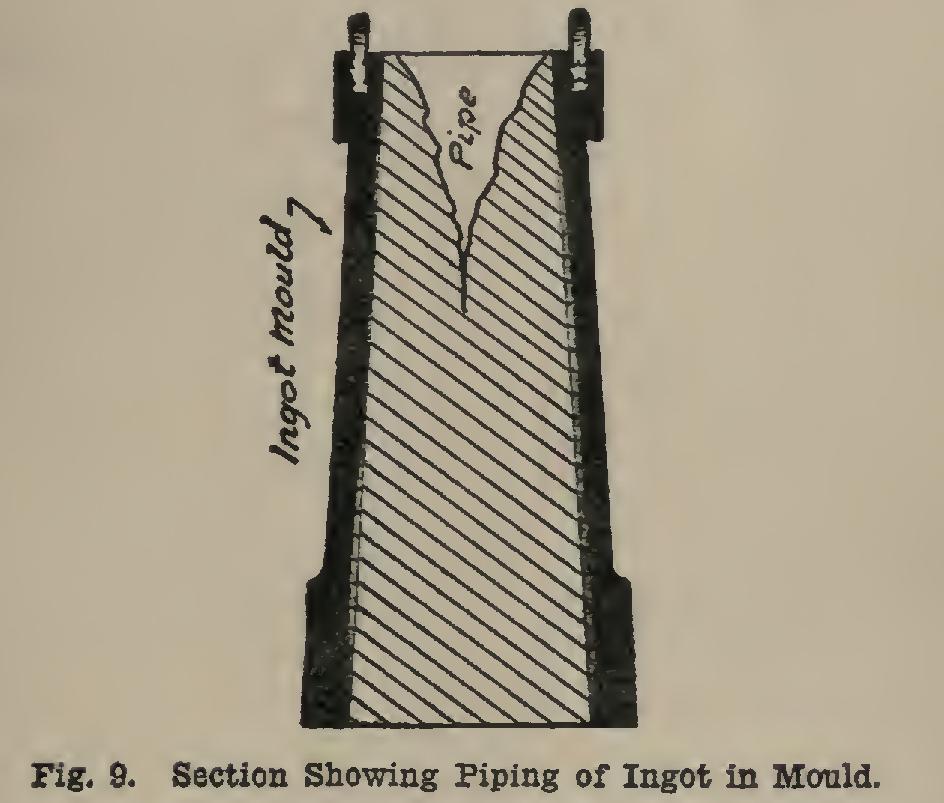
In cooling, the ingot is apt to assume a form like that shown in Fig. 9; and therefore, during cooling, the moulds are covered up with sand or an iron cap. Before the ingots have cooled to anything less than a red heat, they are stripped of their moulds and placed in soaking pits. These are gas furnaces which heat the ingot evenly throughout to the desired temperature for working. The ingot is then taken out and cropped—that is, the ends cut off in order to re move any injurious matter. The ingot may then be rolled down and cut into smaller pieces called billets, which are sold to be remelted or heated and have steel articles made from them, or it may immediately be put through the rolls (see Plate 4) and formed into bars, plates, rails, rods, or any of the various shapes for structural use.
17. Output of Steel.
In 1903 the United States produced over 45 per cent of the world's output of steel, Germany and Great Britain com ing next with 24 and 12 per cent respectively.
The percentage has probably not since changed to any great extent. Table III gives the produc
tion of. Bessemer and open-hearth steel in the three most productive States, as well as in the United States, for the year 1907.
It will be noticed that the three particular States mentioned in Table III produce all but about 16 per cent of the output. A noticeable feature of this table is that the output of open hearth steel is quite up to that of Bessemer. In 1901 the total output was: Bessemer, 8,713,302 tons; open-hearth 4,656,309 tons. On account of the fact that Bessemer steel is not so homo geneous as open-hearth, consumers are using open-hearth in many cases where they had pre viously used the Bessemer product. Then again, to make Bessemer steel requires an ore low in sulphur and phosphorus, and this is expensive as these ores are becoming scarce. It is safe to predict that the output of open-hearth will always be greater than that of Bessemer and will continue to increase. Also, it seems safe to predict that in the future the production of Bessemer steel will decrease.