Depositing Concrete
cement, stone, water, steam, mixed, covering, heated and load
For heavy mass work, thick walls, abut ments, etc., it is not necessary to heat the stone except in unusually cold weather, but sand and water should be heated. If the forms are tight and made of heavy material, it will be necessary to protect only the top of the work; this may be done by covering with a canvas and running steam under it, or by covering with boards or paper and applying a covering of straw or manure. In no case, however, should fresh manure be allowed to come in contact with very green concrete, as it will discolor and spoil the surface. If the work, covered in the manner described, is protected from freezing for several days, it is sufficient, unless it has to be loaded immediately; but thin walls, light foundations, etc., should be protected on all sides in the man ner pointed out above. For reinforced work it is necessary to heat all the materials but the cement; and the concrete should be hot when placed in the forms. Where the work must be placed in service as soon as possible, the only safe practice is to keep the surrounding tem perature well above the freezing point until the work has thoroughly hardened.
The aggregates may be heated by being piled over sheet-iron pipes or drums in which fires are built, or over steam pipes laid through the bottom of the storage bins. The water may be heated by exhaust steam or in any other con venient way. When a mechanical mixer is used, it also is sometimes kept warm, by means of steam coils outside and jets inside.
Concrete increases in strength but very slowly in cold weather; and for this reason, forms should be left on as long as possible, and care taken not to load a structure too soon. Just how old the work should be before removing the forms and subjecting it to its load, cannot be stated, as this will depend entirely upon how fast the concrete hardens. Careful inspection of the structure is necessary before removing the forms and applying the load; and it must be remembered that frozen concrete closely re sembles thoroughly hardened concrete in ap pearance, and, when broken, frequently shows a fracture through the aggregate, although upon thawing it may have but little strength.

General Working Rules Working with concrete is not an occupation in which the layman can experiment inexpen sively. The general rule may well be laid down: Do not purchase an ounce of cement or stone till you know exactly what you are going to do, and how you are going to do it. Famil iarity with the rules governing the mixing, and with the proportions and quantities, is abso lutely essential to success. This is true of all mechanics, and especially true of concrete work.
It is not necessarily true that the worker must know the scientific and chemical properties of the work, but he must know the "how." Of course it is better if he has a knowledge of the chemistry of concrete work, but he may produce good results by merely following exactly the formula that has proved effective and advan tageous in the hands of experts. These general remarks are made for the benefit of the novice who is thinking of using concrete in the build ing of a house, or in the improvement of a home he already possesses. So bear these things in mind: Do not guess as to measurements.
Do not use less cement than any formula calls for.
Mix very thoroughly.
Put your concrete in place at once.
Use only clean water, and clean gravel or stone.
These five "musts," kept constantly in mind and in practice, are the foundations of success. To ignore any one of them spells failure.
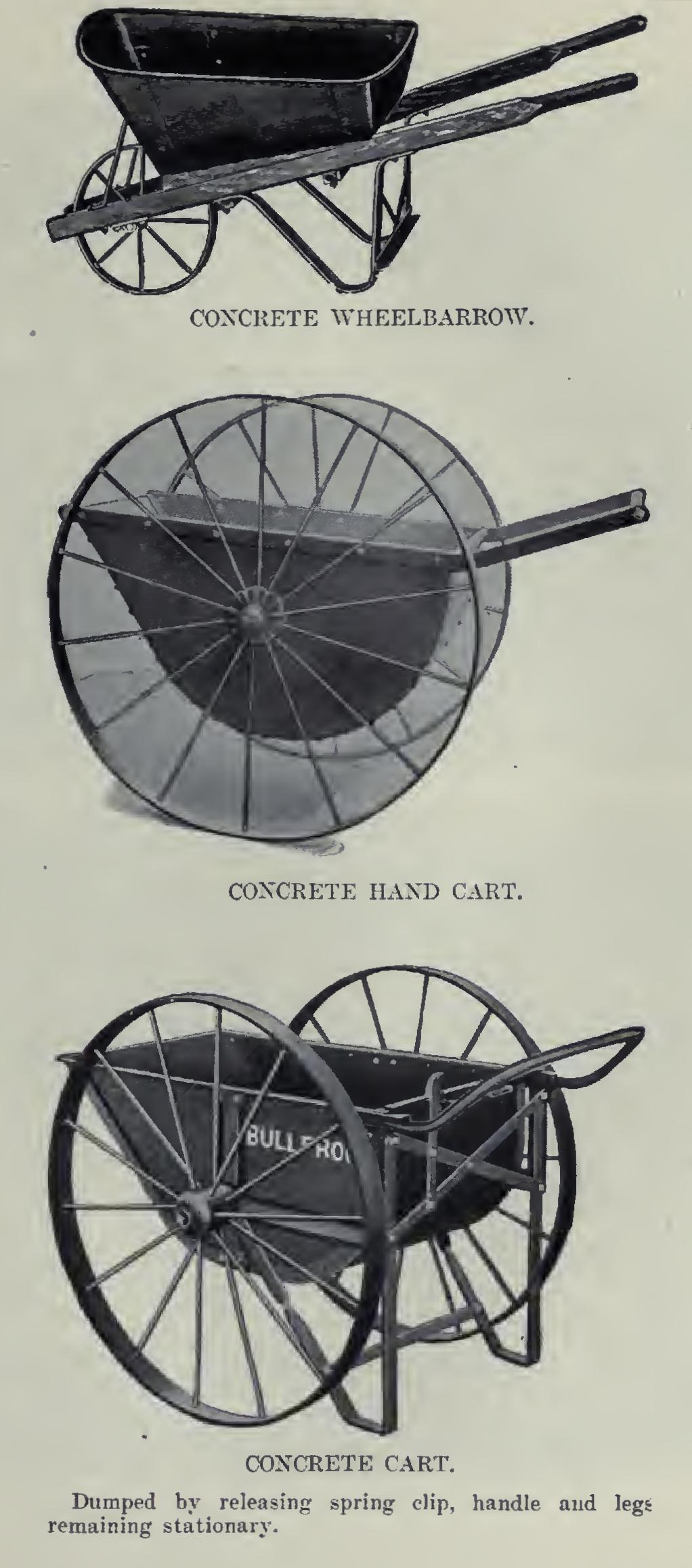
Probably the most important of the above cautions is that relating to the mixing of the concrete. It is in this part of the work that haphazard methods are most apt to creep in, especially if the operations are hurried. The importance of accurate measuring and strict ad herence to proportions, cannot be urged too strongly. For ordinary hand work, not more than a cubic yard should be gauged at a time. The worker should have plenty of space for handling the mixture. Faulty concrete is made more frequently as a result of carelessness in gauging than from any other cause; but the blame is usually ascribed to something else. If the measuring of the cement is done by sacks, or of the aggregate by barrow loads, the utmost care should be exercised to insure accurate measurement so that the chances of poor con crete will be avoided.
The aggregate and the cement should be turned over at least three times on the board. If the mixture looks streaky, and does not have a uniform color, it is not fully mixed. When the water is added, it should be applied grad ually, all the time being mixed. No more ma terial should be gauged than can be handled quickly. As soon as the concrete is ready, it should be shoveled into pails and carried to the place where it is to be used; it should be de posited in position within 20 to 30 minutes after the first wetting of the cement. Nor should there be any disturbance of it after it is placed, more than is absolutely necessary.
If the mixture does not work well, the sand and cement not filling the voids in the stone, reduce the percentage of stone slightly, but first be sure the concrete is properly mixed. Half mixed concrete may present features that are entirely eliminated by turning it over once or twice more.