Concrete in Barn and Stable Construction
inches, build, clean, sand and stone
Piers and Posts.
For this work the builder should excavate below the frost line, and build forms 2 feet square to a point within 6 inches of the surface of the ground. Fill with concrete consisting of one part cement, two and a-half parts clean, sharp sand, and five parts gravel or crushed stone not more than one inch in size.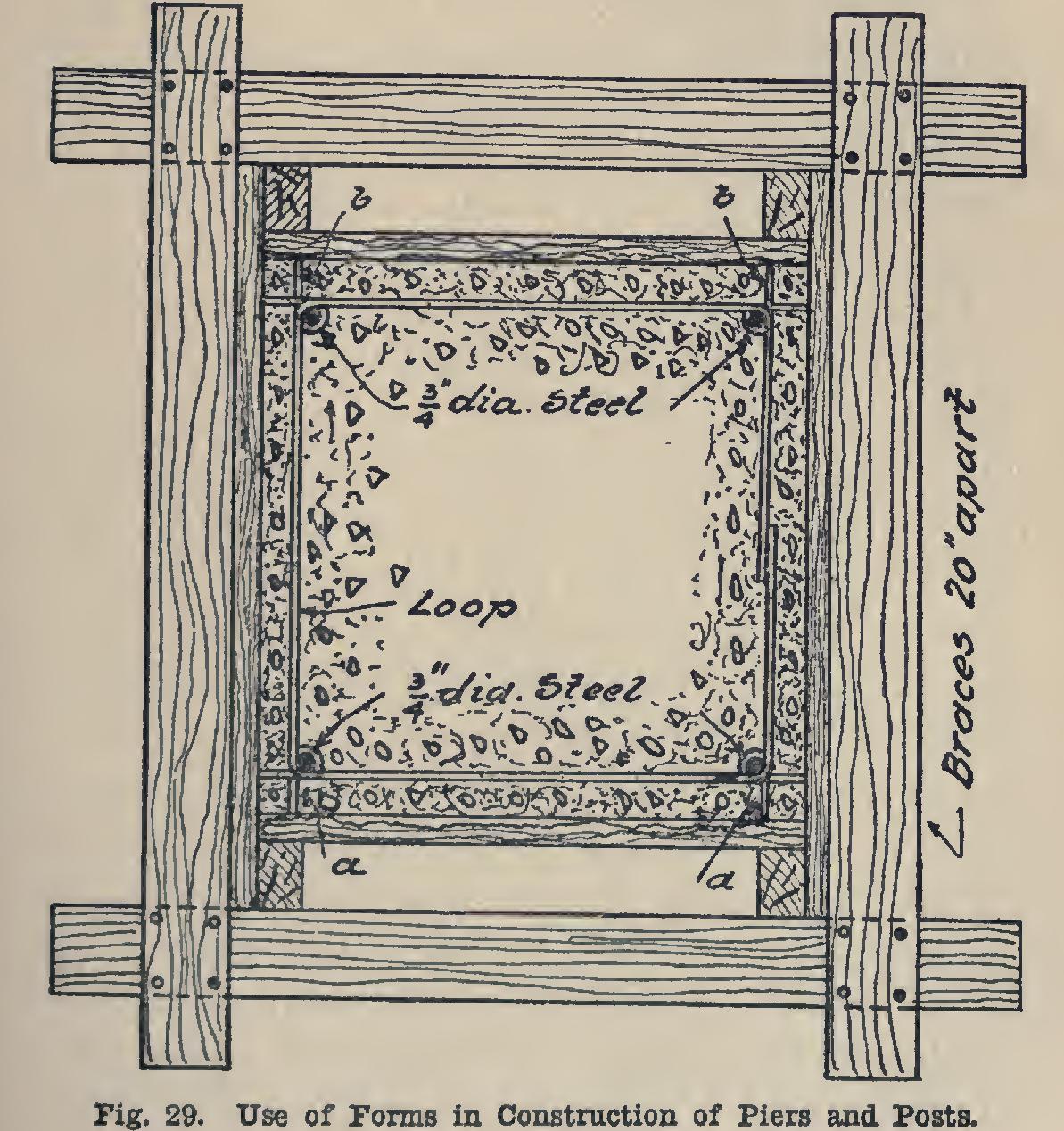
The mixture must be tamped carefully. From the center of this foundation, build a hollow form one foot square and to the desired height, and fill with concrete of the same composition as the other. Before the form is filled, and in fact be fore it is set, place four steel bars inch in diameter, vertically, so that they will be about two inches inside the corners; and around them, at intervals of one foot, wind loops of or wire, tying them to the steel rods with finer wire. Every two feet a short piece of or wire may be tied to each of the ver tical rods so as to project against the form and hold the steel in place. The concrete should be made soft and pliable so that it will flow, and, as it is poured into the top of the mould, work a long paddle, made like the oar of a rowboat, against the forms, to force the stones away from the surface and drive out bubbles of air which tend to adhere to the forms and form pockets. This method of construction makes an excellent foundation for a barn.
A
Concrete Rain Barrel. Among the newer uses to which concrete has been placed is that of making rain barrels. A convenient size, easily made, is 36 inches high, 24 inches in di ameter, with a shell inch thick, the whole being treated with a waterproofing compound. No matter how long such a barrel is left empty in the hot sun, it will not spring a leak.
A
Horse Block. In the construction of a horse block, the method does not differ mate rially from that employed in making a small tank. Build a box 24 inches long, 10 inches wide, and 8 inches deep, outside measure. Turn this bottom up on the floor or some other smooth sur face; and around it build a box or form, without bottom, 36 inches long, 18 inches wide, and 12 inches deep, inside measure. Be sure that the smaller box is set at equal distances from both sides and ends of the larger box, and fill the form thus made with concrete, one part Portland ce ment, three parts clean, coarse sand, and five parts gravel or broken stone. Scrape with straight-edge, and smooth with wooden float. Let it stand for at least 48 hours before remov ing outside form. Keep damp by sprinkling for three weeks, and do not attempt to move it be fore that time. If finished appearance is de sired, as soon as the form is removed a coating one-eighth inch thick, made of one part Port land cement and one part clean sand may be plastered over the entire surface of the block, after picking with a stone axe and wetting thoroughly. See Plate 6.
Hot-Bed Frames. Excavate a trench to a depth below frost, and erect forms for a 4-inch wall. Fill with concrete mixture one part Port land cement, three parts clean, coarse sand, and six parts gravel or broken stone that will pass a half-inch sieve, to level of the ground. On top of these, build forms for a 3-inch wall to the height desired, and fill with concrete of the same proportions. These structures are so small in