Curbs and Gutters
inches, concrete, curb, broken and cement
CURBS AND GUTTERS The foundation for curbs and gutters, as for sidewalks, should be governed by the soil and climate.
Concrete curbing should be built in advance of the walk, in sectional pieces 6 feet to 8 feet long, and separated from each other and from the walk by tar paper or a cut joint, in the same manner as the walk is divided into blocks.
Curbs should be 4 inches to 7 inches wide at the top, and 5 inches to 8 inches at the bottom, with a face 6 inches to 7 inches above the gutter. The curb should stand on a concrete base 5 inches to 8 inches thick, which in turn should have a sub-base of porous material at least 12 inches thick. The gutter should be 16 inches to 20 inches broad, and 6 inches to 9 inches thick, and should also have a porous foundation at least 12 inches thick.
Keeping the above dimensions in mind, exca vate a trench the combined width of the gutter and curb, and put in the sub-base of porous ma terial. On top of this, place forms, and fill with a layer of concrete, one part Portland cement, three parts clean, coarse sand, and six parts broken stone, thick enough to fill the forms to about 3 inches below the street level. As soon as the concrete is sufficiently set to withstand pressure, place forms for the curb; and, after carefully cleaning the concrete between the forms and thoroughly wetting, fill with concrete, one part Portland cement, two and one-half parts clean, coarse sand, and five parts broken stone. When the curb has sufficiently set to withstand its own weight without bulging, re move the board between the face of the curb and the form (shown in Fig. 37), and with
the aid of a trowel fill in the space between the concrete and the form with cement mortar, one part Portland cement and one part clean, coarse sand. The finishing coat at the top of the curb should be put on at the same time. Trowel thor oughly and smooth with a wooden float, remov ing face form the following day. Sprinkle often and protect from sun.
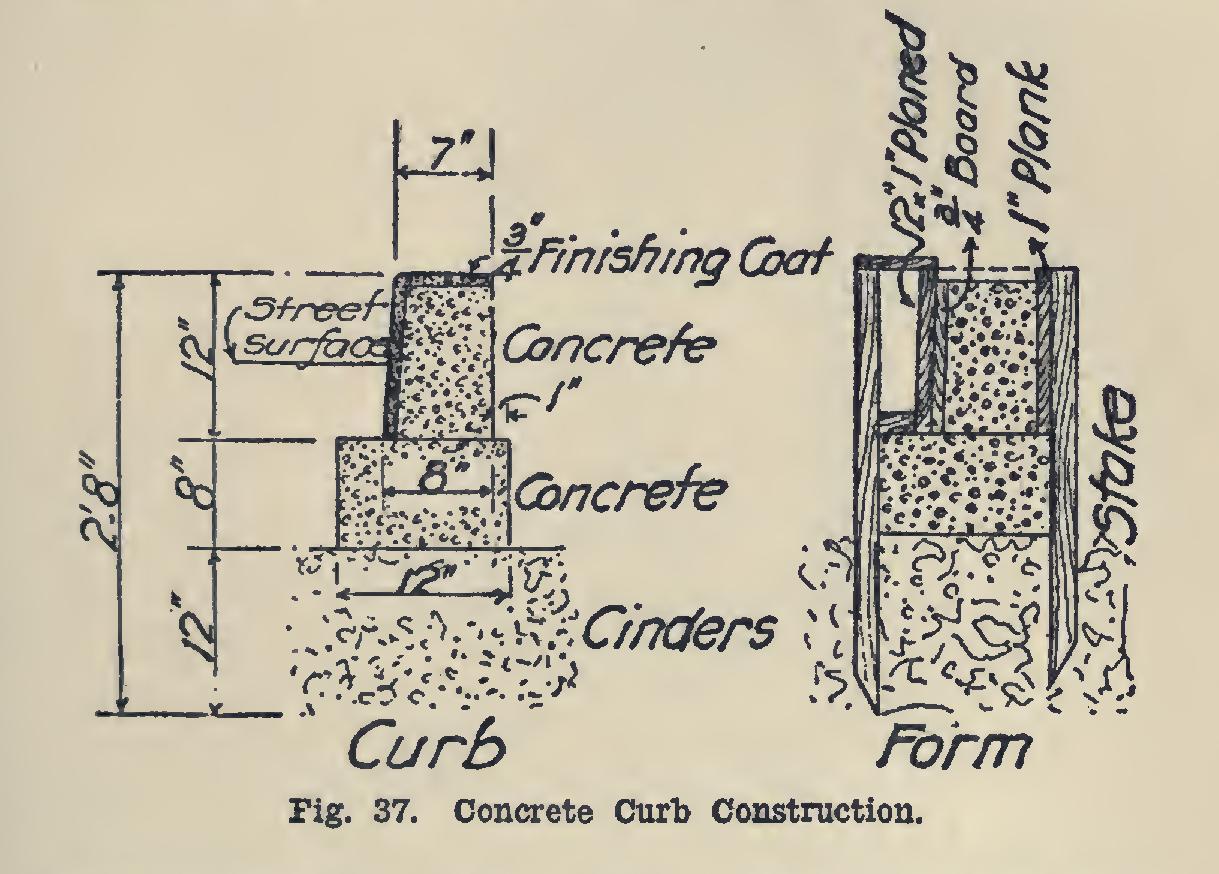
In making curbs alone, excavate 32 inches below the level of the curb, and fill with cinders, broken stone, gravel, or broken brick, to a depth of 12 inches. Build a foundation 8 inches deep by 12 inches broad, one part Portland cement, three parts clean, coarse sand, and six parts broken stone; and from the top of this and nearly flush with the rear, build a concrete wall inches high, inches broad at the base, and inches at the top, the 1-inch slope to be on the face.
Remove the forms as soon as the concrete will withstand its own weight without bulging, and put on the finishing coat in the manner as indicated above. Keep moist for several days, and protect from the sun. Measurements may be varied to suit local conditions.
Protecting Corners.
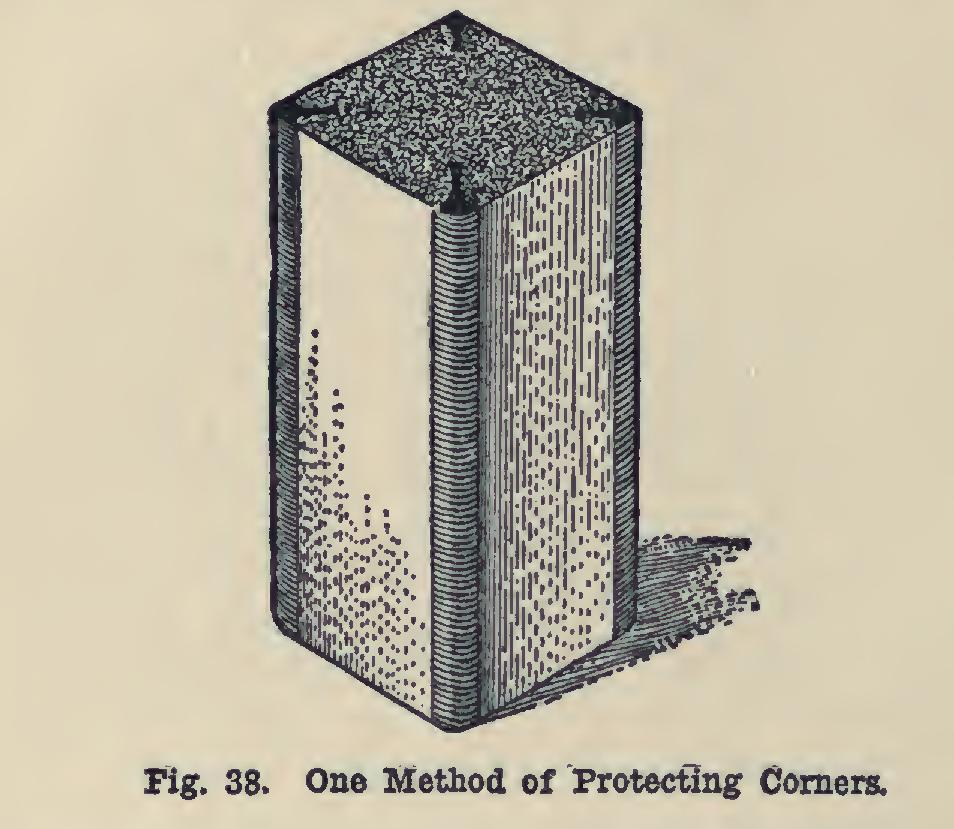
It is often necessary to protect the exposed corners of concrete work. For this work there are a number of devices.
One is the "Wainwright" system, in which the protective material is a galvanized steel T-bar with a dovetailed web.