English Systems of Floor Construction
concrete, fire, joists and lintels
It is commonly supposed to be an American invention, by reason of having been so largely adopted there for floors, etc. On the other hand, although concrete will stand a severe fire with out collapsing, there can be no doubt that ex posure to high temperature tends to weaken it considerably; and when this occurs, both con crete walls and floors should be tested before they are passed as safe. The erection of enor mous smoke shafts with concrete is an American invention, and is an experiment worth watching.
Smoke flues of chimneys of ordinary dwell ings, where constructed of river gravel concrete, usually give evidence, when swept, of some dis lodgment of surface concrete; and these high chimneys are said to be made of concrete com posed of Portland cement and Thames sand, the latter being the detritus arising from flint strata in the chalk formation.
A type of hollow fire clay tile construction floor is shown by Ferguson's, Fig. 18, which has been in use about fifteen years. The steel joists are fixed two or three feet apart; the tubes are slotted to pass under the joists, and the span drels filled in with concrete in the usual way. Unlike most other floors of this character, there are no skewbacks. The depth of the floor tubes is inches in the center, and they weigh about nineteen pounds per square foot. Dovetail grooves, as in Bunnett's of 1858, give a key for the plaster.

In Homan's system of fire resisting tile con struction—or rather one of them, for the Ho mans have taken out enough patents during the last forty years, one would think, to cover the whole field of fire protection—the fire clay lin tels are slotted at the ends, as in other systems, to pass under, and the soffits are also grooved for a key for the plaster. Steel joists are used, and tubular lintels, with concrete filling in on the lin tels. The floor finish may be of cement, or of wood blocks or flooring nailed to the concrete.
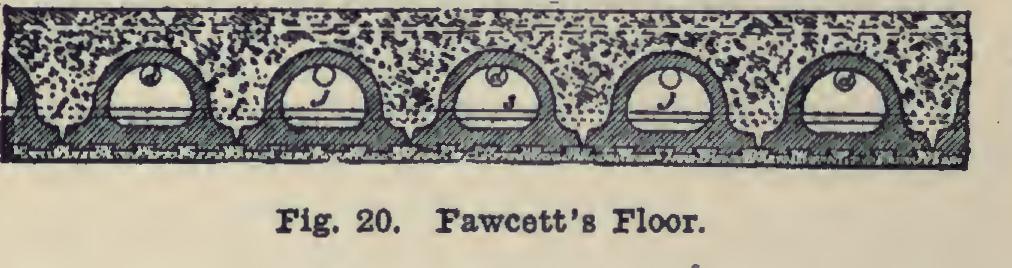
Fawcett's floor (Figs. 19 and 20) is a class of floor similar to Homan's, the difference being only in the section of the lintels. JJ are steel joists; DD, holes in joists for ventilating pur poses; LL, fire clay lintels; F, concrete filling which takes a bearing on the flanges of the joists, relieving the weight on the lintels. Fawcett's floor was patented in 1888.
The Kleine floor is formed with hollow burnt clay blocks laid in courses. Between the courses, light steel bars on edge are built in as the work proceeds, the ends of which rest on the walls or beam supports, concrete being filled on top to the depth required, and the blocks require a tem porary platform beneath.
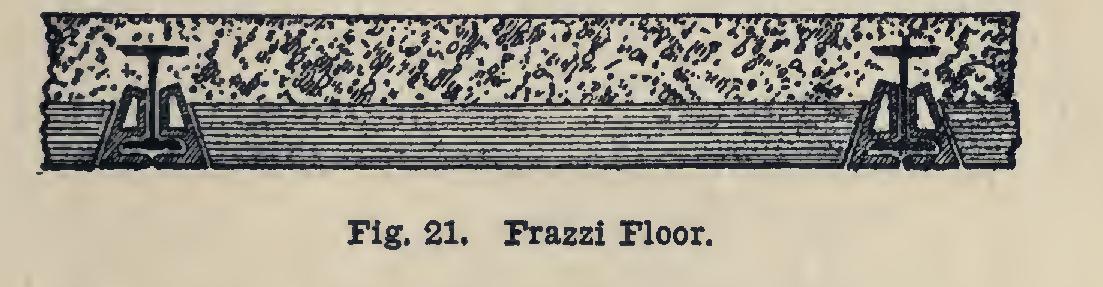
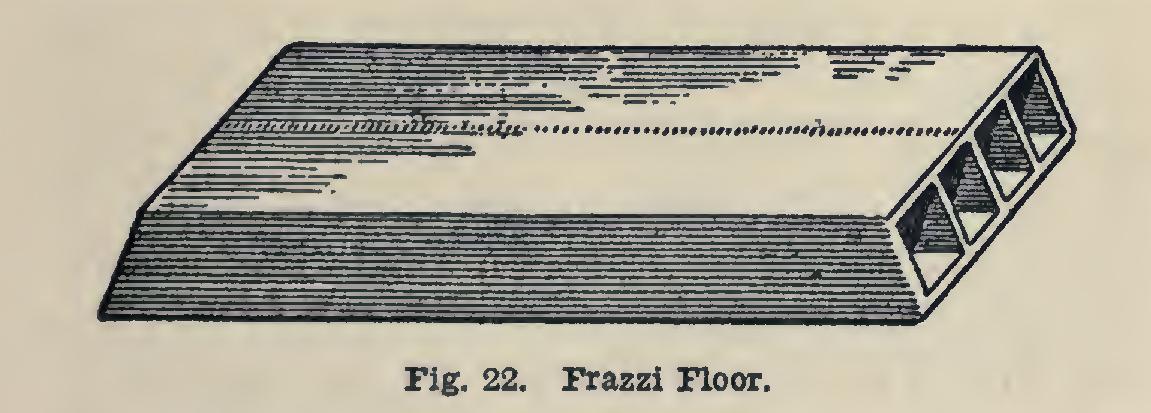
The Frazzi floor (Figs. 21 and 22) has fire clay lintels with skewbacks of the same mate rials, and concrete filled over the top in the usual way.