Abutments and Piers
pier, concrete and bridge
The second requirement for the design of a pier is that it should be able to resist the action of running water or moving ice and debris. Water will have little effect on a masonry pier unless it manages to undermine the footings; and this will not occur if the precautions mentioned in the preceding paragraph are taken. Floating ice and wreckage, however, constitute a formid able menace to the stability of a bridge; and for this reason it is well to have as few piers as possible exposed to the current. Such piers as are exposed should be made massive, well founded to prevent sliding, and shaped to ob struct the current as little as possible and de flect the logs or ice that may be thrown against them. For this reason, piers have their long dimension parallel to the stream, are made as narrow as possible, and are provided with a rounded or pointed cut-water or starling at the upstream end. The nose is often reinforced with an old rail, steel bars, or a cast-iron plate.
The final requirement for a well-designed pier—stability against overturning—is usually supplied for ordinary heights if the precautions mentioned above have been taken. In the case of a high pier, however, it is often necessary for the engineer to make additional calculations in view of possible overturning.
Fig. 74 is a standard drawing for a concrete pier showing a top view, side vie Nv, and section. On the top view may be seen the position of the bridge shoes or pedestals, and the general out line of the pier including the starling. The "Rules for Design" given on the diagram will assist in filling in some of the blank dimensions; the remainder will depend on the height of the pier, length of the bridge span, nature of the foundation, etc., and must be filled out before the carpenter can lay out his forms.
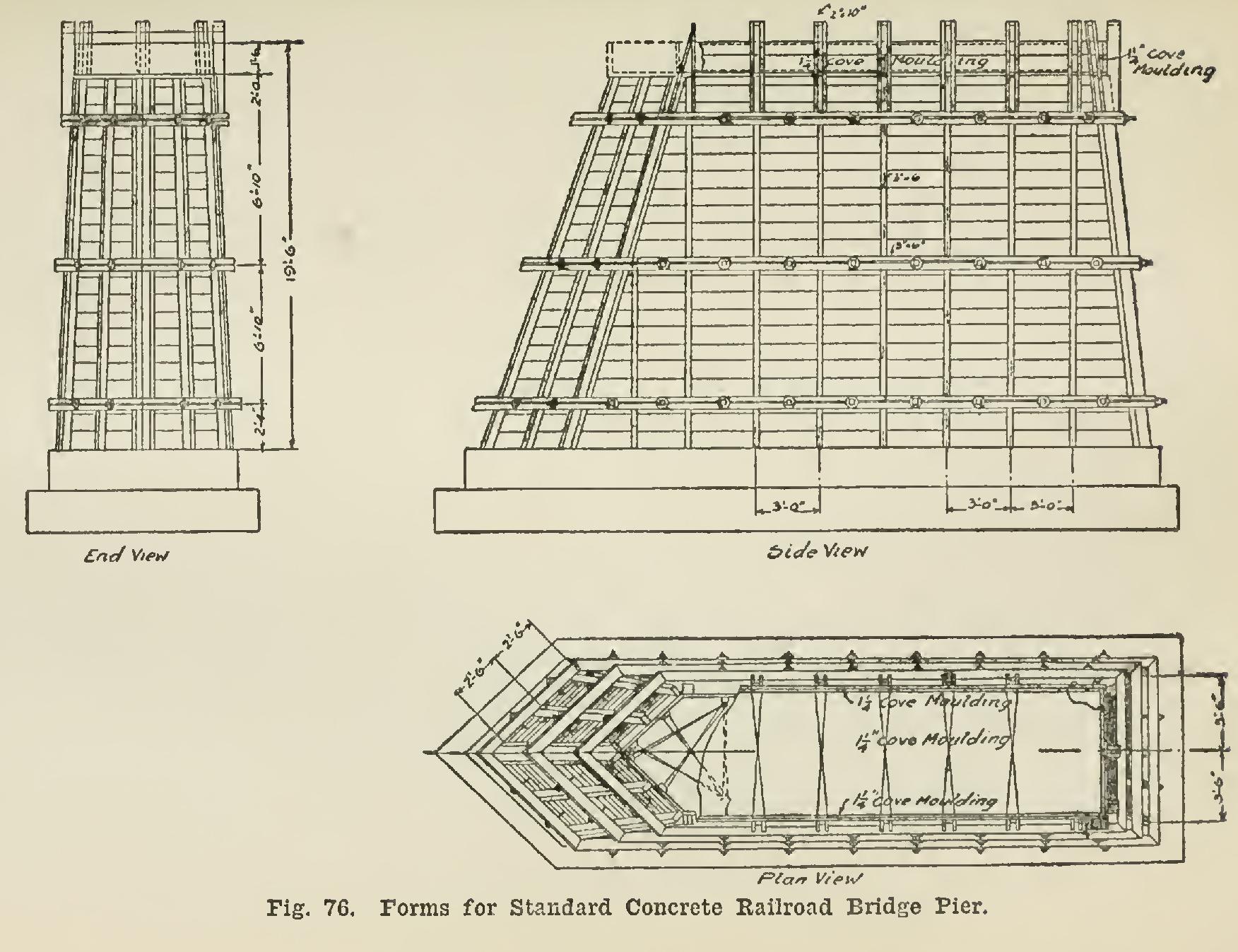
Fig. 76 is a plan of the form work for a con crete pier.
Bridge piers have been built of piles, timber frames filled with stone, metal cylinders filled with concrete, brick, and stone masonry, but are now generally constructed of concrete, which is an ideal material to answer all the requirements.
For piers of average height, plain concrete is all that is required; but for the center piers of swing-bridges, and for piers of extreme height, it has been found economical in many cases to use reinforced concrete and to make the piers hollow.