Comparative Cost of Concrete Bridges
spans, arch, ft, reinforced, steel, bridge and structures
Some other comparisons in first cost may also be in structive: (a) For a bridge over the Neutra at Neuhansel, in IIungary, a concrete bridge consisting of six spans, each 55.8 ft. in the clear, cost $13,700, while a wooden one of twelve spans was estimated to cost $12,000.
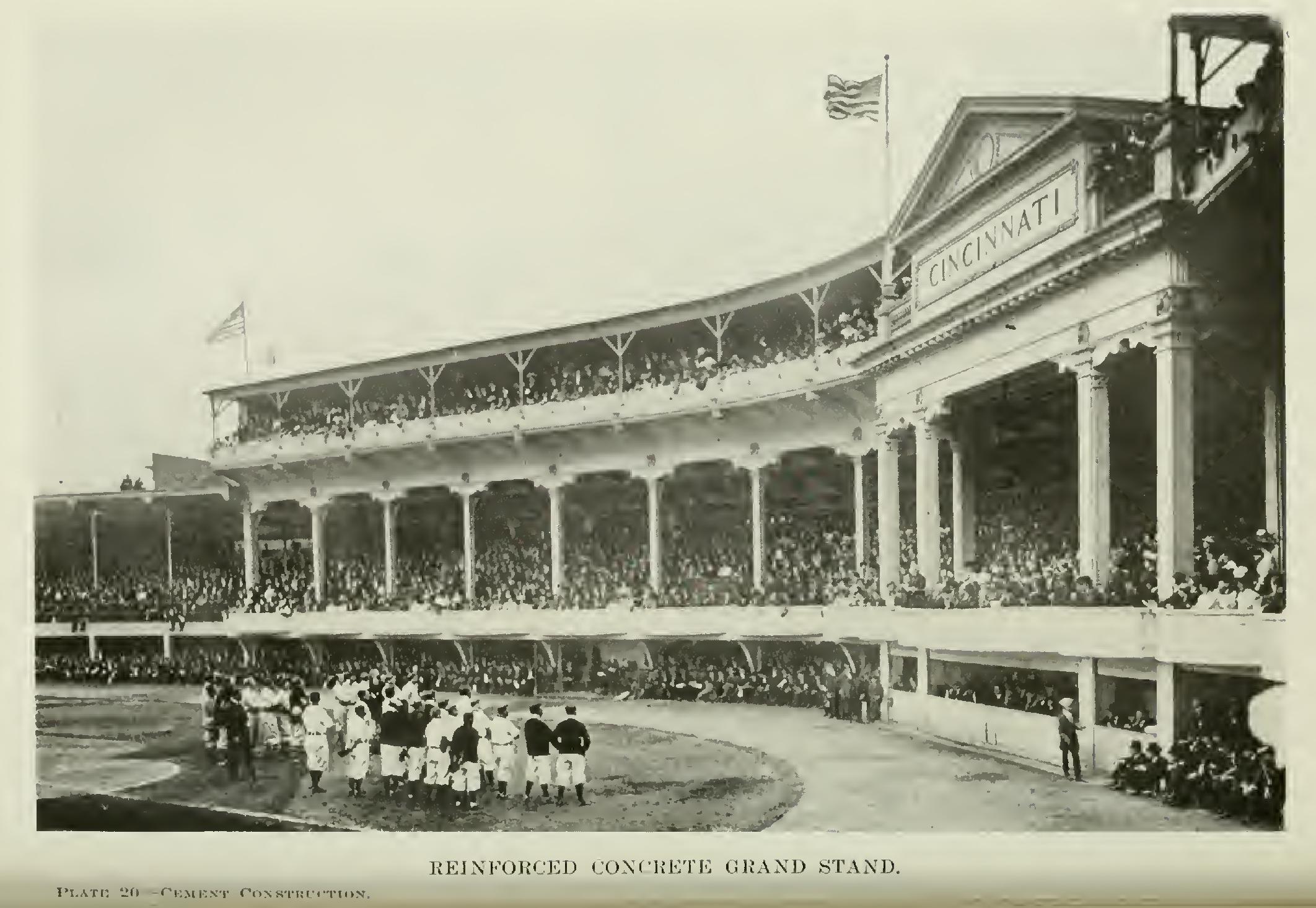
(b) The concrete arch over Park avenue, in Eden Park, Cincinnati, cost $7,130, while a stone structure was estimated at $12,000.
(c) At Belleville, Ill., for a bridge over Richmond creek, plans were prepared for bridges of iron, stone, brick, and concrete. Bids were received on the last two named only, and ranged between $11,259 and $12,830 for a brick arch, and between $10,433 and $12,110 for con crete.
. . .
(d) At Indianapolis, the lowest price received for building two Melan bridges was $105,340, the lowest price for stone bridges being $140,996. Steel bridges, although somewhat lower in cost than the concrete ones, were re jected on account of their inferior beauty and their tem porary character.
In an interview with Mr. Edwin Thatcher, the Nestor of concrete bridge builders of the United States, he stated that concrete could almost always compete with steel for highway structures whenever the floor in each case was to be paved like the street surface. When, how ever, a plank floor was allowed in the case of the steel structures, concrete could not usually compete success fully, simply on the basis of first cost. . . .
Mr. George P. Carver, in his handbook on Reinforced Concrete, gives detailed estimates of concrete arch bridges of 50, 75, and 100-ft. span, 28 ft. wide, from which he has prepared a curve of costs to be used in roughly esti mating such structures for interurban railroad use : The estimates are as follows : Table IV gives some of the dimensions and costs of a number of arches. In the case of single arch spans, the cost per square foot is computed from face to face of abutments and out to out of railings.

Continental European practice is well described by Professor Morsch in "Eisenbetonbau": With the advent of concrete and of cement pipe, arched conduits, easily constructed in concrete, or, for smaller openings, concrete pipes were substituted. With the in troduction of reinforced concrete, however, slab culverts again became useful. Since it is possible with the aid of
reinforcement to make the concrete slab resist any bend ing stress, the span of the slab on the clear way through these culverts can be increased to about 21 ft., so that their field of usefulness has been greatly extended. The span might be still further increased, but beyond about 16 ft., T-beams are cheaper than simple slabs. . . . The usual arrangement is (then) to span the opening with several similar parallel girders and lay a floor-slab be tween them. . . . T-beam bridges of this type, of spans up to 52 ft., are entirely practicable and in most cases cheaper than steel bridges. Special instances exist of 66-ft. spans. . . . With wider spans, the girders become rather heavy, so that T-beam bridges possess little superiority over steel ones. . . .
"An important advantage of such reinforced con crete bridges over railways is that they are not affected by the gases from the locomotives, which, in the case of busy stretches of track and where difficult of access, cause active corrosion and high maintenance charges for steel structures. . . . If the length of a horizontal rein forced concrete bridge is greater than 43 to 66 ft., inter mediate supports must be provided.
"In straight girder bridges of greater lengths, an expansion joint must be provided about every fourth opening. . . .
"In arched bridges, reinforced concrete can be em ployed either for the arch alone or the superstructure, including the roadway, or in all structural parts. . . .
"In medium spans of 130 to 165 ft., the employment of reinforced concrete as the arch material is less fre quent, since in this case, provided a proper profile has been employed, no tensile stresses occur, because of the large dead load. On the other hand, reinforced concrete is better adapted for long spans. If the safe compressive stress in the arch is not to be exceeded, it is necessary to limit the weight of the superstructure, and this can be done by a suitable employment of reinforced concrete. In this way the dead load stresses will be greatly reduced, but the small edge stress may decrease to zero or change to tension under unfavorable live loads, so that the rein forcement is again necessary.