Comparative Cost of Concrete Bridges
structure, repairs, determine, movement and structures
"Between these two extremes there are many reasons for making inspections of more or less thoroughness and frequency.
"The following scheme for inspection seems to be an average of practice. It is applicable to either the di visional or departmental system of maintenance: " (I) By track men daily in connection with the inspection of the track, to note especially whether the structure has suffered any damage from drift, high water, slides, or objects falling from cars, and any movement of the substructure.
" (2) Monthly by a member of a bridge gang report ing through the foreman to the Supervisor of Bridges and Buildings, to ascertain condition and safety of structure and repairs necessary.
"(3) Annually by an inspector, to obtain a detailed report of the condition of the structure for office record, and to determine the amount of deterioration, safety, and necessity for repairs or renewals.
" (4) Annually by the authorities having charge of of the structure, to determine the necessity for extensive repairs or reinforcement or renewals.
"In addition to the foregoing, special examination should be made as occasion may require as follows: " (a) Of structures that are strained high or show signs of distress under traffic.
" (b) Of substructures showing signs of movement, until it has been ascertained that a state of stable equi librium has been reached, or until movement becomes so great that rebuilding is necessary.
" (c) After heavy floods, for evidence of damage to superstructure by drift, and to substructure by scour.
" (d) By engineering department whenever a struc ture is reported as requiring repairs or renewals." The items which are to be noted by the inspector, as required by the Oregon Short Line Railroad, are as follows: A somewhat similar list of items concerning concrete or stone arch bridges is as follows : The points to be noted are almost entirely cracks— their location, width, length, depth, and water-bearing qualities. Their location will determine to a certain ex
tent whether they arc due to settlement or spreading of abutments, to setting shrinkage, changes of temperature, or overloading. Their change of size with variation in load, humidity, temperature, etc., will afford further in formation, especially as to their cause and cure. The amount of water coming through them, and its quality, arc of importance in determining the dangerousness of their existence from another point of view.
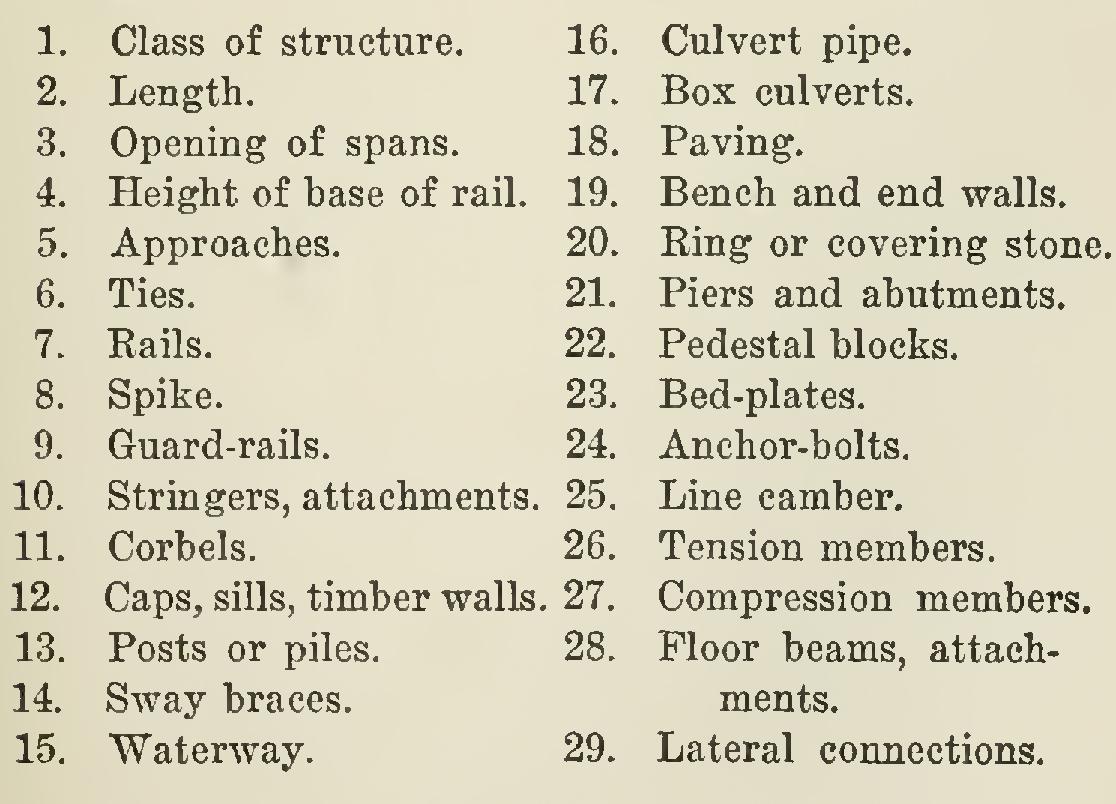
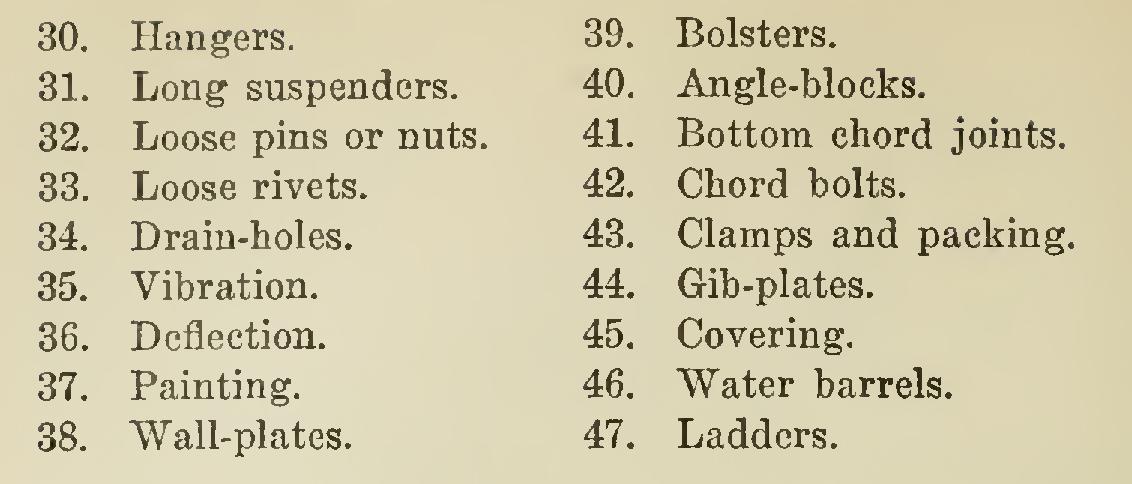
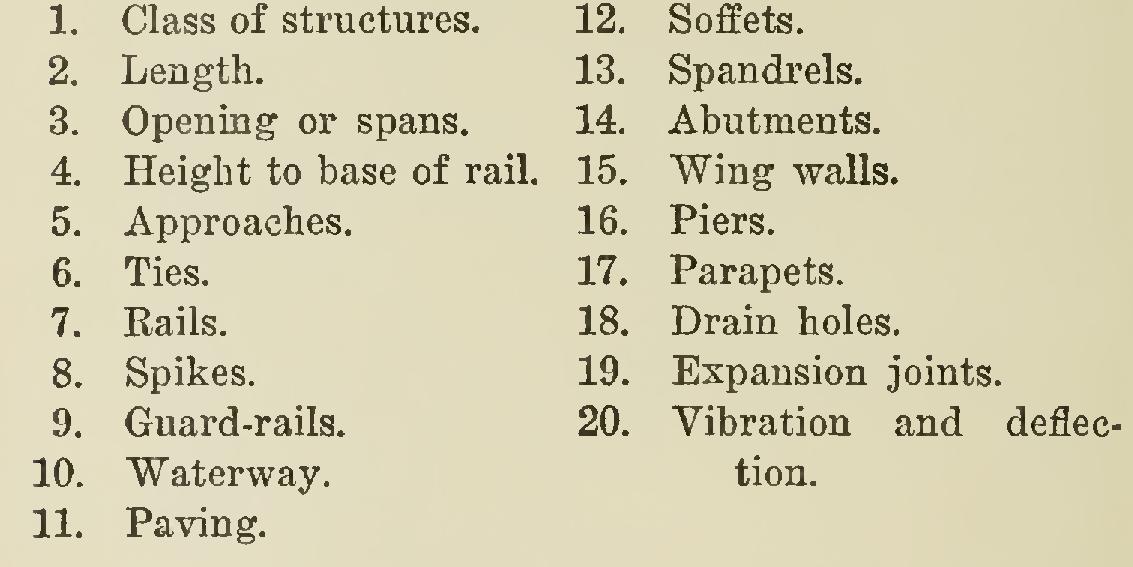
In properly reinforced concrete, failure is sure to be very gradual, so that there is less chance for accident than in some other types of structure ; nevertheless, it is wise to inspect them just as frequently as is done on other varieties of bridges. Their foundations should be given especial care in original design, in construction, and in periodical inspection after completion, because there is almost invariably a smaller waterway left in the design of arch bridges, than in the case of the vertical abutments for a steel bridge. Worse scouring, especially in time of flood, may thus be produced, and inspectors should note all phenomena along this line. On the whole, therefore, no saving can be made in the costs of inspec tion by the erection of concrete structures in place of steel, and hence this small but important item can be ignored in making a comparison.
One of the best-known reinforced concrete construc tion companies gives the following reasons for the choice of concrete structures in place of steel: