Standard Rules for Bridge Masonry Construction
concrete, lbs, ft, feet, steel, shear and structures
Footings for pile foundations should be made 3 ft. thick, with the pile head projecting 1 ft. into the con crete.
Depth of Footings. Wherever exposed to the action of frost, footings should be carried from 3 ft. to 5 ft. be low ground level, depending on the latitude. Footings should be carried to the firmest foundation within reason able reach.
Pile Spacing. Foundation piles should not be spaced closer than 2 ft. center to center in any direction, and at least 2 ft. 6 in. should be allowed in one direction.
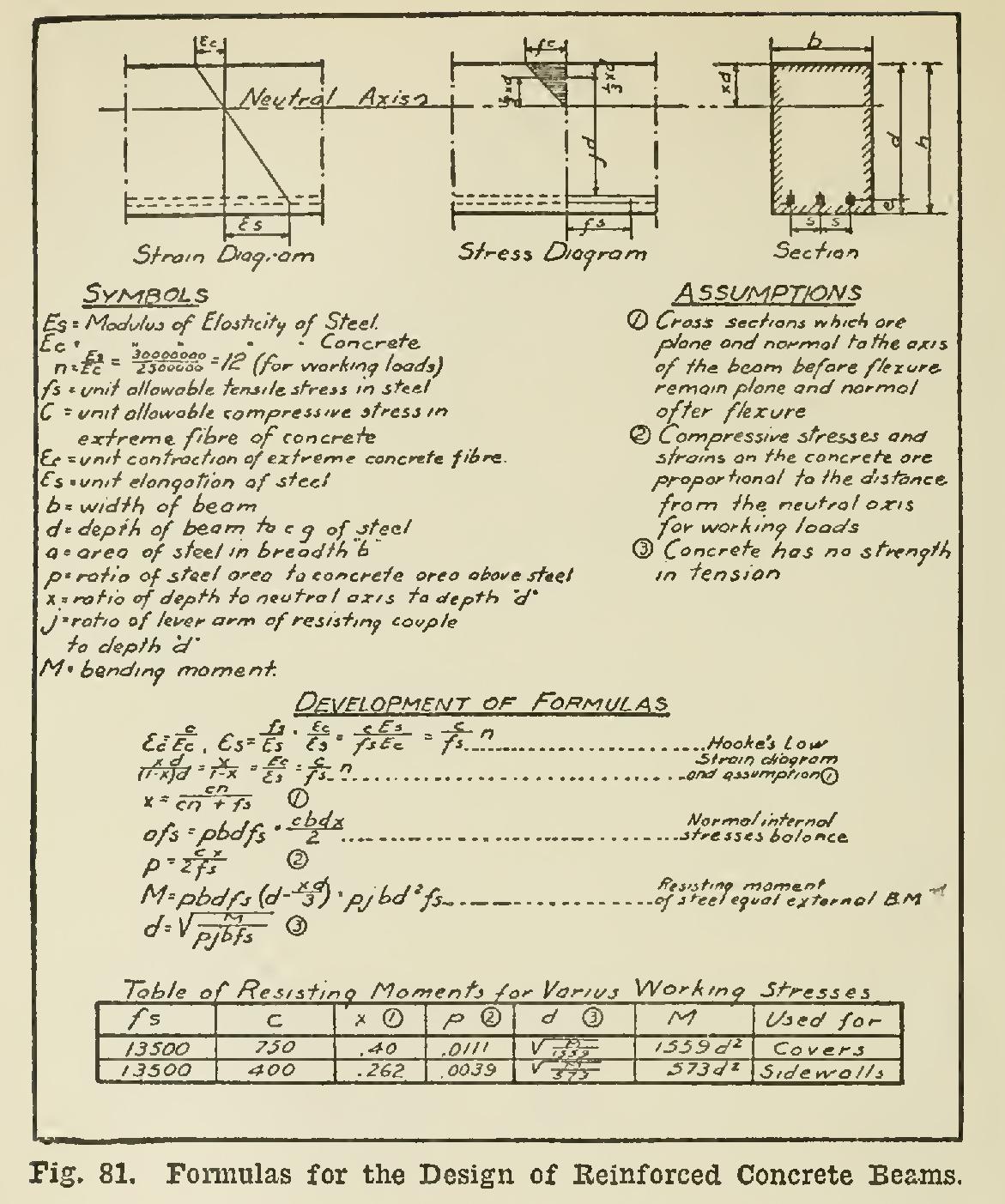
Reinforced Concrete Design for Bridge Work Reinforced concrete structures shall be designed ac cording to the following methods, assumptions, and unit stresses.
Loading. The dead loads for which concrete struc tures are designed, shall consist of the weight of the structure, the fill, and the track. Reinforced concrete shall be assumed to weigh 150 lbs. per cubic foot, and earth 100 lbs. per cubic foot.
The specifications regarding live loads, wind loads, tractive force, etc., shall be the same as given in the "Standards for Steel Structures," with the addition of the following paragraph: "When the ballast or fill under base of rail on a con crete structure is less than two feet, the wheel loads shall be considered as concentrated along the track, and as either concentrated or distributed over eight feet trans verse to the track, according to which of the latter as sumptions gives the greater stresses. When the fill is more than two feet, an equivalent uniform load shall be used, distributed over eight feet at the base of rail, and spreading transversely six inches per vertical foot through the fill and twelve inches per foot through the concrete. The equivalent uniform load shall be assumed as 12,000 lbs. per linear foot of track for spans under twenty feet, and equivalent to standard E-55 loading for spans over twenty feet.
Impact. An impact allowance of 50 per cent shall be added to all live loads.
Coefficients of Elasticity. The ratio of the coefficient of elasticity of steel to the coefficient of elasticity of con crete shall be assumed to be twelve. This ratio is based on an initial coefficient in the concrete of 2,500,000, and a steel coefficient of 30,000,000.
Factors of Safety. A factor of safety of at least three and one-half shall be allowed in concrete structures. The following unit-stresses shall be al lowed in the concrete of reinforced structures unless otherwise noted in these standards: (Concrete, 1 :2.5:5 or better) Lbs. PER SQ. IN.
Direct compression 500 Compression on extreme fiber in beams under flexure 750 Shear; true shear not combined with flexure 200 Shear; combined with flexure 30 The maximum allowable tension in reinforcing steel shall be not more than one-third the elastic limit, and shall in no case exceed 15,000 lbs. per square inch.
Shear. In members under flexure, the average verti cal shear shall not exceed thirty pounds per square inch where no web reinforcement is provided. Where rein forcement is provided, the average vertical shear shall not exceed seventy-five pounds per square inch.
Where web reinforcement is necessary, it shall be de signed to carry all of the web stresses.
Web reinforcement shall consist of bent-up bars, or stirrups, or both. The bars or stirrups shall be spaced not farther apart in the direction of span than the depth of the beam; they shall be hooked to the reinforcement on the tension side of the beam, and they shall be made suf ficiently long to develop their strength in bond.
Bond. The following values for bond between con crete and steel shall be used: For plain bars. 60 lbs. per sq. in.
For deformed bars .100 lbs. per sq. in.
Bars shall be lapped or imbedded at least 60 times their thickness or diameter if plain, and at least 40 times if deformed.
Temperature Stresses. Concrete structures shall be designed to provide for a variation in temperature of 50 degrees Fahrenheit-15 degrees rise and 35 degrees fall. The coefficient of expansion shall be taken as .000,005,5.
If expansion joints are not provided, sufficient steel shall be used to provide a tensile resistance (at an elastic limit stress) equal to the tensile resistance of the concrete section (at 200 pounds per square inch).