Standard Rules for Bridge Masonry Construction
bars, pass, concrete, lengths, stone, reinforcement and sand
Longitudinal Reinforcement.
In all slabs or walls, re inforcement in a direction at right angles to the main re inforcement shall be provided, such reinforcement to have a sectional area of about 1-900 of the concrete area.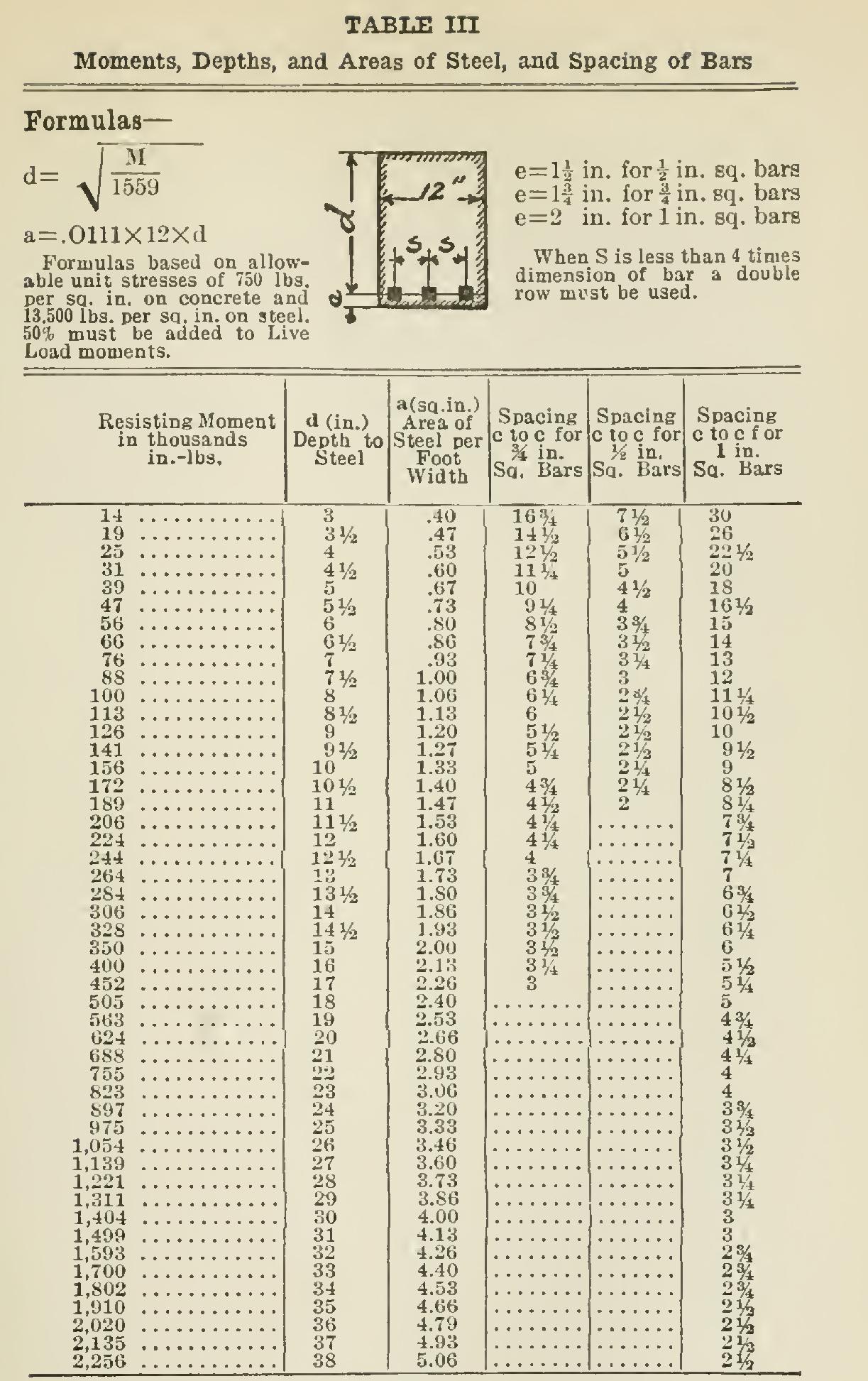
Bending Moments. All beams and slabs shall be as sumed as freely supported simple beams in calculating positive bending moments ; but negative moments of ap proximately one-half the theoretical shall be provided for (at working stresses).
Detailing Reinforced Concrete for Bridge Work Drawings. Plans and details of reinforced concrete structures shall show the size, length, and exact location of all reinforcing material. In general, the sizes and lengths shall be shown on the elevations and the spacings on the cross-sections.
In highly reinforced work, the concrete dimensions and the reinforcement details shall be shown on separate views. Large-scale cross-sections and diagrams shall be added where the bar arrangement is complicated.
Bending diagrams shall be shown for all bent bars, and such bars shall be given some reference mark.
Lengths of Bars. Bars shall be called for in lengths which can be cut from stock lengths with min'Anum waste. Bars shall be called for in even feet or half-feet wherever possible. As few different lengths as possible shall be used.
Spacing of Bars. Bars shall be spaced not closer than four diameters center to center, and not farther apart than the depth of the beam or slab. The bars shall be chosen of such a size that the spacing will be, preferably, about 6 to 9 inches.
The distance from the surface of the concrete to the center of the bar shall be at least the thickness of the bar, plus one inch.
Bends in Bars. Unnecessary bends, bends in heavy bars, and many bends in the same bar shall be avoided. Small-sized bars of low elastic limit shall be used for stir rugs and for reinforcement which must be bent to a small radius.
General. In the design and arrangement of reinforce ment, due regard shall be given to the cost and difficulty of construction.
Billing of Bars. All
reinforcing material shall be listed in a "Bill of Reinforcement," showing number, size, length, mark, and location. The material shall be listed in the order in which it is put into the structure— material in the footings to come first, etc. Large numbersof bars of varying lengths, as in wing-walls, may be billed in total linear feet ; but lengths should be noted on plan. Specifications for Concrete Bridge Masonry Concrete masonry must conform to the following speci fications: 1. Cement. All cement shall be Portland cement, and shall conform to the specifications of this department. The brand shall be approved by the Engineer.
2. Sand.
The sand shall be clean and coarse, or a well-graded mixture of coarse and fine grains, with the coarse grains predominating. Sand containing more than 5 per cent of clay or loam shall not be used until tested and its use approved by the Engineer.
3. Gravel.
The gravel shall contain no stones over two inches in diameter, and not over 30 per cent of its volume shall be too large to pass through a screen having one-quarter-inch meshes. The sand in the gravel shall conform to the requirements for sand specified above.
4. Stone.
The broken stone shall be from sound, hard, and durable rock, such as trap, limestone, or gran ite; clean and free from foreign substances ; and shall be composed of angular fragments of the following sizes: (a) Two-inch stone, containing everything that will pass through a ring two inches in diameter, and screened until none of it will pass through a screen having one quarter-inch meshes.
(b) One-inch stone, containing everything that will pass through a ring one inch in diameter, and screened un til none of it will pass through a screen having one-quar ter-inch meshes.
(c) One-half-inch stone, containing everything that will pass through a ring one-half inch in diameter, and screened until none of it will pass through a screen having one-quarter-inch meshes.
When, in the judgment of the Engineer, the character of the work will permit, it shall be unscreened and crusher-run. In this case, everything that will pass through the required size ring is wanted just as it comes from the crusher, provided it contains no foreign sub stances. An artificially mixed crushed stone will not be accepted.