Trestles and Viaducts
ft, viaduct, key, feet, concrete and track
The stone used was granite, crushed so that all would pass through a one-inch ring, and was thoroughly screened.
The concrete in the footings was made of a mixture of one part cement, three of sand, and six of stone, ex cept that in wet pits more cement was added. In all the rest of the work, a 1:2:4 mixture was used. This was made quite wet, and the concrete was thoroughly worked into the reinforcement with spades and rammers. No concrete was allowed to go in that had stood as long as fifteen minutes.
The Nelson St. Viaduct, illus tiated in Plate 10 (B), is an example of an arch viaduct carrying a roadway. It crosses the tracks of the Southern Railway.
The total length of the structure between abutments, 479 feet 31 inches, is divided into ten spans varying in length from 20 to 75 ft. The roadway carried is 32 feet wide from curb to curb, and sidewalks 9 feet wide are can tilevered out on each side. The roadway is paved with wood blocks on a concrete base. The sidewalks have a granitoid surface laid directly on the concrete. Each of the 10 spans is carried by 4 arch-ribs, 5 feet on center under the street-car tracks; and 2 outside ribs, one under each curb. The roadway ribs are designed to carry 100 pounds per square foot or a 15-ton road roller in motion. The track ribs are designed for a succession of 40-ton electric cars.
The beauty of the structure is very striking. It is not obtained by the use of highly orna mental work requiring difficultly moulded fea tures, but lies in the simple and graceful general proportions. All of this is obtained without extra expense, as the effect is produced by the artistic arrangement of material rather than by extravagant embellishments.
An Ocean Viaduct. One of the most wonder ful feats of modern railroad engineering is the extension of the Florida East Coast Railway to Key West. The track is carried from key to key on a viaduct which consists of about 500 rein forced concrete segmental and semicircular arches of from 45 to 60 feet span, and has an entire length of about six miles. This distance
is divided into four parts, there being a viaduct two miles in length between Long and Conch Keys, known as the Long Key-Conch Key via duct (Plate 11); a viaduct between Knights Key and Pigeon Key, about 7,800 feet long, known as Knights Key Channel viaduct; a third structure known as the Moser Channel viaduct, just south of Pigeon Key, about 7,300 feet long; and the fourth, known as the Bahia Honda Har bor viaduct, about 4,950 feet long and composed of 60-foot arches.
Approximately the following quantities of material will be required in the construction of these viaducts: 300,000 barrels of cement, 225, 000 cu. yd. of sand, 200,000 cu. yd. of crushed stone and gravel, and about 5,000 tons of steel reinforcing bars. The piers for these viaducts are constructed in from 6 to 30 ft. of water on very hard but porous lime rock and coral, which is overlaid with sand.
The cross-section through the center of one of the arches, Fig. 55, shows the typical design that has been employed. The arches are 15 ft. wide at the crown, allowing sufficient width for a single standard-gauge railroad track. The sides are battered at the rate of 1 in. to the foot of height. The rails of the track carried by the structure are about 31 ft. above mean low water.
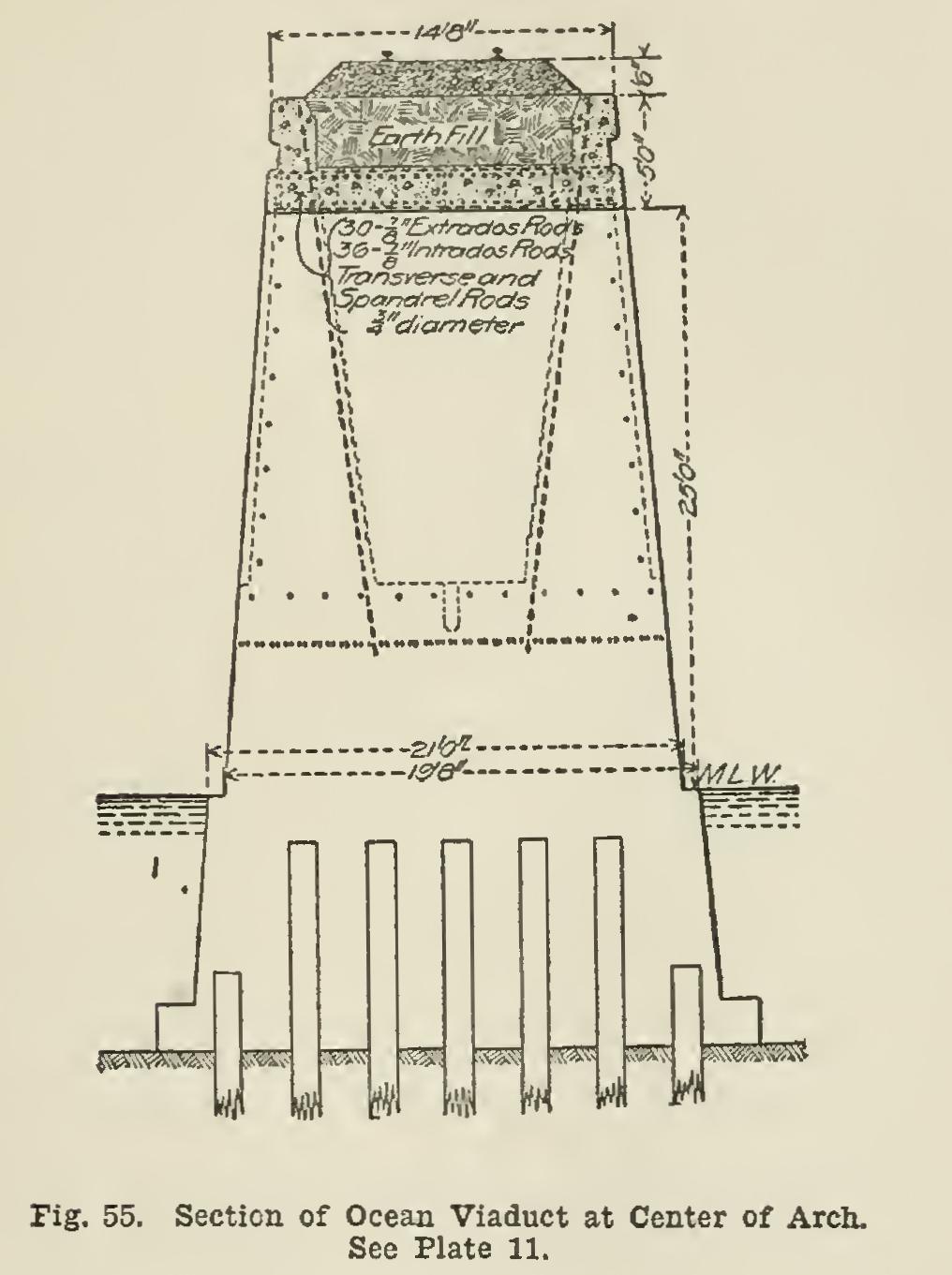
The piers are about 21 ft. long, and 7 to 12 ft. in width. Every fifth pier, being considerably wider than the other piers, is an abutment. The arch-rings are 2 ft. thick at the crown, and about 4.5 ft. thick at the top of the pier. The spandrel walls are about 18 in. thick at the top, 3 ft. above the crown of the arch, and batter down 1 in. in 12 in. on the outside, and in. in 12 in. on the inside, making the width about 5.5 ft. on the top of the pier. There are about nine tons of % and twisted steel bars in each com plete arch.