Historical and Descriptive
square, inches, center, rule and timber
Brace Rule.—The "brace rule" is always placed on the tongue of the square, as shown in the central space at x in Fig. A, Frontispiece.
This rule is easily understood; the figures on the left of the line represent the "run" or the length of the two sides of a right angle, while the figures on the right represent the exact length of the third side of a right-angled triangle, in inches, tenths, and hundredths. Or, to explain it in another way, the equal numbers placed one above the other, may be considered as represent ing the sides of the square, and the third number to the right the length of the diagonal of that square. Thus the exact length of a brace from point to point having a run of 33 inches on a post and a run of the same on a girt, is 46.67 inches. The brace rule varies somewhat in the matter of the runs expressed in different squares. Some squares give a few brace lengths of which the runs upon the post and beam are unequal.
Octagonal Scale.—The "octagonal scale," as shown on the central division of the upper portion of blade, is on the opposite side of the square to the "brace rule," and runs along the center of the tongue as at S S in Frontispiece. Its use is as follows: Suppose a stick of timber ten inches square. Make a center line, which will be five inches from each edge; set a pair of com passes, putting one leg on any of the main divisions shown on the square in this scale, and the other leg on the tenth subdivision. This division, pricked off from the center line on the timber on each side, will give the points for the gauge-lines. Gauge from the corners both ways, and the lines for making the timber octagonal in its section are obtained. Always take the same number of spaces on your compasses as the timber is inches square from the center line. Thus, if a stick is
twelve inches square, take twelve spaces on the compasses; if only six inches square, take six spaces on the compasses, etc. The rule always to be observed is as follows: Set off from each side of the center line upon each face as many spaces by the octagon scale as the timber is inches square. For larger timbers than the number of divisions in the scale, the measurements by it may be doubled, or trebled, as the case may be.
The diagram, Fig. 4, shows the application of the rule applied to the end of a stick of timber or on a plane surface. Let B C D E, be the square equal to six inches on a side. Draw the center lines, B C, and D E, then with the dividers take from the scale six parts, and lay off this distance from the center of each; as B1, B2, E3 and E4, C5 and C6, D7 and D8. Draw lines from 1 to 8, 2 to 3, 4 to 5, 6 to 7, and the octagon figure is complete.
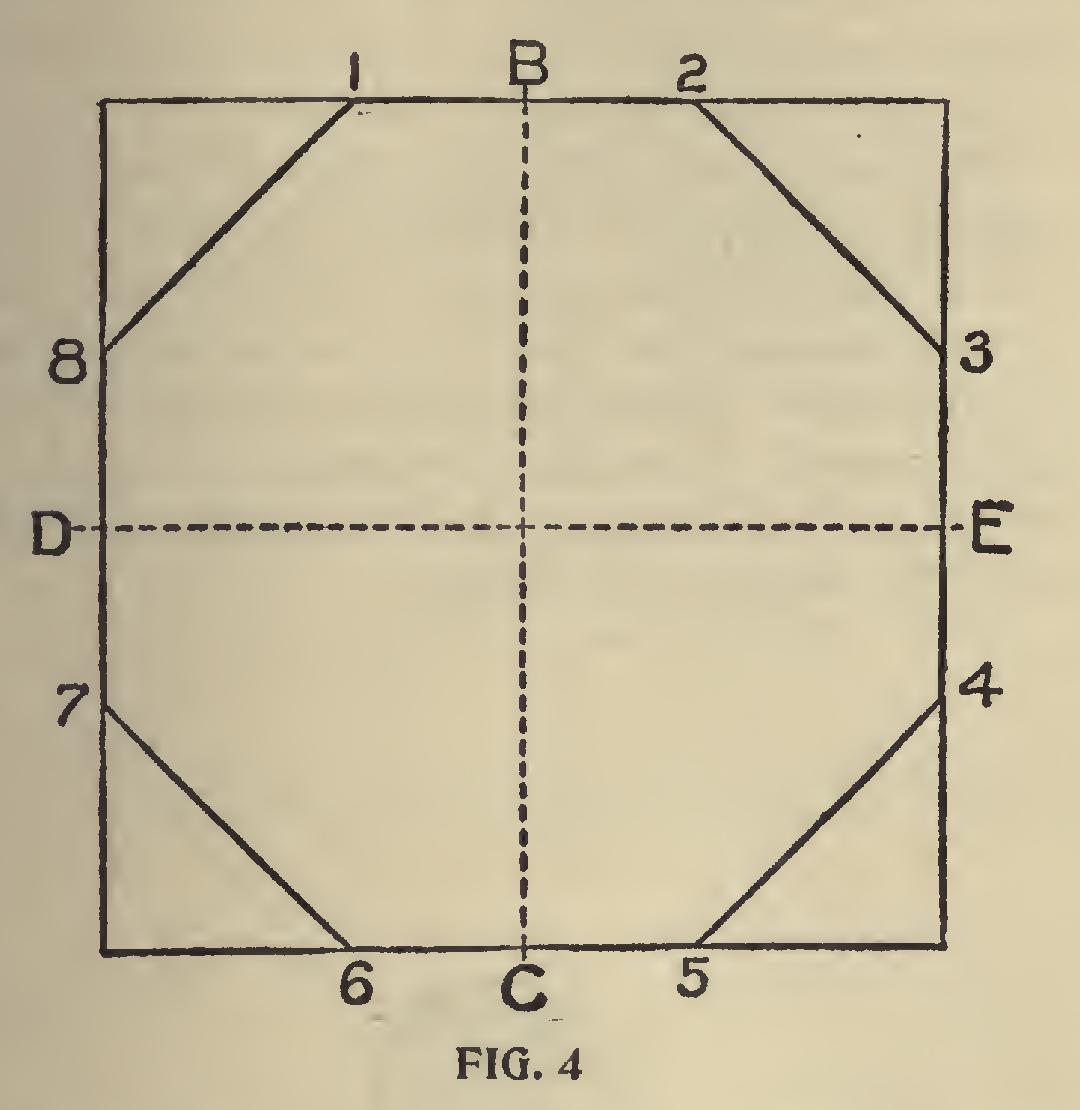
A rule for laying off octagons is figured on nearly all carpenter's two-foot rules, marked off from the inner edges of the rule; one set of figures is denoted by the letter E, another set is denoted by the letter M. The set marked E measures the distance from the edge of the square to the points indicated in the diagram, by the figures 1, 2, 3, 4, etc. The set marked M is used for finding the points 1, 2, 3, 4, etc., by measuring from the middle or center lines, B, E, C, D.
We have now fully described all the lines, figures, and scales that are usually found on the better class of squares now in use; but we may as well remark here that there are squares in use of an inferior grade, that are somewhat differ ently figured. These tools, however, are such as cannot be recommended for the purposes of the scientific carpenter or joiner.