A City Sewage-Disposal Plant
tank, sewage, bacteria, contact-beds, beds, air, effluent and chamber
A CITY SEWAGE-DISPOSAL PLANT We shall now consider the construction and operation of a sewage-disposal plant for munic ipal drainage. This manner of disposing of the waste matter is giving universal satisfaction. The plant here described will take the entire waste of the town or city for which it is in stalled, breaking it up in the darkness of the septic tank, digesting it in the contact-beds, and pouring the effluent into a stream or other point, no longer the disgusting filth which entered the system, but water, clear as crystal and harmless as if distilled. Some of the contractors who in stall these systems even go so far as to drink the effluent, to show the thorough working of the plant.
The sewers will all empty into the main septic tank, which is shown in Fig. 108. The construction of this tank is such that the sewage moves through it with a scarcely perceptible current, the design being to keep the sewage in the tank about 24 hours in order to give the bacteria upon whose work the efficiency of the system depends a chance to break up and change to liquid form the solid matters contained in the sewage.
We are so accustomed to hear of bacteria as the enemy of mankind, that most of us forget— if indeed we ever knew—that there are many species of bacteria which are the friends of man. Acting as scavengers which live upon decom posing matter, they save man from the conse quences of his reckless indifference to his own health and the health of others; and, when given the right kind of workshop, they very quickly dispose of all that is harmful and likely to breed disease germs.
While there are very many different kinds of bacteria, they are commonly divided into two classes, in accordance with the conditions under which they live and breed. These are the anaerobic bacteria, which flourish in the dark, shut away from all air and light; and the aerobic bacteria, which must have plenty of both light and air if they are to increase and multiply.
The Septic Tank.
The workshop for the anaerobic bacteria is the closed tank above described. It is made as nearly air-tight as possible, only a small vent-pipe being provided for the escape of gas which is given off by the decomposition of sewage. The walls are built of concrete, and a concrete arch covers the tank completely.
The inlets to the tank are by way of a grit chamber, designed to catch road washings and other heavy substances which would clog the tank. The grit chamber has a cleansing valve to facilitate its being emptied whenever this becomes necessary. The two inlets dip well
below the surface of the contents of the tank, in order that the force of the inflowing sewage may not break the blanket of thick scum which shuts out from the sewage below it all light and air coming through the vent or the manholes. Under this blanket, the bacteria—millions in number—work away at the incoming sewage, and pass it on to the outlet in the form of some what dirty water.
In order that the outflow may be steady, and across the whole tank, a slotted pipe is set just below the surface of the contents; and through this slot the escaping affluent finds its way to the effluent chamber, where a goose-neck draws it off into the effluent pipe, which carries it rap idly to the contact-beds.
The cleansing chamber, shown at the right in Fig. 108, is provided for the purpose of draw ing off the sediment or mineral deposits which accumulate very slowly, being made up of such matters as the bacteria cannot break up. In sewage composed chiefly of domestic wastes, these substances are not very many in number, so that the sediment requires drawing off not more than twice a year at the most—which prac tically makes this part of the system a negligible factor.
The Contact-Beds.
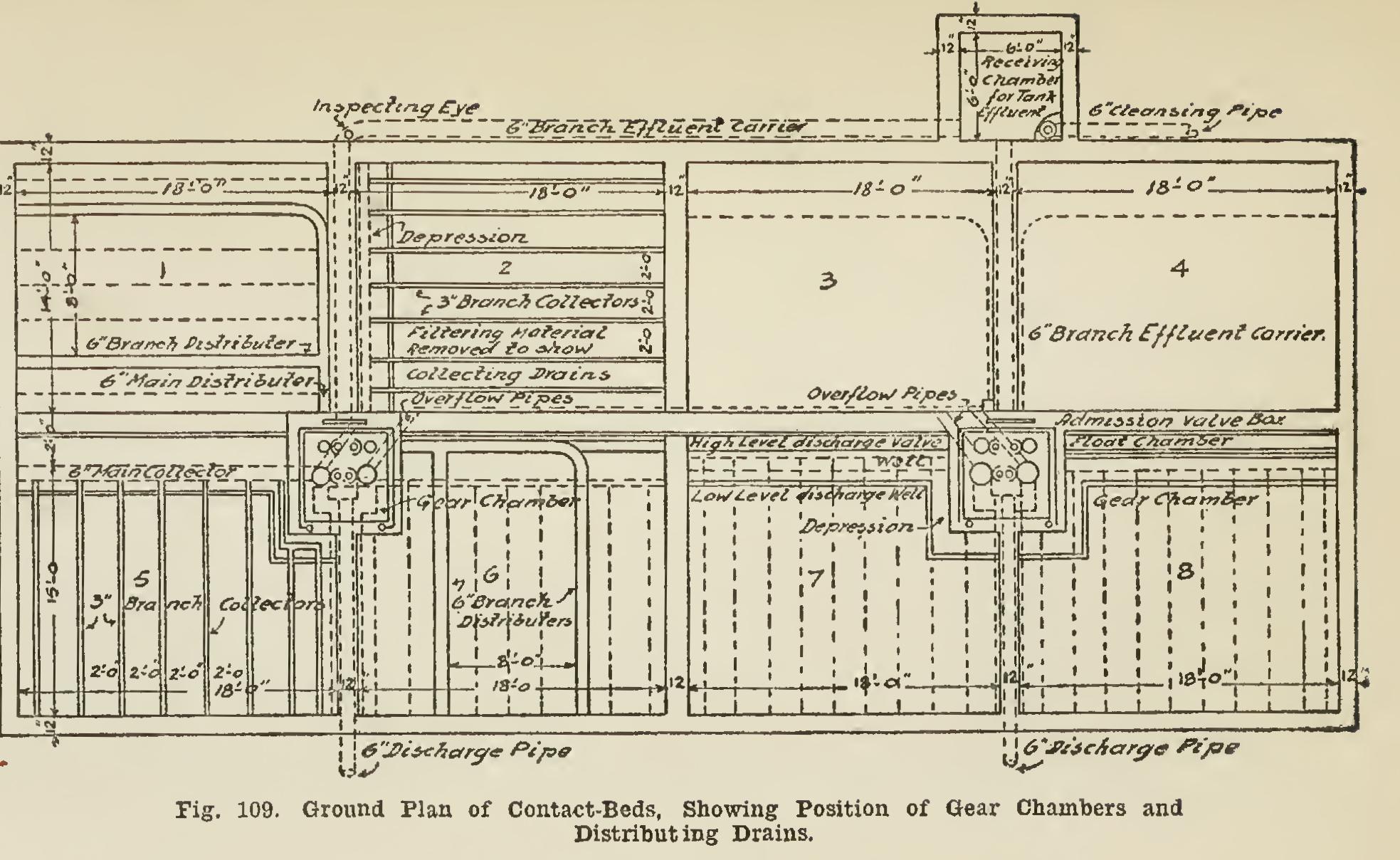
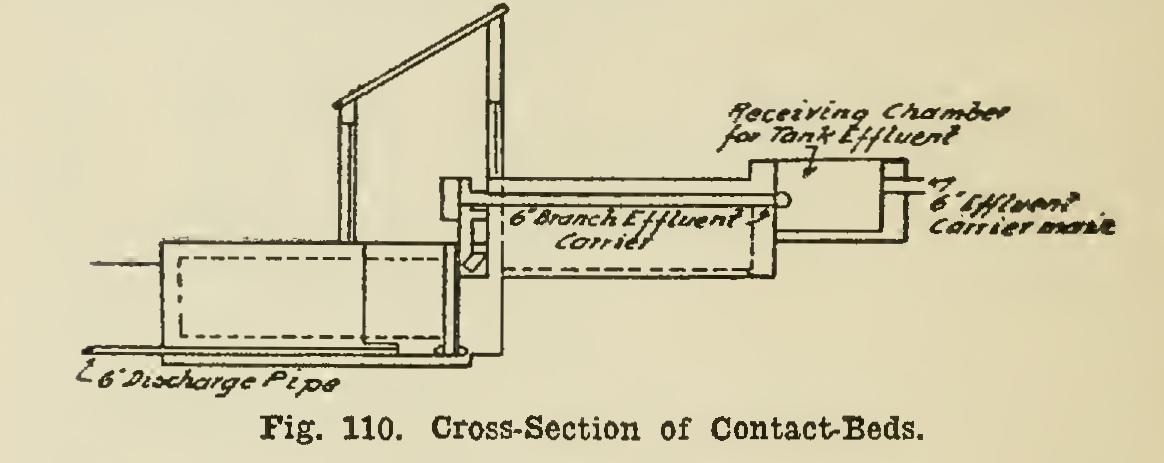
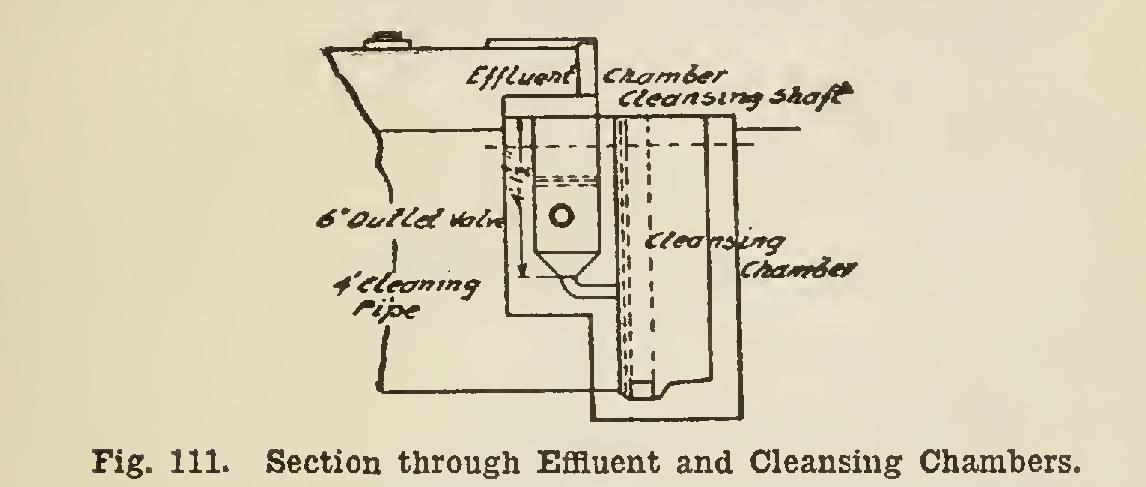
The contact-beds shown in Figs. 109 and 110, are the workshops of the aerobic bacteria, which take up the work where their busy neighbors left off, and carry it on to completion. Fig. 111 is a section through the effluent and cleansing chambers.
In order to supply the aerobic bacteria with the air and light necessary to their existence, these beds are filled with clinker, which pro vides for the admission of the largest possible supply of air; and the operation of the beds is so arranged that each is given a rest of several hours before the period of work, thus insuring the aeration which keeps the beds from becom ing cloed up with sewage through overwork ing the aerobic bacteria.
In the plant here illustrated, the contact-beds work in the cycle 1-3-2-4. Thus, while No. 4 is filling, No. 1 is empty, No. 3 discharging, and No. 2 full. Beds 5-6-7-8 are at a lower level than beds 1-2-3-4, and take the discharge from the beds above them, thus continuing the work of purification.
The apparatus for alternating the flow of sewage is automatic in its action, requiring only the attention of a man to oil it when necessary.
careful study of this text and the accompany ing sketches will make the entire subject of the disposal of city sewage by means of a septic tank and contact-beds perfectly clear to the reader.